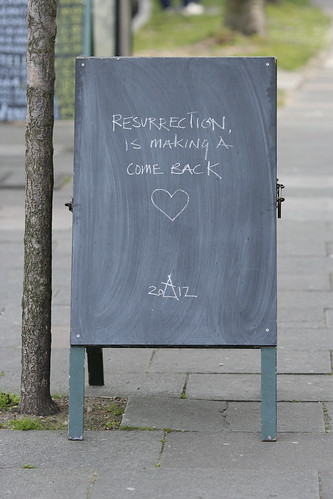
Showing posts with label resurrection. Show all posts

30 May 2020

Alive in the eternal remembrance of God

I have just found a theologian saying what I've been thinking and trying to express well in the last couple of years. The emboldened clause is the key bit for me just now:

In the long term, I think that theology is about knowing that our life as we know it could finish in a second; but on the other hand, if we are kept in the memory of God, we are really immortal. How can we live our everyday life like that, on the edge between mortality and eternity? The only answer I have touched on is love, which became personal and incarnated for us. The main message of the gospel is that love is stronger than death. In the end, faith is not a set of beliefs, but feeling surrounded by the love of God and reflecting that love back to the world Interview: Andreas Andreopoulos, theologian
The bit that I'm struggling to find a way to express and that Andreas doesn't say here is to do with how the memory of God holds us so that we are freely ourselves in God's love and philosophically how we might understand continuity of identity.

I suspect in regard to the latter, the answer is probably that we are always in God and that never ceases; our eternal medium of being continues because it is eternity itself; God. Or something like that. God present yesterday, today and tomorrow, knows us in each moment and carries us over beyond the moments of this life. This life cannot continue to hold us, but God's can and will.

20 April 2014

More than a conjuring trick with bones

In the film The Princess Bride,  confronted with a dead Westley (the hero) and told that he is dead, Miracle Max (played by Billy Crystal) says in a delicious NY accent "Look who knows so much about dead ...  it so happens your friend is only *mostly* dead. And mostly dead is a little bit *alive*" and then goes on to administer a restorative which resuscitates Westley so he can go on to finish the plot. I mention it because a lot of us think about resurrection as if it is a kind of resuscitation. A zombie Jesus only mostly dead somehow revived but fundamentally still restricted to the normal laws of time and space, decay and entropy.

Well, it's not like that with Jesus on Holy Saturday /Easter Eve: he's dead, really dead. Dead as the proverbial doornail. Not mostly dead; truly dead. Brain activity: zero. He's gone, passed away, flower food, he is an ex-messiah. More: his soul doesn't go marching on, there's no ghost hanging around fretting about his life's work being unfinished and agonising over his friends' and relatives' grief.

He's as dead as, well,

we are dead when we die. That's it. The end. Finished. Kaput. The long sleep: no awareness because there's nothing to be aware: we're gone; no longer exist, so no wake up call. Oblivion.

And Jesus has to be as dead as that else there's no help for us.

If Jesus does not truly die, then our dying remains the last word.

Jesus has to enter into our death: where there is nothing beyond. Just absence, nonexistence, uncontinuance.

Well, not quite. For, as it is getting popular to say that someone who has died lives on in our memory; that as long as we remember them, they live in us. In some ways that's the democratised version of especially skilled or favoured people wishing to live on in their accomplishments. "I want to achieve immortality through my art". Well, I agree with Woody Allen "I don't want to achieve immortality through my work, I want to achieve immortality through not dying."

The problem with 'living on' in someone's remembrance is that 'I' don't really live on. Again as Woody Allen put it "Someone once asked me if my dream was to live on in the hearts of people, and I said I would prefer to live on in my apartment."

Living on in someone's memory seems not to involve me enjoying the world, relationships or, well, life. Some other 'I' gets to do that while borrowing some of what they know of me to interpret their experience*.

So, while living on in remembrance may console the bereaved, it doesn't help us to live on in our apartments**.

And in any case, those who remember themselves die and with them whatever is left of us in their memory.

But there is one who remembers eternally. In fact, to say 'remembers eternally' may not be so different to saying 'knows always', or even foreknew. The God of Abraham, Isaac and Jacob is the God "not of the dead but of the living; for to him all of them are alive" . And that's the point. The remembrance/knowing by the Everliving, the Creator, is who we are. God ever-livingly and ever-lovingly re-members us. Our knowing and remembering each other is a shadow of that fullest knowing-remembrance. While something truly does live on in human remembrances, we truly live on in God's knowing-remembrance for that remembrance is the Source of all living and in loving us, the source and ground and upholding of our being 'us'. In God's remembrance/knowing and creativity 'we' truly are us. God is our continuity of existence.

So, when Jesus enters into our kind of death, becomes one with our finality, the only hope beyond that is that God is the God of the living, not the dead; that God really does know-remember him. The Resurrection is no 'conjuring trick with bones', it is not a resuscitation. God re-members Jesus***. it is a paradigm of New Creation: the New takes up and transfigures the former; creation is caught up into re-creation. Jesus is remembered into Life: the seed of the new creation is planted in the soil of the old order of sin and death. in the words of the liturgy: Jesus 'reveals the resurrection'.

Death is not, after all, the last word. The Last Word is the last word, just as he was the First.

-----------------------------------------------------------------------------------------------------------------------

This post is a re-working of my Easter sermon into a written form and with some further reflection.It's a preliminary set of thoughts heading towards the *** note below. There is a need also to think further about the primacy of Jesus' resurrection.

*I realise that there's a lot more to explore about what 'I' might be. But I don't think elaborating on that discussion doesn't seem to me to take away from my basic pint here. And while I remain indebted to Douglas Hofstadter's exploration, even his 'expansion' of human consciousness doesn't address this fundamental loss of I-ness.

**Putting me in mind of "in my Father's house there are many apartments, and i go to prepare a place for you."

***The relationship of Father and Spirit with the Son is remembered by them. The Resurrection grows out of Trinitarian perichoresis. I would like to explore this further it due course.

19 October 2009

Out of body experiences -brain and selfhood

One of the stranger things to get reported and then subjected to religious and spiritual speculation is the OBE. He's some research that anyone with interest in new spiritualities and brain/spirituality stuff should check out (and certainly those of us involved in interface with new spiritualities are likely to have come across it): Out of your head: Leaving the body behind - life - 13 October 2009 - New Scientist And here's your whetting the appetite titbit: "Other brain regions have been implicated too, including ones close to the TPJ. The emerging consensus is that when these regions are working well, we feel at one with our body. But disrupt them, and our sense of embodiment can float away. This does not, however, explain the most striking feature of out-of-body experiences. 'It's a great puzzle why people, from their out-of-body locations, visualise not only their bodies but things around them, such as other people,' says Brugger. 'Where does this information come from?'"
Be aware as you read the article that the question doesn't get answered with experimental data: only speculations, some of which seem reasonably well-founded but the question isn't really answered. There are some who have a vested interest in mind or soul-body dualism who are very keen to interpret such data as we appear to have in such a way as to support the idea of a 'detachable' something which goes beyond the body. I'm skeptical -partly because it raises further questions about the means of sensing and the means of information storage and retrieval without a brain in direct contact; so an affirmative on this idea just opens up a whole can of worms. Not that such a consideration should foreclose the issue; just that it seems it complicates things. I'm also skeptical because a Christian view of personal wholism doesn't need to defend or even propose a soul-body dualism. The idea of the resurrection of the body would seem to indicate that if it were possible that soul or mind could exist independently of material support, then it is not a state to be desired or set too great a store by ...
I could say more but I'll leave it there -for now at any rate.

22 March 2008

Christ is risen. A summary of the state of scholarly play

This seems to be a pretty useful summary of where things are up to. Not as sure as some Christians would like, but far more positive towards Christian claims than the likes of Richard Dawkins would have us believe.
Despite the arguments of some Christian apologists, most mainstream scholars do not treat the resurrection as belonging to their field of inquiry. It is similar to Jesus' healings. Historians would not say that Jesus actually performed miracles - that would be to turn from history to philosophy and theology. They can only say that he did things which those around him interpreted as miraculous. So, too, with the resurrection. No historian wearing his or her historical cap would say that God raised Jesus from the dead. That is a theological interpretation of the evidence. What most scholars do affirm is more modest, though not without significance: Jesus' tomb was empty shortly after his crucifixion and significant numbers of men and women experienced what they believed to be appearances of the risen Jesus. These are the historical facts of Easter Sunday: an empty tomb and resurrection experiences. They are accepted not only by serious Christian scholars but also by leading Jewish historians such as Vermes and self-confessed agnostics such as Professor Ed Sanders of Duke University, who once wrote: "That Jesus' followers (and later Paul) had resurrection experiences is, in my judgment, a fact. What the reality was that gave rise to the experiences I do not know." This is typical of the responsible historian's approach to Easter: whatever the explanation, something extraordinary happened.

20 March 2008

Christ rose again, say 57%

It's only a brief report; Church Times - Christ rose again, say 57 per cent in British poll and I can't see things like the size or composition of the sample being reported. Though I've saved you the trouble of finding the actual article. (The Church Times really ought to consider putting links into their online offerings). It's here. "57 per cent of respondents said that they believed Jesus had been executed by crucifixion and buried, and had risen from the dead. More than half of these (30 per cent of the total) believed in a bodily resurrection, while 27 per cent of the total believed that Jesus had risen in spirit form. Asked about life after death, 44 per cent said that they believed their spirit would live on after death. Only nine per cent believed in a personal physical resurrection."
Nothing unpredictable about the 'distaste' for bodily resurrection, the main thing is the amount that would go with a statement that sounds reasonably consonant with Christian ideas. Even more bizarrely;
of the 250 or so atheists interviewed, 14% thought Easter was about Jesus dying for the sins of the world, 12% believed he rose again from the dead, and, bizarrely, 7% thought he was son of God. However confused Christian opinion is, atheist opinion beats it hands down.


It begs the question of how we can move people individually and corporately along a version of the Engel Scale. I suspect it is about addressing the lack of seeing implications other than the ones they have already drawn, and of encouraging a sense that it is about a new creation and invites our fuller participation. In other words getting beyond the comforting reassurance about life beyond death which is where it starts and stops for most, I would guess. I suspect, though, that having an approach which links spirituality and personal development (à la new age) and draws cogently and coherantly on things that can be traced back to the Resurrection of Christ would be worth pursuing further...

15 October 2004

REsurrection bodies

Metanexus Institute
Intersting article from a philospher with scientific interests on the resurrection of the body. Not sure that I go entirely with it all but I do think that the non-dualist approach is basically right. Just wondered how God was supposed to fit in. I have my ideas -God is the holder of our pattern and guarantor of identity, thereby -which seems perhaps to be plug one of the holes in the argument. But then is that a God of the gaps or a legitimate 'place' for God?

The Science And Spirituality Of Addiction

 What drew me in was the collocation of science and spirituality in the title. I'm also a little interested in addiction through having ...