Showing posts with label violence. Show all posts

24 June 2023

Why we hate -a book review

The topic of this book is important as we are seeing a rise in all sorts of hatred across many societies. Social media seems not to helping -rather the reverse: fanning the flames. Our global community is increasingly being stressed by climate forcing -related changes which are beginning to push populations into harm's way in terms of forcing people to confront others who are being demonised. And our propensity to emote synergistically with those around us has always been a force for fanning the flames of conflict as we can be induced to hate someone designated 'enemy'. 

I came to this book also with my own questions about how anger and hate interrelate and how our psychology around hate can be manipulated and how that manipulation can be counteracted. 

I thought I'd give this book a try also because I recently became intrigued by this:

Hilge Landweer distinguishes between Verachtung (contempt) and Hass (hate). She argues that contempt fits perfectly into the neoliberal emotional landscape, because it’s a gesture of turning away from, and dehumanising the other person, not taking them seriously. Hate, on the other hand, takes its object very seriously. In a system of class hierarchies, there’s contempt from above and hatred from below. The ruling class don’t have to take the enemy seriously most of the time – unless the working class organises and strikes. But when you’re an oppressed person, you really have to take your oppression seriously, because otherwise you can’t exist. You can’t survive... " https://novaramedia.com/2023/04/17/is-hate-politically-useful/ ...

This was intriguing not least because it recognises the place of power in our emotional responding. And I recognised something in this about where anger and hate might be legitimate and about that adage "love the sinner, hate the sin" -is that sound advice? Or is there more complexity involved? And, as a Christian, is some of Landweer's analysis anywhere near what we might want to bring to reflection on Ephesians 6:1-10?

The book spends a lot of time initially on history and evolutionary  background to violence and discrimination. At this level, it didn't meet with my desire to examine hate as emotion firstly rather than as social attitudes relating to othering. Of course, this does lead me to consider the the relationship between othering, in-group and out-group attitudes on the one hand and detestation or contempt in individual psyches -and indeed the genesis of such hatred as well as the social construction or structuring of such emotions.

One of the things I appreciated was the outlining of good reasons to consider that homo sapiens are fundamentally a co-operative species (which scriptural-theologically I would locate in the narratives of Genesis 1 and 2) though that sociability is capable of being co-opted to ill. And the examination of the move from hunter-gatherer to settled agricultural societies with cities helps to justify both dimensions of that thesis.

I felt that the examination of wars and of just war theories was helpful and nuanced. It was also enjoyable that there is a British centre of gravity in the writing, in an era when so much takes a perspective of the other side of the Atlantic.

So, while this was not what I was expecting, it did throw light helpfully on the psychology and anthropology of war and prejudice. I guess the core thesis is that there are traceable factors that become culturally embedded but as it is 'merely' culture and not hardwired biology that does these things (though biology does play a part but not determinedly) , then we can design cultural ways out and around and beyond these hatreds.

I warmed to the authors deft handling and compassionate and fair-minded approach. 

Links

Why We Hate on Bookshop
Michael Ruse’s Website

 #WhyWeHate

02 January 2018

Seven Stories: How to Study and Teach the Nonviolent Bible


One of the characteristics of this book is to take Rene Girard's scapegoat theory of human culture and violence as disclosive and helpful for hermeneutics.
If the mainspring of the Bible is not the legal weight of each word but a progressive engine of disclosure, overturning a root human condition, then we are discovering a radically new hermeneutics. One which provokes human transformation. (p.26)
As I am a little more skeptical about Girard* nowadays, I was interested to see whether one really had to commit to that package in order to find this useful or not. Or whether it could be that the insights can be accepted without the whole package.

The book is set out as a resource for groups or class-work and is designed attractively from a typographic point of view -though not so easily read on screen in the pdf format I had access to, I trust that this will be addressed by suitable formatting for e-book versions in due course. Part of the course-book nature of the volume shows up at the end of each chapter where there are discussion questions and personal questions. I did wonder whether those ought to be the other way round: to encourage readers to be honest and in touch with their own history and responses before entering a group situation. Also, each chapter begins with aims and key points as well as a heads-up for key terms. Good educational practice.

The parts dealing with hermeneutics are set out clearly and succinctly which is no mean feat, I think. I was at first surprised by the basic laying out of the canon of scripture but as I saw it was done comparatively including the RC and Orthodox canons I began to see the point -it gently de-absolutises some approaches to reading scripture by raising implicit questions about why some of us can be so fierce about things which have a little bit of contingency about them -and what does that do to our considering scripture to be God-breathed? -Obviously I'm not going into that here and neither does this book, but it is important to dwell on it before coming over all crusader.

We also have a useful and equally succinct  primer in atonement theories (possibly one of the best I've seen in this respect), and again this can have the effect of encouraging more considered discourse on what Jesus's Ministry, Cross and Raising achieve. This section helps us to see the way that culture relates to plausibility and tends to assist in the foregrounding of particular theological motifs. Again we need to develop a healthy sense of contingency about such things, not to dispose of them but to be able to make use of them (or not) wisely in the service of God's mission. One of the things it notes in presenting these theories is the role that violence plays in the motif, hinting at how that can, in turn, give subliminal permission to populations, rulers or church polities to endorse the use of violence.

There is a brief outline  of the development of the the doctrine of penal substitionary atonement (PSA) which is again helfpful not least in reminding us that the term 'hilasterion' used in Paul is 'mercy seat', that is a place where mercy is found. It also notes that there is not a developed doctrine in Paul, merely metaphor and allusion.

The introduction to Girard's take on violence in human society is very clearly done and again briefly; a great service to the reader. The re-presentation of the Hapiru (=Hebrews) as a class rather than a race is a fair idea and worth putting out there in this regard. This enables us to appreciate reading the text of scripture as a sedimentation of revelation of divine love struggling against the violent defaults of human thinking and its projection onto the divine. This calls us to attend to the whole fabric of scripture and the deep -structures or divine drumbeat of love, resisted as it is by the vested interests of violently upheld power and wealth.

For those who have already been thinking a lot about non-violence, the gospel and Christian peacemaking, there is probably little in this that will surprise. Though the Girardian reading of the fall may be intriguing and thought-provoking. Where this book really scores is in offering a well-presented, clearly argued and succinct tour of the 'deep structure' of non-violence in scripture in a way that is thoughtful. The strength of the Girardian reading of the Hebrew Bible is to give a way to reframe what appears at first to be divine violence. It is a strength that this book is not so much an argument for a particular reading (or set of readings) but an invitation, in effect, to 'reason together' by inviting study and asking questions, including personally reflective questions. It is a kind of invite to try the approach on for size.

The book is also offering itself as a helpfully laid-out teaching/learning resource. In the USA I guess it would work as adult Sunday school material. In Britain it would more naturally lend itself to cell-group or home-group contexts or even to a Lent-course particularly for people who are keen to get to grips with something a bit 'meatier' and are okay with a degree of challenge.
if the
mainspring of the Bible is not the
legal weight of each word, but a
progressive engine of disclosure,
overturning a root human condition,
then we are discovering a radically
new hermeneutics. One which
provokes human transformation.
if the
mainspring of the Bible is not the
legal weight of each word, but a
progressive engine of disclosure,
overturning a root human condition,
then we are discovering a radically
new hermeneutics. One which
provokes human transformation.
if the
mainspring of the Bible is not the
legal weight of each word, but a
progressive engine of disclosure,
overturning a root human condition,
then we are discovering a radically
new hermeneutics. One which
provokes human transformation.

Links for this Review

Seven Stories on Amazon
Anthony Bartlett’s Website
Wood Hath Hope Website
Anthony Bartlett on Facebook
#SevenStories
Seven Stories: How to Study and Teach the Nonviolent Bible: Amazon.co.uk: Anthony W Bartlett: 9780692931943: Books:

*I don't find the linkage between the three pillars of the theory very convincing. I definitely think that the mimetic theme is right -and this was the reason I first looked into Girard. I also am convinced that there is something important in recognising that the sacrifice of Christ is among other things an unmasking of violence and power. I'm less convinced by the rivalrous sacrificial crisis-resolution aspect in that it purports to offer a universal cultural mechanism, and I'm simply not sure that it is so. I do think that there is a reality to the scapegoating mechanism but I just don't think it is necessarily a total explanation or a universal. And then I guess too that my own take on atonement -basing it in forgiveness rather than things like 'satisfaction' or 'penalty' tends me towards considering that seeing sacrifice purely as a human construct misplaced onto the divine may be in danger of removing an important insight about love.

05 April 2014

Learning war no more

 It used to be the case that the psychological studies seemed to indicate that video games didn't cause violence. I guess that they were mainly showing that there was not a direct causal link. But I had always thought that it wouldn't be a direct link, rather it would be creating dispositions and habits of thought -a 'mentality' as I expressed it, more likely to result in violent attitudes and in turn attitudes would be more likely to foster behaviours. The obverse side to that would be that by funding our imaginations so heavily with responses of violence and aggression, we are failing to develop a repertoire of reactions and attitudes that could lead to non-violent outcomes, defusing tension, reconciliation etc.


So, yet more research has been added to the more recent discoveries in research that indeed the intuition I (and others) had is broadly correct. So:

Children who repeatedly play violent video games are learning thought patterns that will stick with them and influence behaviors as they grow older, according to a new study. The effect is the same regardless of age, gender or culture. The lead researcher says it is really no different than learning math or to play the piano.

Life lessons: Children learn aggressive ways of thinking and behaving from violent video games, study finds -- ScienceDaily:
 Of course, we now have a problem: the earlier directly causal research now inhabits a broad public perception of the matter so there's a culturally significant attitude that we don't have to worry about violence in computer games or on television because it doesn't cause violence and it might even be cathartic. So we have a challenge to reverse that now that we know better: we have to try to get the attitude changed to one of 'garbage in, garbage out: violence in gaming trains us in violent reactions and attitudes'.


Then, what we've got to do is find ways to develop games that are engaging, 'fun' and credible but which 'train' us in conflict resolution and fund imaginations for non-violent reacting. I wonder if anyone is trying to do that?

30 December 2013

Slaughterhouses and violent crime -more reason to be vege

About three weeks ago at a staff "Christmas" do one of my colleagues -having observed my vegetarian option and exercised a modicum of curiosity about it, confessed to considering becoming vegetarian having come across research showing a link between factory-slaughterhouses and crimes involving lack of empathy in communities surrounding them. It has stayed in my mind and so I decided to do a web search on the matter
Perhaps the quickest and fullest way in is this article reporting the research: Probing the link between slaughterhouses and violent crime | Toronto Star. The basic finding is this:
Criminology professor Amy Fitzgerald says statistics show the link between slaughterhouses and brutal crime is empirical fact.
It seems that the correlation is rock solid. However, as often, the interpretation needs more work.Mainly the interpretive issue is whether working in slaughter houses causes an increase in the categories of crime studied, or whether the work itself attracts the kind of people most disposed to such crimes. The latter seems to me to be less likely given an aspect of the research itself:
“Some residents started to recognize that the crime rates were going up and started complaining, and the slaughterhouse companies were quick to blame the immigrant labour pool they were relying on,” Fitzgerald says. She found that abattoirs still seemed to raise the crime numbers when she controlled for these factors.
My suspicion is also that, taking into account framing and priming, there is a plausibility to work involving high levels of desensitisation to suffering tending to form people more likely to commit crimes where a lack of empathy is likely to be a significant factor. The desensitisation issue is problematised in the article:
"the correlation was not as strong for smaller farms where animals were killed. " Though I actually predicted that when I began to read the article - "“It seems like there’s something about the industrialization process,” says Fitzgerald. “you have people who are actually responsible for slaughtering thousands of animals a day.”

My reason for not eating meat is largely about environmental impact and sustainability: not eating meat reduces ones carbon footprint and there is not enough land to feed meat to the world's population at western rates of consumption. I can however, as something of a peace activist, begin to feel this reason gaining credibility for me.

21 November 2013

Religion, war and peace -A Christian contribution to an interfaith event

Last night, I was one of the speakers at a Voices of Faith event where a Jewish, Muslim and Buddhist also presented their own takes on the topic. I used a prezi to navigate through the 15 minute presentation. I thought I'd give a write-through of the content (bearing in mind I had to abbreviate my presentation to fit into the time available so this is a filled-out version with a bit more background and explanation in it. the prezi is here.

First off 
[dove image made up of weapons' silhouettes), a note that this approach to war and peace is my own reading of the Christian tradition, it is also one that takes a rather different 'tack' to what might be expected in the interests of trying to make a proposal which could be more than a simple exposition of a Christian 'take' but rather something that invokes the nature of Ultimate Reality to invite us to consider how our respective faiths construe that in relation to the issue of violence. So I'm interested not just to give a basic exposition of Christian scriptures and framing them within the development of Christian thinking over the following centuries, but rather to seek something that opens out what I take to be the theological deep-structure in relation to human history.

Christmas Truce 
 [Picture of WW1 Christmas Truce handshake with swapped soldierly parapernalia]. Christmas Eve 2014 sees the 100th anniversary of one of the most remarkable events in the history of warfare: the unofficial Christmas truces of 1914. They commonly began with German soldiers and officers putting up Christmas trees, shouting or writing Christmas greetings, and singing songs recognisable to their British counterparts such as Stille Nacht (Silent Night). From these beginnings troops met in no-man’s land to bury their dead, exchange gifts and souvenirs, share festive food and drink, give cigarettes and cigars, sing and entertain each other, swap names and addresses, conduct joint Christian services, and even, it is rumoured, to play football. These were not isolated incidents but were widespread right down the front from the North Sea to Switzerland, made possible in part by shared traditions of Christian celebration. It was a hopeful moment of recognition of common humanity and a rejection of the cruelty of industrialised warfare pursued by rulers in a deadly game of global imperial competition for territories and resources. It was quashed by orders backed by threats, and by replacing troops with men ‘untainted’ by the Truce (including soldiers from the Empire who didn’t share a tradition of celebrating Christmas).


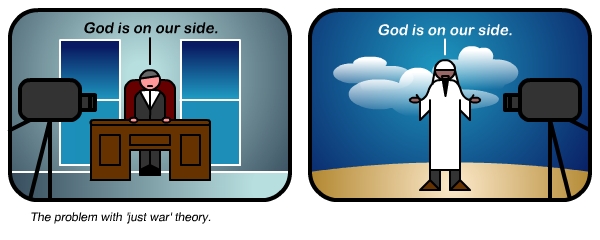
WW1 was a war arising from Imperial ambitions clashing -principally those of Germany on the one hand and Britain and France on the other. It was precipitated by a failure of the deterrence supposedly offered by huge military alliances and offers of mutual aid in literal co-belligerence. At the heart of it were supposedly Christian nations -the next picture frame focuses on the German troops' belt buckle with the words "Gott mit Uns" which means 'God with us' and while the British didn't have a direct equivalent in terms of clothing it is clear that many British propagandists and opinion-formers held a similar view -that God was keen for the British to win because they were the guardians of Christian civilisation against German barbarism. The mirroring of each others' official 'theologies' of war and nationhood is tragic and would be laughable if it weren't what actually happened with such dire consequences. Obviously, they couldn't both be right.


My question in this forum is how they ('we') arrived there? How did two supposedly Christian countries both with good civilisational credentials end up demonising each other and slaughtering one another and claiming it was God's will? Worse yet, we should recognise it's not just Christians implicated in this. In an interfaith understanding event, we should also understand that troops on both sides held different faiths and also secular and atheist views. On the British side, one of the means to put a stop to the informal truces at Christmas in 1914 was to draft in other-faith troops from parts of the Empire that didn't share the Christian sentimentality about Christmas.


A Myth and a riposte [picture of an Ancient Near Eastern deity and a piece of art depicting a visual interpretation of the seven days of Genesis 1-2:4]. Here I press on into the unusual turn of my exposition, looking at something more ancient that most of our religious traditions.

There were two ways of viewing humanity in relation to our purposes on earth and relatedness to deity in the Ancient Near East (ANE). Both deal with origins, ostensibly: chaos and order; what is the human place in the cosmos; what are we humans here to do; what is authority in human affairs? But each have a rather different message for us as humans.

Ancient Near Easter myths:
[picture of ANE deity in full armour holding thunderbolts] though these varied in characters and the detail of plot lines, they tend to tell stories which indicate that order is created out of chaos by the might of the gods and that order is establish and maintained by violent actions. Human beings are, in this kind of schema, made out of the offal of the slaughtered defeated god (who represents chaos) and are made in order to do the work that the gods don't want to be bothered with. So we're getting a picture of humans not being high in the value and dignity stakes -we're almost afterthoughts made from disrespected  materials to slave for the gods and their representatives on earth (the kings and priests). For our purposes though, we should note that the created order is violently produced: ultimate reality is violent, 'agonistic'.

Genesis 1-2:4
[picture of seven thin panels hinting at the 7 days of creation] seems (to me) to be telling a counter-story emphasising that creation is founded in an original peace rather than violence, and that we humans have a dignity since we all image God -a view which automatically flattens hierarchy and deligitimises kingly and priestly claims of privilege. We are also created for rest as well as to participate in the work of God.

So there are two world views on offer, and I would argue that these are still a fundamental choice set before us. Do we believe ultimately reality is about love, peace, co-operation, dignity and so on or do we believe it is ultimately about self-assertion, violence, hierarchy, winners and losers. Every time we claim that there is no choice but to do violence, we are in effect asserting that ultimate reality is about violence rather than co-operation: division rather than relationship.

Moving from ANE to Jesus
 [picture of figure on cross with dove alongside a sunrise photo], we consider the specifically Christian dimension.
[focus on picture of figure on cross offering a dove] Jesus's teaching is heavy with love of neighbour, love of enemies, forgiveness. His ministry is full of reaching out to the despised and the hated, and his last earthly week is full of choosing not to offer violence but rather to absorb the hatred and violence offered. For these reasons the church of the first three to four centuries consistently teaches that Christians may not be involved in violence.

There occurs in the fourth century a growing rapprochement of the Roman Empire with its Christian minority which eventually leads some Christian theologians developing just war theory
[see green table labelled 'Just War Theory'] which sought to allow Christians to participate in the defense of civilisation while maintaining moral limits and building in mitigations. This is consolidated by the emperor Constantine who supposedly has a vision [see picture of sunrise]
probably prompted by a sun-halo like in the picture. But overlaid by hearing a voice
[close in on next picture -red cross and words]  saying in hoc [signo] vinces -'Conquer by this sign'. Constantine then put the sign of the cross on his army's armour and went on to win the battle. He politically then makes Christianity a licit religion and sets the Roman Empire on a course to absorb Christianity and the Church to legitimise the Empire (and its violence).


The next thing we know on this trajectory is that not only is the Church giving comfort for the doing of limited violence but developing a holy war theology which creates the possibility of crusades -violence as a way to extend the church's mission. By this point it becomes obvious that the limited allowance of deadly collective violence by the just war theory was indeed the top of a slippery slope into warfare as an instrument of policy for the church. In effect overturning the teaching and example of Christ. And that is how we end up with troops killing and maiming each other each side in the name of Christ, justice and 'peace'. Truly, the decision to offer any kind of justification for violence is likely to be increasingly loosened in scope and ways are found to express reasons for taking up arms in terms that look like they might be 'just'.

On not feeding the four horsemen.
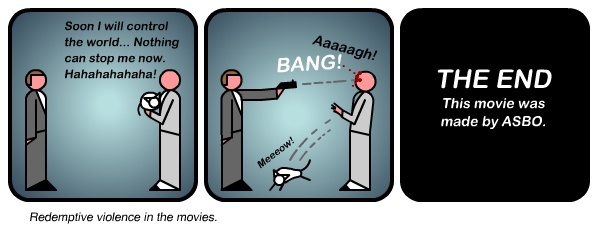
[Painting of the four horsemen of the apocalypse]. The ANE creation myth is essentially a myth of redemptive violence: a way of proposing that violence is what effects important change and brings about good, the goodies must employ violence to make sure that their 'good' values prosper and prevail. It is a myth that is propagated in many -most- Hollywood films. It encourages us to think that means are not necessarily directly or inherently related to ends; that we can create good by doing harm.


Our societies are held captive by the Myth of redemptive violence. The Judeo-Christian traditions question that. Jesus' teaching very strongly undermines it. Our faiths have been co-opted by the MRV and our imaginations colonised by it. We must stop sanctioning violence, full stop. Only then will we be able to stimulate imaginations to envisage solving problems peacefully. Only then will we be committed enough to begin to tear down the automatic justifications and misleading chains of reasoning fed by the relentless MRV-form narratives spilling out of the media. 

If we allow ourselves to think that violence could sometimes be justified, very soon we will find that we are defending horrors such as firebombing, dropping nuclear bombs, waterboarding, drones ... the list will grow and grow.


23 May 2013

Video gamers aggress non-human opponents less

I think that this might be relevant to the subject matter I've been exploring in relation to forgiveness and atonement: :
"The more human players perceived the aggressive targets to be, the more verbally aggressive they were and the more violent words they generated," the study says. "Although we predicted that less human targets would result in more aggression, players seemed to be more aggressive after perceiving more human targets."
Human-like opponents lead to more aggression in video game players
 You may recall that I suggested in exploring anger that taking it 'personally' was a key factor in generating a sense of having been wronged as opposed to simply suffering an accidental detriment. I suspect that this finding supports or corroborates that. If it is the case that we react more angrily when we think we're deliberately being targetted for harm by someone with intent to do us down, then we might expect that the more we can recognise our harmer as having agency, the more likely we are to 'take it personally'. So it seems that non-human 'agents' are quite likely to be perceived as less agentive, less 'personal' -and so less deserving of us taking it personally.

Now, I don't know how, if at all, this relates to kicking the cat (that famous scenario of taking it out on something else non-human -which I don't condone btw) or whether it makes ET's safer from us. It might be interesting to compare/contrast this with the greater ease of unleashing lethal force against those we don't see in front of us (think drones and IBMs) -but that seems to be related to reducing the possibility of empathy rather than upping the ante on aggression.

I take it for granted that video gaming in this respect uses the same brain 'circuitry' as actual aggressive acts and that the interpretive 'circuitry' is the same as in real life. So at an emotional level there is little differenc between a fantasy situation and a real life one.

08 September 2012

Vid games: violence? Nah -characters are overcompensates

There's a lot of moral panic and other sillinesses about video games. This article does a nice job of examining what some of the bigger-picture issues are rather than the shallow-knee-jerkers.
For example, a bit of truth-telling, getting past the cultural mythology:
games are inherently wussy. The stereotype of the bespectacled dweeby gamer is an inaccurate cliche, but there's no denying games are far from a beefy pursuit. Which is why shooty-fighty games go out of their way to disguise that. Every pixel of Modern Warfare 3 oozes machismo. It's all chunky gunmetal, booming explosions and stubbly men blasting each other's legs off. Yet consider what genteel skills the game itself requires. To succeed, you need to be adept at aiming a notional cursor and timing a series of button-pushes. It's about precision and nimble fingers. Just like darning a sock in a hurry. Or creating tapestry against the clock.
Okay, so some of the comments can be a bit catty; but I guess that's part of trying to puncture the bubble of myth, but it makes a good point:
Behind the military manoeuvrings, the human story revolves around people backstabbing, bitching, making catty asides, breaking off friendships and betraying one another. Ignore the gunfire and it's like a soap opera set in a ballet school.
The disappointment is that this is about as far as the critique goes. That last quote seemed to promise a further consideration of the kinds of relating and assumptions that are being modelled and fostered. And then it would be a mere hop and a skip to noting that the metanarrative hooks into the myth of redemptive violence and considering how bad that is as a model for interpersonal relationships ...
Ah well, it looks like I may have done it after all.

Charlie Brooker: The trouble with video games isn't the violence. It's that most of the characters are dicks | Comment is free | The Guardian

05 August 2012

Cultural priming by the Gun: Aurora's unheeded lesson?

I think Latour's idea of noting a certain agency in objects is really useful. It is, of course, an embedded/networked agency, but it allows us to pay attention to the fact that objects in our life-worlds 'call out' to us: they connote things, they imply interactions and these connotations and implications prime us for behaviours and perspectives. The article I've linked to here looks at this in respect of gun possession and in partial response to the Aurora shooting.
philosopher Bruno Latour goes far as to depict the experience of possessing a gun as one that produces a different subject: "You are different with a gun in your hand; the gun is different with you holding it. You are another subject because you hold the gun; the gun is another object because it has entered into a relationship with you." While the idea that a gun-human combination can produce a new subject may seem extreme, it is actually an experience that people (with appropriate background assumptions) typically attest to, when responding to strong architectural configurations. When walking around such prestigious colleges as Harvard and the University of Chicago, it is easy to feel that one has suddenly become smarter. Likewise, museums and sites of religious worship can induce more than a momentary inclination towards reflection; they can allow one to view artistic and spiritual matters as a contemplative being. The Philosophy of the Technology of the Gun - Evan Selinger - The Atlantic
I found this helpful in developing my intuition based on my own experience. admittedly not an experience of gun possession (I have never held a real gun and wouldn't have a clue how to set it up for use). My reflection stems from the experience of owning a toy gun: for me as a child, the potetiality of the object and its meaning simply compelled me to find targets and to 'shoot' them. The toy drew me to seeing the world in terms of potential targets and to pull the trigger. Admittedly it is only a toy, but that pulll to act out the play-purpose of the object was very powerful and I cannot see why that same sort of compulsion would not act to varying degrees in unconsciously priming one to respond to the implicit call of the object (as reinforced semiotically daily in entertainment media). Some people would experience that 'call' more fully than others but statistically, over a large population it would be likely that some would respond to the fullest extent. The message of the gun, as with any tool, is 'use me'; it's only a matter of time before some particularly prone or sensitive souls heed that message and give the gun what it 'wants'.

That's not to diminish the agency of the person who pulls the trigger, but it is to recall that all agents are not equal in our agency, and our agency may be stronger or weaker at different times and in various circumstances. However, we cannot hide from the responsibility to protect the weak and vulnerable and to make appropriate efforts to diminish temptation for those who are more damaged or undeveloped. I think, personally, that this is an implication of Jesus' words about the responsibility of those who 'cause  ... to sin'. If we do not recognise and act upon what we know about priming and the psychological and cultural effects of objects on our subjectivity, I fear that we are responsible before God to some degree.

I think too, that this adds weight to seeing violence and nonviolence as a cultural matter and thus of the kind of imaginations and subjectivities we prime and 'nudge' into being and expression. One of the Christian objections to pornography is to do with the effect upon someone of filling their hearts and minds with a certain kind of desire. It seems to me that this insight should be applied consistently across to the ownership and hospitality to other kinds of objects too, most especially those that pertain to violence and the myth of redemptive violence.

09 July 2012

Rioting as ecstatic experience

A dimension that is often missing from discussions and accounts of violence and other forms of crime, is the way that involvement in such activities, especially where crowds or large groups are concerned, is actually a desirable experience in some way. From a Guardian report on a recent CofE report on the 2011 riots:
Austin Smith, a Passionist Catholic priest from Liverpool who died in 2011, who said such rioting could be "literally an ecstatic experience" after the Toxteth trouble in the 1980s.
"Something is released in the participants which takes them out of themselves as a kind of spiritual escape," Price said. "The tragedy of our times is that, once again, we have a large population of young people who are desperate to escape from the constrained lives to which they seem to be condemned.
"Where hope has been killed off, is it surprising that their energies erupt in antisocial and violent actions?"
Especially where such actions have this "ecstatic" quality where there is a joy in shared enterprise and in breaking boundaries and in the physical activity -not to mention in getting some 'goodies'. And then there may be the sense of 'sticking it' to a society that has been excluding and 'screwing' you. A potent and heady mixture indeed. And if we don't recognise this joy (I think Nietzsche did), we may be less able to deal with it.
Church report on riots warns about effects of cuts | UK news | The Guardian:

31 July 2011

Corporal punishment = long-term negative effects

It is congruent with the proposals that creating low-anxiety, inclusive learning environments produces better learning. Write up is here: Corporal punishment may have long-term negative effects on children's intelligence: "Children in a school that uses corporal punishment performed significantly worse in tasks involving 'executive functioning' -- psychological processes such as planning, abstract thinking, and delaying gratification -- than those in a school relying on milder disciplinary measures such as time-outs,"
I wonder whether this has some bearing on learning outcomes for different communities in Britain. There are some distinct educational outcome differences between different cultural communities inhabiting the same socio-economic spaces in cities in on instance I know of, the attendance of male children at after school classes where corporal punishment is often part of the the environment, is not only getting in the way of their being able to do the homework and be rested for the next day's work, but may be creating a higher anxiety response to classroom/learning situations. The further danger is this:
These results are consistent with research findings that punitive discipline may make children immediately compliant -- but may reduce the likelihood that they will internalize rules and standards. That, in turn, may result in lower self-control as children get older. ... corporal punishment does not teach children how to behave or improve their learning. In the short term, it may not have any negative effects; but if relied upon over time it does not support children's problem-solving skills, or their abilities to inhibit inappropriate behaviour or to learn

08 May 2011

The Curse of the Black Spot

I enjoyed last night's Dr Who, and I've found myself musing over a couple of aspects of it. Check out here (at least for the time being) for some further info or reminders: BBC - BBC One Programmes - Doctor Who, Series 6, The Curse of the Black Spot: "Beset by terror and cabin fever, the pirates have numerous superstitious explanations for the appearance of a mysterious Siren."
So, what I found intriguing having slept on it is the plot structure. A lot of popular viewing, and indeed literature, employs a plot line which is basically 'heroes and others are threatened by some malevolent force (whether a thing, a population or something more amorphous) and the goodies work together using their resources (usually cunningly) deployed to destroy, neutralise or rout the malevolents'.
Of course, that kind of plot arc is basically reinforcing, normally, the myth of redemptive violence (MoRV) which is arguably a key mythic pattern in our culture (I happen to concur with Walter Wink that it actually is). What I enjoyed about this plot is that it opened up the imagination to other ways of plotting the things we face.

In the classic MoRV take, the scenario that the episode opens with would be resolved by either leaving things with the discovery of how the Siren accessed their ship or hiding places and closing it off and getting away or, more usually, discovering something that enabled them to destroy or 'neutralise' the monster. What happened here was the discovery that the 'monster' isn't really but is actually an intelligent programme (an emergency medical hologram -borrowed from Star Trek Voyager?) whose mission is to save the injured and ill by taking them to a life-support unit and keeping them alive albeit comotose pending a visit by real medics. In this case, because the crew of the space vessel the Siren is from, have died from an earth virus (shades of War of the Worlds?), the medics are never going to come and, unlike Voyager, this holographic medic hasn't evolved beyond 'her' programming. So the EHM paramedic simply snatches anyone injured or ill and warehouses them. The resolution here is not from the MoRV script but by understanding the 'enemy', trusting their intelligence and working with their beneficent desires for an outcome of win-win. MoRV, of course is not about win-win but a zero sum 'game'.

I salute the win-win storyline. What this also tells me is that in the struggle for a more peaceful, safer and more just world a big part of it is to expand the moral imagination. Part of our problem as a global society is, I would contend, that our ability to think (collectively) about how to resolve conflict, differing aims and objectives etc is infested by MoRv in such a way that it disables possible win-win plotting. We need to big up stories of win-win plotting (and other kinds of non-MoRV) so that the resources that we have, collectively, to put ourselves into plot-lines-in-life that enable human flourishing for all. So let's have more of these win-win plots and let's celebrate them and encourage them to fill our hearts and minds and so drive from our real-life plotting the automatic recourse to win-lose and MoRV which, I think, made the mistakes of responding to the Twin Towers attack by going into Iraq.

The second thing I've been musing is much less cosmic but nevertheless still intrigues me.
The Siren (whom we discover is an emergency holographic paramedic) looks remarkably like the stowaway lad who we discover to be the captain's son. Maybe this was a co-incidence or merely a resemblance in my own mind, but maybe it has further significance. Within the information from within the story, it could be that the lad was the basis for the programme's choice of form to appear in (the alien skeletons were clearly not human and probably, in our eyes, properly monstrous -big teeth, bony crest on the skull). But then, if this was the case, how did it know (a) to put clothes on and (b) to put female garb on given that all the models it had on the ship were male?

24 August 2010

Gameful, positive impact gaming

I've been spending time recently in the company of some little people who are delightful in many ways. But I found myself reflecting this morning on how thoroughly their imaginations seem to have been colonised by martial-arts and televisual violence (think: Power Rangers, SHS, etc). The difficulty being that these forms of imaginary fighting are heavily based on individual strength and agility, make a rather arbitrary demarcation between goodies and baddies (ie they are like two football teams rather than being divided by values and commitments) and rather contextless (again rather like sports contests).

So I found myself worrying about the way that, in conversation about some of WWII, they seemed to think that a solution to Nazi presence would be to act violently towards German soldiers in a 'superhero' sort of way. Many of their scenarios began with 'What if ...'. At one point I felt I had to say to them that if one of a village did hit a soldier then that would actually result in everyone in the village being punished and many people being beaten up. I didn't press the point but, listening to them, I was becoming more and more disturbed by the way that fantasy violence was so disconnected from the world of systematic oppression and how the ideology of 'redemptive violence' was being laid down in imagination in ways quite divorced from reality. This is, in itself, quite an interesting reflection on arguments about just wars or otherwise: we need to recognise that too many people have an image of what it is about that is simply not robust enough to recognise the real brutalities and miseries.

So that's why I think it is good that some people are trying to produce imaginatively engaging games that don't continue to feed the memes of fantasy violence.
Check it out:
With a hat-tip to those lovely people at Worldchanging.
GAMEFUL, a Secret HQ for Worldchanging Game Developers by Jane McGonigal — Kickstarter: "Gameful is an online 'Secret HQ' where you can connect with other people who believe in the power of games to make us better and change the world.

It will be a free resource -"

30 September 2009

Live by the sword, die by the sword

Look at this: Protection Or Peril? Gun Possession Of Questionable Value In An Assault, Study Finds.: "on average, guns did not protect those who possessed them from being shot in an assault. The study estimated that people with a gun were 4.5 times more likely to be shot in an assault than those not possessing a gun."
No surprise to those of us whose reading of the gospels leads us to think that we reap what we so and that living by 'the sword' is to put ourselves in harm's way; not to deter.
Of course, there are some politically rightist Christians who appear to disagree about that, but it's interesting that this research seems to question their dismissal of gospel imperatives in favour of a version of Luther's two kingdoms theology.

20 February 2009

Violent Media Numb Viewers to others' pain

More evidence that gigo applies to the human mind: violence and uncaringness viewed creates a numbness to others' suffering. The overview is here: Violent Media Numb Viewers To The Pain Of Others and a quote to give you the flavour: "'These studies clearly show that violent media exposure can reduce helping behavior,' said Bushman, professor of psychology and communications and a research professor at the U-M Institute for Social Research.
'People exposed to media violence are less helpful to others in need because they are 'comfortably numb' to the pain and suffering of others, to borrow the title of a Pink Floyd song,' he said."
Now the question really is whether the methodology allows the claims; the results look pretty conclusive.

30 August 2008

Children live what they learn? Bullies are the bullied too.

If there is a mimetic 'instinct' built into humans (and I think the evidence is strong to say there is), then, perhaps, this is no surprise. "bullies are more likely than their classmates to suffer from low self-esteem, depression, and behavioural problems from early childhood and through primary school. They are more likely to suffer from mental health problems later in life too." More details here: Study finds bullies are the bullied too | Education | guardian.co.uk. It could lend support to my thinking that 'original sin' is transmitted via a cascade of detriments internalised by the mimetic drive; that is to say it is both socially-generated and yet innate.

14 January 2008

Aggression As Rewarding As Sex, Food And Drugs

When I read the headline Aggression As Rewarding As Sex, Food And Drugs: I thought 'yeah; I recognise that there is a kind of buzz to it and it would explain the recreational fighting that I see and hear about in cities'. So while we humans are more peaceable than chimps (who couldn't manage to live in cities of several millions without a bloodbath), we do have to find ways to undermine this pleasure in aggression. Here's a summary of the research.
"“We learned from these experiments that an individual will intentionally seek out an aggressive encounter solely because they experience a rewarding sensation from it,” Kennedy said. “This shows for the first time that aggression, on its own, is motivating, and that the well-known positive reinforcer dopamine plays a critical role.”"
Some bullying is like courtship; it's the foreplay of a violent encounter; that's the payoff, the reward. That's what we have to work at delegitimising.

23 December 2007

Everything Must Change: part 5

Sorry for the delay in posting this; I've been caught up more with writing my lesson plans for next term and in some church stuff.
Part five
Here we begin to unpack more thoroughly some of the themes that were outlined earlier, starting with the 'divine peace insurgency'. The trouble is that religious narratives are being used in the contemporary world to justify violence against enemies. In fact, the Hebrew bible has quite a bit of nastiness in it involving religiously sanctioned violence and even the Jesus of the gospels seems to have a less fluffy side involving a glorious return to put all his enemies under his feet. So McLaren's task in chapter 19 is to highlight the way that the gospels' deeper subtext is actually subversive of the violence-justifying ideologies, including those that might look to the Hebrew bible to do so. In particular a helpful reflection on the encounter with the 'Canaanite' woman and the following feeding of the four thousand where the seven baskets full of crumbs can only plausibly correspond to the seven gentile nations that were supposed to be driven out of the promised land. Once again, it is an appeal to the culturally contextualised understanding of Jesus that shows the deeper and fuller meaning and offers little comfort for those who would justify sacred violence.

In the twentieth chapter we are taken through a sobering reminder of the economics of weapons and war and see how the USA has, in effect, become Empire. with an ultimately illusory pursuit of absolute security and in chapter twenty-one we're reminded how in the pursuit of that security, paradoxically , makes it more and more unachievable. It becomes difficult to understand why 'we' continue in the war business unless we factor in the economic angle based on economies of scale: it's cheaper to produce lots of weapons and sell the surplus. And then there is the mythic status of war which produces a whole lot of emotional highs to which we, as societies, become addicted. So, in the next chapter we are introduced to warriors anonymous which talks about replacing our craving for violence with the challenge to struggle for justice and the relief of want and aid in times of disaster.

During the course of this section, McLaren calls for a rapprochement between pacifists and just war defenders around exploring what would truly make for peace. I amen this call but wonder whether part of the problem is really that just war thinking has been so thoroughly co-opted that it cannot now be part of the solution. As McLaren points out in an earlier chapter, in the words of Einstein: no problem can be solved by the consciousness that created it.

Amazon.co.uk: Everything Must Change: Jesus, Global Crises, and a Revolution of Hope: Books: Brian D. McLaren

11 December 2007

This Is Your Brain On Violent Media

Does violence on TV or in films cause or strongly influence violence in real life. Well, here's a smoking gun of research if not the in flagrante: "“Our findings demonstrate for the first time that watching media depictions of violence does influence processing in parts of the brain that control behaviors like aggression. This is an important finding, and further research should examine very closely how these changes affect real-life behavior.”"
This Is Your Brain On Violent Media:

27 October 2007

TV and Film Violence

Those of us who are used to thinking about the Pauline advice about our minds tending to influence attitudes and habits and actions, have tended to think that there must be a link between violence (and sex, for that matter) portrayals in media and acting out. This article is a kind of 'where the research seems to have got to' on the portrayal and consumption of images of violence and the effects in society. As such it's really helpful. It acknowledges that it's not a simple thing but that there are correlations showing up in the studies. For example, "Even though we can't establish a simple, direct, cause-and-effect relationship between media violence and violence in our society, we can draw some conclusions from the data. Studies show that people who watch a lot of TV violence not only behave more aggressively, but are more prone to hold attitudes that favor violence and aggression as a way of solving conflicts. These viewers also tend to be less trusting of people and more prone to see the world as a hostile place."
Which is the kind of thing that I had naively hypothesised; so I would be feeling chuffed were it not for the subject matter. How to respond is a further matter only really hinted at. However, an intriguing link is mention in passing, to do with advertising smoking ...
The article mentions an article for greater depth and it appears to have moved. I think that this is it. It's also worth checking out a wider range of articles here.
TV and Film Violence:

Review: It happened in Hell

 It seemed to me that this book set out to do two main things. One was to demonstrate that so many of our notions of what goes under the lab...