31 January 2011
permission to fail
It's good to see Maggi running with a theme that I've been mulling over in the last year and longer. permission to fail – Maggi Dawn: "To do our best we need to have permission to take huge risks. But you can only do that if you also have permission to fail."


30 January 2011
Kindle -a bit of a review
I've had a Kindle for about 3 months now and having heard that it is now outselling physical books on Amazon, it seems that reflecting a bit on my own use and thoughts might be timely.
I bought the thing for a handful of reasons. One was that when I hold books -especially thick ones- for any length of time to read them (you know, holding the pages open and keeping the weight of it at the right height etc) I am starting to get into various RSI issues: wrists, fingers, neck. So having something light without pages has definite advantages. Secondly, the e-ink thing is a bonus: luminous screen reading is tiring in comparison with reflected-light reading, so again e-readers with e-ink score well for me (it's me age). Then is the scholarly application: you can underline passages and these are synced with your account and you can then go to the appropriate page on the web and grab the quotes you might want to use. Similarly, the note-making facility, backs up your thoughts, observations and critiques on the way through the book also to be grabbable from your machine's account. In addition the ability in most cases to change the format and size of the type-face means that I can allow for different lighting conditions and even my own tiredness by increasing the font size and shape. The smaller sizes are fine for bright environments when I'm not tired -it means less battery used because I change page less often. Though given that the battery can last for several weeks that may not be a huge consideration. (E-ink only uses power to change the display).
'But I love the paper, the smell ... [the romance ... the fetishisation ....]'. Yes, yes, I know: I like the book as an artefact myself and imagine that I will continue to enjoy owning them. However, I do like the fact that I can carry a whole load of stuff with me and put it in my coat pocket -even with a protective cover on my Kindle fits in the inside pocket of my coats and the outside pockets too. So easy and it means that I can easily have a read while on the bus or even standing in a queue. Also the aforementioned advantages of reading with less tiring and physical fatigue has become quite significant to me.
So, I don't imagine I'll give up my Kindle and I hope that it will continue to expand the amount of books available. Also the Kindle will read pdf's and various other word-processed formats and there are 'papers and magazines being published in the format.
That last remark points to one of the downsides: not every book is available as an e-book. Now, I suspect that this will change over the next few years, especially as publishers begin to realise just how much potential market there is out there.
The other downside, though far more minor, is that there are two competing e-book standards and they won't read each other. However, it is really easy for a book to be published in both formats and I suspect that they will be increasingly in the coming handful of years. This won't be quite as bad as VHS vs Betamax. The other interesting thing is that it is so easy to publish, a fact that will in time, I think, begin to reshape the way that publishing works for authors and the relationship between authors, editors and audiences.
The other thing that will need developing is the ability to lend your copy to someone for longer than two weeks and eventually the ability to sell your copy on as a second hand copy -if the DRM system they use is meant to make the e-book rather like a physical book in terms of singularity and un-copyability, then we should have the right and mechanism to dispose of the book for a sum -or even give it away to a charity. I can't see why this shouldn't happen, I imagine it's about no-one having really given it much thought yet -but maybe there's some reason beyond the obvious?
The other thing is about cost. Actually this is a couple of things: one is VAT in the UK; paper-books are exempt, e-books aren't. They really ought to tidy that up, preferably to remove VAT from e-books. The other is the way that publishers are ripping us off. Really, not all of them all of the time. And I'm quite content that they should make money to pay wages and salaries and to offset costs. But hang on; the costs of an e-book must surely be significantly less. I can't really see why some academic books are being sold at £50 plus as ordinary books, but even worse to have e-books not significantly different in price ... that's 'you're avin a giraffe' territory. Especially when some publishers are clearly not doing the bits of extra formatting work that is needed to make e-books really zing.
So what do publishers and writers need to ensure for a good e-book experience? Well, in a word, hyperlinking (and Kindle books are actually DRM-souped up HTML documents). In particular, contents pages (placed literally at the beginning so that they are easy to navigate back to) to chapters and preferably subheadings to aid rapid navigation. Also making sure that footnotes really do work so you can click back and forth: it is tiresome to have to remember the location numbers and manually put them in to go back and forth.
I'm confident that these are all things that will become the norm, but I'm putting them down here as a kind of plea to publishers and writers to make sure it's done. I'm thinking that I may be in touch with some publishers to tell them one or two of these things and suggest that they have sold inferior goods where these features are not in place.
Kindle Wireless Reading Device, Wi-Fi, Graphite, 6" Display with New E Ink Pearl Technology: Amazon.co.uk: Kindle Store
I bought the thing for a handful of reasons. One was that when I hold books -especially thick ones- for any length of time to read them (you know, holding the pages open and keeping the weight of it at the right height etc) I am starting to get into various RSI issues: wrists, fingers, neck. So having something light without pages has definite advantages. Secondly, the e-ink thing is a bonus: luminous screen reading is tiring in comparison with reflected-light reading, so again e-readers with e-ink score well for me (it's me age). Then is the scholarly application: you can underline passages and these are synced with your account and you can then go to the appropriate page on the web and grab the quotes you might want to use. Similarly, the note-making facility, backs up your thoughts, observations and critiques on the way through the book also to be grabbable from your machine's account. In addition the ability in most cases to change the format and size of the type-face means that I can allow for different lighting conditions and even my own tiredness by increasing the font size and shape. The smaller sizes are fine for bright environments when I'm not tired -it means less battery used because I change page less often. Though given that the battery can last for several weeks that may not be a huge consideration. (E-ink only uses power to change the display).
'But I love the paper, the smell ... [the romance ... the fetishisation ....]'. Yes, yes, I know: I like the book as an artefact myself and imagine that I will continue to enjoy owning them. However, I do like the fact that I can carry a whole load of stuff with me and put it in my coat pocket -even with a protective cover on my Kindle fits in the inside pocket of my coats and the outside pockets too. So easy and it means that I can easily have a read while on the bus or even standing in a queue. Also the aforementioned advantages of reading with less tiring and physical fatigue has become quite significant to me.
So, I don't imagine I'll give up my Kindle and I hope that it will continue to expand the amount of books available. Also the Kindle will read pdf's and various other word-processed formats and there are 'papers and magazines being published in the format.
That last remark points to one of the downsides: not every book is available as an e-book. Now, I suspect that this will change over the next few years, especially as publishers begin to realise just how much potential market there is out there.
The other downside, though far more minor, is that there are two competing e-book standards and they won't read each other. However, it is really easy for a book to be published in both formats and I suspect that they will be increasingly in the coming handful of years. This won't be quite as bad as VHS vs Betamax. The other interesting thing is that it is so easy to publish, a fact that will in time, I think, begin to reshape the way that publishing works for authors and the relationship between authors, editors and audiences.
The other thing that will need developing is the ability to lend your copy to someone for longer than two weeks and eventually the ability to sell your copy on as a second hand copy -if the DRM system they use is meant to make the e-book rather like a physical book in terms of singularity and un-copyability, then we should have the right and mechanism to dispose of the book for a sum -or even give it away to a charity. I can't see why this shouldn't happen, I imagine it's about no-one having really given it much thought yet -but maybe there's some reason beyond the obvious?
The other thing is about cost. Actually this is a couple of things: one is VAT in the UK; paper-books are exempt, e-books aren't. They really ought to tidy that up, preferably to remove VAT from e-books. The other is the way that publishers are ripping us off. Really, not all of them all of the time. And I'm quite content that they should make money to pay wages and salaries and to offset costs. But hang on; the costs of an e-book must surely be significantly less. I can't really see why some academic books are being sold at £50 plus as ordinary books, but even worse to have e-books not significantly different in price ... that's 'you're avin a giraffe' territory. Especially when some publishers are clearly not doing the bits of extra formatting work that is needed to make e-books really zing.
So what do publishers and writers need to ensure for a good e-book experience? Well, in a word, hyperlinking (and Kindle books are actually DRM-souped up HTML documents). In particular, contents pages (placed literally at the beginning so that they are easy to navigate back to) to chapters and preferably subheadings to aid rapid navigation. Also making sure that footnotes really do work so you can click back and forth: it is tiresome to have to remember the location numbers and manually put them in to go back and forth.
I'm confident that these are all things that will become the norm, but I'm putting them down here as a kind of plea to publishers and writers to make sure it's done. I'm thinking that I may be in touch with some publishers to tell them one or two of these things and suggest that they have sold inferior goods where these features are not in place.
Kindle Wireless Reading Device, Wi-Fi, Graphite, 6" Display with New E Ink Pearl Technology: Amazon.co.uk: Kindle Store
Data, Information, Knowledge, Wisdom?
http://www.newway.org.uk/datasheets/pastoral_cycle.phphttp://www.learningandteaching.info/learning/experience.htmWhen I looked at this I had TS Eliot's lines running through my head:
. That's a bit of a caveat. Nevertheless this diagramme does seem to capture something, though there are some salient critiques and further suggestions in the comments. If you've admired, as I have, the contents of the book 'Knowledge is Beautiful', then this will seem familiar in style -for good reason.
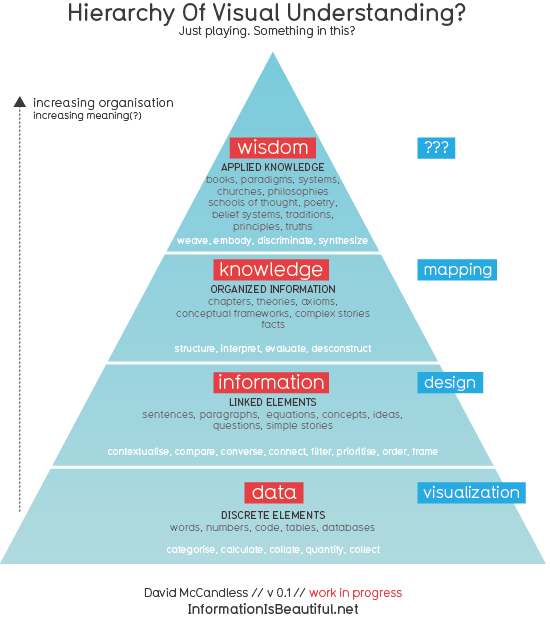
It's quite interesting to note that this kind of progression is not unusual see this (and more here):

What I'm finding myself intrigued by is the way that the elements in these models seem to correlate to the elements in the Kolb Cycle and the Pastoral Cycle ... don't you think?
If my intuition is right, then it lends further support to my contention that those models 'work' in as far as they do because they are naming important and real elements or stages in learning.
Data, Information, Knowledge, Wisdom?
Where is the Life we have lost in living?-- from T.S. Eliot, "Choruses from 'The Rock'"
Where is the wisdom we have lost in knowledge?
Where is the knowledge we have lost in information?
. That's a bit of a caveat. Nevertheless this diagramme does seem to capture something, though there are some salient critiques and further suggestions in the comments. If you've admired, as I have, the contents of the book 'Knowledge is Beautiful', then this will seem familiar in style -for good reason.
It's quite interesting to note that this kind of progression is not unusual see this (and more here):
What I'm finding myself intrigued by is the way that the elements in these models seem to correlate to the elements in the Kolb Cycle and the Pastoral Cycle ... don't you think?
If my intuition is right, then it lends further support to my contention that those models 'work' in as far as they do because they are naming important and real elements or stages in learning.
Data, Information, Knowledge, Wisdom?
God’s Mission is the Eucharist
I found this quite helpful, though it may be a little more allusive than some would like.The Living Church Foundation | God’s Mission is the Eucharist
Here's the final paragraph: "The Eucharist is realized in, and not imposed on, a place. It happens through mutual offering and not through coercion. Hence, eucharistic missioners look for inviting ways for the people to gather in expectant praise of God, to listen to Scripture, to confess sins, receive forgiveness, share the peace of Christ, offer resources for a common life, feed the hungry, give the homeless and lonely a place to belong, to bring their concerns to God in prayer, and to realize the bonds of communion lying beyond the boundaries of old loyalties, tribes, families, and nations. The Father sent the Son so that we might become the body of Christ. The Eucharist is how this body behaves. God’s mission is the Eucharist."
I think that this fits well with a vision of the Eucharist as enacting an eschatalogical drama in the sense of a gathering of the things of this world so that they may be transfigured; that is, carrying the presence of God-in-Christ-by-the-Spirit whilst remaining truly themselves; being relocated into an new economy of mutuality and glory...
Here's the final paragraph: "The Eucharist is realized in, and not imposed on, a place. It happens through mutual offering and not through coercion. Hence, eucharistic missioners look for inviting ways for the people to gather in expectant praise of God, to listen to Scripture, to confess sins, receive forgiveness, share the peace of Christ, offer resources for a common life, feed the hungry, give the homeless and lonely a place to belong, to bring their concerns to God in prayer, and to realize the bonds of communion lying beyond the boundaries of old loyalties, tribes, families, and nations. The Father sent the Son so that we might become the body of Christ. The Eucharist is how this body behaves. God’s mission is the Eucharist."
I think that this fits well with a vision of the Eucharist as enacting an eschatalogical drama in the sense of a gathering of the things of this world so that they may be transfigured; that is, carrying the presence of God-in-Christ-by-the-Spirit whilst remaining truly themselves; being relocated into an new economy of mutuality and glory...
27 January 2011
Can we change the way the brain deals with stress?
The answer is yes: "New research suggests we may be able to change the structure of our brains by taking up meditation."
This article shows the brain scans. It's no surprise: we already know that cabbies learning the Knowledge change their brain shape because of the neuronal connection being built in particular areas. So it might be expected that regular meditators similarly change their brains' structures and habits of association. BBC News - Can we change the way the brain deals with stress?
This reminded me of my time offering basic meditation techniques as staff development at a University under their 'Stress Busters' programme. On the programme in question the claim is made that this is without religion or hippy-ness. And that is believable in the sense that a lot of this stuff is common to all sorts of religions and cultures. The real issue is what you might do with it. The interesting thing, of course, is that it seems to be that the basic 'brain training' underlying much of it is good for your emotional well-being.
This article shows the brain scans. It's no surprise: we already know that cabbies learning the Knowledge change their brain shape because of the neuronal connection being built in particular areas. So it might be expected that regular meditators similarly change their brains' structures and habits of association. BBC News - Can we change the way the brain deals with stress?
This reminded me of my time offering basic meditation techniques as staff development at a University under their 'Stress Busters' programme. On the programme in question the claim is made that this is without religion or hippy-ness. And that is believable in the sense that a lot of this stuff is common to all sorts of religions and cultures. The real issue is what you might do with it. The interesting thing, of course, is that it seems to be that the basic 'brain training' underlying much of it is good for your emotional well-being.
26 January 2011
How a Marxist might see the creed
This is such an intriguing piece. A positive appraisal of the Apostles' Creed from a broadly Marxist point of view.
How about this: "it seems to me that Christianity is materialist in something like the same way. After all, its central doctrine is the incarnation, and Saint Paul taught the resurrection of the body."How a Marxist might see the creed | Mark Vernon | Comment is free | guardian.co.uk:
How about this: "it seems to me that Christianity is materialist in something like the same way. After all, its central doctrine is the incarnation, and Saint Paul taught the resurrection of the body."How a Marxist might see the creed | Mark Vernon | Comment is free | guardian.co.uk:
No Ideas but in Things
If you're interested in Cultural Studies or political theory it's likely you're going to come across Marxian/Marxist thinkers using the terms 'structure' and particularly 'superstructure'. This article has a helpful couple of paragraphs to introduce what they mean, basically. This is done in order to show how Walter Benjamin manages to assimilate and move beyond that analysis. The article is here: notes for the coming community: No Ideas but in Things
Now here's where analytical rubber starts to hit the ground:
I think that this means that it is possible to do useful analysis of cultural artefacts/texts without necessarily having a fully developed analysis of the whole material base. I rather suspect that the fundamental insight underlying Godel's incompleteness theorem would question that approach anyhow. Be that as it may; it does seem to me that the micrological approach is fruitful (whatever Adorno said). This is possible because, Benjamin asserts, there is a third factor 'infrastructure'.
Is other words you have to pay attention to the actual 'stuff' and the trialogue between 'stuff', processes and ideas. Which is much more like, I would argue, the way that human beings 'access' things anyway: we encounter the things in themselves, in the midst of the forces that shape and shaped us and the ways that make meaning in relation to these things (noting too the reflexivity of processing all of this through a social nexus).
I think. Though it may be that I'm reading this through the lens of the approach to cultural analysis that I have come to (and which I put out there towards the start of 'Engaging Culture') which is an attempt to synthesise the insights of several culturally analytical approaches (including Marxian) on the basis that they can't have the credibility and traction they have had without being able to do things that resonate and produce insight. However, as a Christian with a belief in human fall/ibility, and taking on board the insights of post-modern thinking, I also think that their totalising is a problem. So I like in Benjamin's insight the way that it enables us to see the relationships between 'things' in the human world as reflexive and dialogical rather than simply causal in one direction or another. I think that this is to recognise that complexity (arising from chaos) is the name of the game.
And yet, is that a further totalising? Maybe not: the point of chaos/complexity in that respect is to engender a certain humility and constrainedness about our analysing while allowing us a model of why that should be, and so remain useful. As a Christian, I also warm to the materiality and particularity of Benjamin's approach. It echoes the incarnation and the way that this gave the early church a purchase for critique of neo-platonism and thus gnosticism (which wasn't nearly as benign as the Dan Browns of the world might lead you to believe).
Now here's where analytical rubber starts to hit the ground:
The distinction between structure and superstructure, Agamben claims, cannot be based on a simplistic causal relationship. The need to figure out the entire material structure before one can go up to the immaterial superstructure is a false need. If anything, Benjamin shows that there is a direct correspondence between the two, which abolishes the metaphysical or dialectical distinction between animality and rationality, nature and culture, matter and form, economy and politics, reality and poetry. By making immediate or unmediated connections between elements of the structure and the superstructure, Benjamin does not practice vulgar materialism, but a courageous one.
I think that this means that it is possible to do useful analysis of cultural artefacts/texts without necessarily having a fully developed analysis of the whole material base. I rather suspect that the fundamental insight underlying Godel's incompleteness theorem would question that approach anyhow. Be that as it may; it does seem to me that the micrological approach is fruitful (whatever Adorno said). This is possible because, Benjamin asserts, there is a third factor 'infrastructure'.
The paradigmatic example of an infrastructure is the arcades ... covered passageways that were very popular in nineteenth century Paris ... An arcade is not an expression of ideas, whether they are economic or political, material or formal. Those ideas are expressed in this thing that we call an arcade. Whatever may be the structure or the superstructure of the arcades ... it must come to manifest itself through the infrastructure, and not vice versa. The infrastructure thus becomes the secret key that unlocks the mysteries of the city.
Is other words you have to pay attention to the actual 'stuff' and the trialogue between 'stuff', processes and ideas. Which is much more like, I would argue, the way that human beings 'access' things anyway: we encounter the things in themselves, in the midst of the forces that shape and shaped us and the ways that make meaning in relation to these things (noting too the reflexivity of processing all of this through a social nexus).
I think. Though it may be that I'm reading this through the lens of the approach to cultural analysis that I have come to (and which I put out there towards the start of 'Engaging Culture') which is an attempt to synthesise the insights of several culturally analytical approaches (including Marxian) on the basis that they can't have the credibility and traction they have had without being able to do things that resonate and produce insight. However, as a Christian with a belief in human fall/ibility, and taking on board the insights of post-modern thinking, I also think that their totalising is a problem. So I like in Benjamin's insight the way that it enables us to see the relationships between 'things' in the human world as reflexive and dialogical rather than simply causal in one direction or another. I think that this is to recognise that complexity (arising from chaos) is the name of the game.
And yet, is that a further totalising? Maybe not: the point of chaos/complexity in that respect is to engender a certain humility and constrainedness about our analysing while allowing us a model of why that should be, and so remain useful. As a Christian, I also warm to the materiality and particularity of Benjamin's approach. It echoes the incarnation and the way that this gave the early church a purchase for critique of neo-platonism and thus gnosticism (which wasn't nearly as benign as the Dan Browns of the world might lead you to believe).
Subscribe to:
Posts (Atom)