Showing posts with label health. Show all posts

26 February 2018

Funerals should affirm the reality of death

I think that this is in the same ballpark as a post of mine from a couple of years back.

current practice seems determined to deny both the fact and the solemnity of death. We say “We are sorry for your loss,” and talk about the deceased’s “passing”.
I'd just invite Angela to consider the place of 'customer is always right' capitalism in reinforcing and maintaining this unhealthy situation. And don't get me started on this new euphemism 'passing'! I guess it's derived from 'passed away' but somehow even the 'away' was felt to be too final, so it is cut off in its prime. Passing is the new dying.


Angela Tilby: Funerals should not deny the reality of death: 'via Blog this'


29 August 2013

Volunteering may be good for us

Though we should note the caveat "the findings have yet to be confirmed in trials", taken with findings that cumulatively show that churchgoing seems to corelate with longer and healthier life, it is perhaps no surprise that:

Some observational evidence points to around a 20 per cent reduction in mortality among volunteers compared to non-volunteers in cohort studies. Volunteers also reported lower levels of depression, increased life satisfaction and enhanced well-being Go on, volunteer -- it could be good for you!
It may well be that this is capturing essentially the same thing as the church-going data is picking up: part of the ethos of church-going is about giving ones time and effort, without financial payment, for the common good. Of course there are other issues and some of these relate to the happiness and stress-reduction dimensions of life. And, most importantly, it is well to note a corelation, it is another thing to produce a convincing reason for it which seems to have explanatory power and is productive of testable hypotheses.
More research is needed to unpack the theoretical mechanisms by which volunteers may accrue different health benefits
And, of course; "Volunteer too much, and the habit can become a burden, bringing problems of its own." -as some of us who have been involved in church leadership are only too aware; sometimes people have to be protected from their own enthusiasm, guilt-drivers and indeed interpersonal difficulties with co-volunteers. Indeed, I'd like to see a study that helps to open out the issues related to guilt-driven volunteering as opposed to more freely-offered efforts, for example. I hove the sense that running a church or other organisation on guilt is bad for people all round in the longer term.

And part of the issue in volunteering is the type of people who typically do it: is the study actually measuring a population who would be better off even if they didn't volunteer, because of other factors?
... volunteering is associated with improvements in mental health, but more work is needed to establish whether volunteering is actually the cause. It is still unclear whether biological and cultural factors and social resources that are often associated with better health and survival are also associated with a willingness to volunteer in the first place. The challenge now is to encourage people from more diverse backgrounds to take up volunteering, and then to measure whether improvements arise for them.
My suspcion is that maybe church populations are more diverse and that if the church-going benefits are related to the volunteering benefits (as I suspect they are), then that may be evidence that it is to do with volunteering rather than pre-existing cultural or biological factors. But we'll see ...

21 July 2013

We really should keep journals

At the moment I'm working on a couple of projects at work involving putting together learning materials for people to help them to be better resourced at work. In one of them, I'm proposing to encourage participants to practice, at least from time to time, journalling and other self-reflective disciplines. Some of it is emboldened by knowing that research in psychology etc seems to show that they help well-being in various ways. For me the sweet-spot is that they are also involved in spiritual disciplines helping us to relate positively to God. 
I'm amused/bemused by this bit:
... you shouldn't view journalling as an attempt to formulate solutions to your problems; the real benefit comes from the third-person perspective that's attained when you externalise your thoughts. It's interesting to speculate whether the effect may be similar to that of meditation: not changing your thoughts and feelings so much as changing your relationship to them – so that you no longer take them to be an unquestionable, intractable, non-negotiable reality. Why you really should keep a journal, no matter how cheesy that sounds
The reason is not because of the starting advice: I think it's vital that we find ways not to approach problem-solving directly at times. No, I'm convinced that finding the third-person reframing is vital and is part of cultivating a proper obliquity. The reason for my a/bemusement is that it seems that prayer is clearly going to perform this function (obliquely to relating to God, naturally). I guess that it's the relatively large amount of research on mindfulness meditation that pushes the mention of meditation to the fore, but really the way that this is being explained does seem to indicate that prayer can function in this way. In fact, I think it is time to look more carefully at the 'fashionable' mindfulness/meditation research and consider how the various aspects uncovered are represented in Christian spiriutal practice. I do this in an earlier blog post albeit in a very outliney sort of way which references an article which actually prefigures some of the Guardian article's references.

I'm also interested to note that the advice is to not do it daily but less frequently. That'll go well with some of the people I'm wanting to work with on this. Check out this article for a bit more thinking and advice on the topic.

06 June 2012

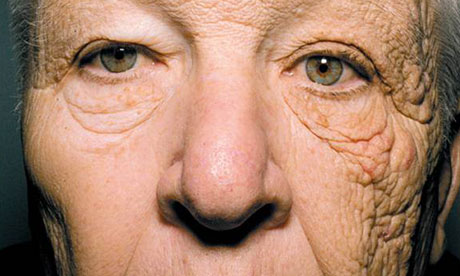
Two faced by the sun

I've been avoiding the sun for about 15 years now: fair skin and a tendency to burn easily plus celtic ancestry make me a prime candidate for some kind of -noma. So it's with a sense of 'Boy I'm glad I'm doing this' that I view this picture

Check out the backstory -but that's not a made-up face; it's a real person. One face, but two sides of a story | Society | The Guardian:
The left-hand side of the 66-year-old's face is deeply lined, pitted and sagging after 28 years of sun exposure through the side window of his lorry. The right-hand side, shaded by the cab as McElligott delivered milk around Chicago, is the taut, unblemished face of an apparently much younger man.
And apparently people who drive with their hands in the sun should also be wary ...

26 May 2011

The Americanization of Mental Illness

Here's one of those things where I get that sense of 'I'm not surprised to hear this but I hadn't quite clocked it before'.
The Americanization of Mental Illness - NYTimes.com: "the forms of madness from one place and time often look remarkably different from the forms of madness in another". In other words 'madness' has an element to it of cultural construction. That's not to say it is entirely so, merely that we tend to form the expressions of mental illness according to cultural mores and that in some cases cultural tensions exacerbate different underlying mental or emotional dysfunctions.

To take one comment from the article commenting on a cross-cultural study of anorexia: “Culture shapes the way general psychopathology is going to be translated partially or completely into specific psychopathology. When there is a cultural atmosphere in which professionals, the media, schools, doctors, psychologists all recognize and endorse and talk about and publicize eating disorders, then people can be triggered to consciously or unconsciously pick eating-disorder pathology as a way to express that conflict.”

And it is also to do with the way that mental illness is received in the host community (which, of course, will have a reflexive effect as the ill person will potentially view themselves and their condition through the cultural lens they have to hand). For example, in east Africa in those areas where schizophrenia tends to be understood as a spiritual affliction; "An ill individual enjoying a time of relative mental health could, at least temporarily, retake his or her responsibilities in the kinship group. Since the illness was seen as the work of outside forces, it was understood as an affliction for the sufferer but not as an identity." And surely that kind of attitude must have effects on the health, over time, of the sufferer.

Part of the point is to recognise that we, in the west, are exporting more than medicine with our mental health treatments; "Western mental-health discourse introduces core components of Western culture, including a theory of human nature, a definition of personhood, a sense of time and memory and a source of moral authority. None of this is universal,"
I find this quite intriguing when it comes to the care of people in a multicultural environment like a modern university. Not yet sure how it 'cashes out', but it's a perspective to hold beside what we see unfolding.

27 January 2011

Can we change the way the brain deals with stress?

The answer is yes: "New research suggests we may be able to change the structure of our brains by taking up meditation."
This article shows the brain scans. It's no surprise: we already know that cabbies learning the Knowledge change their brain shape because of the neuronal connection being built in particular areas. So it might be expected that regular meditators similarly change their brains' structures and habits of association. BBC News - Can we change the way the brain deals with stress?
This reminded me of my time offering basic meditation techniques as staff development at a University under their 'Stress Busters' programme. On the programme in question the claim is made that this is without religion or hippy-ness. And that is believable in the sense that a lot of this stuff is common to all sorts of religions and cultures. The real issue is what you might do with it. The interesting thing, of course, is that it seems to be that the basic 'brain training' underlying much of it is good for your emotional well-being.

16 January 2011

A shorter working week for health and environment?

When I was a kid (like: about 10 -so back in the late 60's and early 70's) teachers were telling us that htey were thinking that htey needed to educate us to know whwt to do with all the leisure we were going to have in the future. I realy wish they'd been right: I've got about 3 books that I'd like to be able to finish not to mention a couple of art projects...

So, you can imagine I'm both keen on this idea and also sadly skeptical. It's form those nice people NEF.
Twenty-one hours is close to the average that people of working age in Britain spend in paid work and just a little more than the average spent in unpaid work. Experiments with shorter working hours suggest that they can be popular where conditions are stable and pay is favourable, and that a new standard of 21 hours could be consistent with the dynamics of a decarbonised economy.
I'm wondering if this would affect vicaring ...
The report (pdf) here.
It's interesting to see the summary of experiments in reducing working hours in developed nations as is the brief history of the invention of the working week -it's worth remembering that it was invented; it's not entirely natural or inevitable. Pay too does not necessarily reflect profitability or other measures of value but rather power (think bank exec bonuses) and power is potentially a democratic vector and in that connection we should recall the messageof the researc indicating that more equal societies have better outcomes in welfare and happiness. Some of this may chime with the ideas that Tom Sine and others have been propounding. In many ways, too, this is pointing towards a way of life much closer to what the Green Party manifesto desires to produce.

Interesting facts mentioned: In the UK the value of housework and childcare carried out without pay would be 21% of GDP if it had all been paid at minimum wage in 2005; informal carers are said to be saving the UK economt £87bn pa.

10 January 2011

Recognize the Road to Burnout -spiritually

It's important to catch it sooner rather than later: for your own good and the good of your nearest and dearest -they're the ones who suffer the most from it in the early stages; believe me. So do check this article out and file it away for future use if necessary.
Running on Empty? How to Recognize When You're on the Road to Burnout | Psychology Today
Among the things that it points up as potential signs are these:
"Psychological signs, such as loss of enjoyment for activities once enjoyed; sadness; excessive anxiety or worry; panic attacks; feeling trapped without options for relief or escape; loss of motivation; loss of concentration; emotional hypersensitivity at seemingly inconsequential things; feelings of helplessness, hopelessness, or pessimism; and/or increasing feelings of irritability, frustration, or anger"

For Christian (and from experience) I would say that some of these impact your prayer life especially loss of enjoyment of activities once enjoyed, loss of motivation. Some of the other things are the kinds of things that show up in self-examination and the danger is to misdiagnose them by simply telling yourself (and God) that you've done and thought wrong. Thing is it may not be the wrong you think. The real sin may be lack of self care so that you don't have the energy to give properly to others and to other-care. That's not ot say that you have an excuse to be irritable (or whatever); just that the response should be to take appropriate care of yourself (and keep the spirit of the law on Sabbath) rather than simply confessing and moving on ... to repeat again because you're still tired and worn down. The sin then is to continue in the burnout patterns rather than seeking to sabbath.

test yourself. Leave work on a Friday and commit to treating yourself to a relaxing, stress-free weekend. Don't bring any work home, sleep in on Saturday and Sunday morning, eat right, and occupy your time with activities that you rarely allow yourself to enjoy (yes, I know you're busy, but trust me--make the time).

If you wake up on Monday morning feeling exactly the same as you did before your time off, you're probably going to have to make some pretty significant changes in your lifestyle to turn things around.

30 October 2010

Burnout and how to deal with it

I came across this via Lifehacker which is a site worth keeping an eye on for the variety of info collected and a sense of just what useful or potentially useful stuff there is out there. Anyway, I looked this over; I've accompanied people professionally on a journey through (parts of) burnout and I have been in situations where, I now recognise, I've been on the edge. So it was great to see a lot of good advice which chimes with what I'd learnt myself over the years, all in one place and not so long a piece that it is disheartening even to contemplate reading it (the last thing you want if you are burning out, eh?). So check it out here: It's a funny old game: Burnout and how to deal with it:

Here's one of the gems:
"...a Burnout Inventory that uses three measurements to identify it
1. Exhaustion
2. Cynicism
3. Inefficacy"

Of course note that all of these need some careful thought about just what the symptoms mean in a wholistic way -the author notes the cultural dimensions of cynicism, for example. And I would add that it's worth checking out that exhaustion is longer-term and not just an unusual and intense time at work or home or in leisure (in which case, rest!), and that you have effective measures for inefficiency and not just a vague sense that you're not getting things done: one effect of depression (which kicks in with burn-out at least later on) is to decrease self-esteem.

There's a good question that we should all ask ourselves before we get to a point of burnout. It's this:
"When pushed to the limit and beyond how do you behave ?"
This is something to ask for help from those who know us well to answer it effectively. Then we can use the answer to keep an eye on ourselves. One of the typical onset difficulties is that incipient burnout is often interpreted by reference to others (often cynically) or mis-attributing blame/responsibility and so we need to be alert to that and to other typical signs in ourselves. I've found this quite helpful over the years, but still get tripped up by things in less-familiar situations or where there are significant dimensions of a job that are sufficiently new to me.
The other useful summary is this:
"A summary would be that you feel very alone, depressed, and judged. To compound it the more you try to get out of it (by doing more of the same) the more you experience it,"

The thing to remember is that in a properly functioning organisation, line managers are for making sure you have adequate (or better) support and for taking responsibility for your work in the sense of making sure that it can be done. If there are problems, they are there to help solve those problems and to help keep you effective and comfortable and secure in the workplace. If they will not do this your union may help or you should look to work elsewhere: it's a dysfunctional organisation and your health is not to be considered a means to address the dysfunction!

Of course, the real bummer is when you have a whole organisation where a significant number of people may be experiencing some of the onset (or worse) of burnout; just think about the potential for cross-transference of blame and guilt-feeling, the brittleness and vehemence of responses all being wound up into a nice tight coil!

If you spot the symptoms, I'd concur with the following list (all except the cat thing: in my case it's a dog and walks)
  • Get some exercise to help with general wellness (always do this !), as well as being properly tired for sleep
  • Take a break
  • Hang out with friends
  • Ensure you communicate with your partner about why you feel bad (so they don't think it's them)
  • Give the cat extra treats
  • Remove yourself from things that are associated with work (i.e. sitting in front of a PC all day)
  • Get help/advice from unbiased sources (very important, people at work have their own agendas)
Please note that these are not luxuries: they are part of proper self-care which is part of being fit to be a good neighbour and colleague as well as a good employee or volunteer.

For Christians I'd also point out that the effects we're discussing here have an effect on ones prayer life. Burn-out and relating to God are not parallel tracks: they affect one another potentially in both directions. It can be that a good affirming relationship to God can help us to withstand the slings and arrows of outrageous torment (to mangle the bard), but it is also the case that burn-out or its first-footings can make it hard for us to find the zest or energy to relate to God in accostomed ways. It's important at those times to give ourselves a break and remember that God first loved us, that God is all about grace and that our attempts to bully ourselves into 'working' at prayer in certain ways are likely to exacerbate the problem.

We need to be able to relate to God as a supportive presence not as another harsh taskmaster (like our work has become -or our organisation or our managers). As spiritual director in such times I'm more inclined to encourage people to spend time doing things they find restorative (sabbathing in a real sense) and to just sit with the recognition that God just loves 'em, is for them and supports them. I think I might want to be on the look-out for things that actively help them to connect with a restorative and affirming sense of God: walks on sunny days, painting, cleaning out the garage (yes, for some people that helps!), running, whatever ... and encouraging that to be part of the regular routine of life.

I could write more about the calling of human organisations to be agents of human welfare both 'internally' and 'externally', but I have done some of that elsewhere and am continuing to reflect on this in relation to the 'corporisations' stuff I'm collecting and (occasionally) writing up.

13 October 2010

Chicken or egg with screen time and problems?

What I can't see in this article Screen time linked to psychological problems in children is a clear sign that the alternative hypothesis has been considered: "The results showed that more than two hours per day of both television viewing and recreational computer use were related to higher psychological difficulty scores,"
This led to the statement that restricting children's screen time might be good for them. But what if the relationship between screen-time and psychological disturbance is not cause and effect but effect and cause? Or even both signs of some other (unnoticed or unconsidered) factor that effects both of those things?
Admittedly, I'm being a bit skeptical of things that look like they could feed the 'woe woe and thrice woe' attitude to ICTs, so maybe the interpretation is right. But even if it is, then the cause needs to be known and possibly the question asked whether there are carry-overs or implications for people who have to work with ICTs for 8 or more hours a day ... ? So, my verdict: more research needed ...

PS just found a comment on this research here at Neuranthropology: A way down on the page under 'Digital'; "My guess is that screen time can be a proxy for other things going on in a home, such as parental neglect, and so the real cause of the later psychological problems is not elucidated by this study."

29 April 2010

Working class under attack from health paternalism?

Well, it's an intriguing take on the matter: Working class are under attack from health paternalism | Patrick Basham and John Luik | Comment is free | guardian.co.uk: "Working-class culture is under assault by political elites seeking to denormalise a way of life."
I'm very sympathetic to the notion that the nation/state might be stigmatising a set of pleasurable behaviours on the basis that they are associated with a certain class. But I'm not entirely convinced that this particular kite will fly. The main 'evidence based' aspect of it, which should be the clincher is the unjustified and unsupported assertion that (unspecified) assaults on (unspecified) WC pleasures are often based on (unspecified) junk science. I'm left wondering what is being referred to; the only things I can think of that might constitute this "war" on WC pleasures are smoking and cardiovascular health matters (involving promoting exercise, less fat and salt consumption etc). These are not based on junk science.

So, it doesn't stack up. And there are other problems too.
First off: which working class are we being invited to consider here? I know working class households who would not really identify or be happy with the version which I think may be being defended in this article. I'm suspicious of the hegemonic normalising of a particular version of working class and I'm suspicious of the ideology at work in using class warfare motifs in defence of 'lifestyle choices' which are not, arguably, in the best interests of those taking them. In fact, follow the money: who will benefit from people continuing to smoke and eat badly ...

Secondly, doesn't the author recall that culture is a dynamic and evolving thing? The working classes' cultures now are different in various ways to those of, say, 30 years ago. Some of those differences are 'natural' responses to changes in material culture, some of it has been engineered or at least encouraged by advertising. We should remember too the insights of research and study that the 'dis-empowered' are still able to make their pleasures in resistance to and playing off dominant and hegemonic forces. They can and do make up their own minds; they can and do respond to what they perceive as being in their interests or otherwise. 'Denormalise a way of life'? Ways of life are constantly denormalising and renormalising. Why shouldn't the common good, the health of individuals and the insights of research and evidence be fed into the complex dynamical system which is a live (sub)culture?

Thirdly, do we not have a duty-of-care to encourage people to look after their own health? We, as a nation, already do this in terms of various citizenship initiatives at schools (and have done since I were a lad) not to mention all sorts of education campaigns such as (to choose ones that are now relatively well accepted) wearing seat belts in cars and helmets on motor cycles. Not to mention that if certain sections of a community routinely take risks with their health and then the consequences are treated and cost the rest of us money, then do 'we' not have a right and a duty to point out that this is the case and is not fair? Is it not a fair idea to try to save money, time and effort for the benefit of the common good?

01 September 2009

!! ?? !!

Speechless: even having seen these claims before ... It makes me so cross that people can lie so outrageously and not be effectively challenged. ... shakes head sadly ... Obama is losing the health debate – but he can still mobilise and win | Gary Younge | Comment is free | The Guardian: "They have argued that if Steven Hawking were British he would be dead, even though Hawking is British and alive. They insist that under the NHS the state decides whether to 'pull the plug on grandma'."

For a little light relief, the article goes on to say this:
In a blend of the comic and the tragic one protester, who was hospitalised after he got into a fight at a town hall meeting in St Louis, had to have a whip-round to pay for his medical bill – it turns out he had no health insurance.


And, assuming these figures are about right; then there is a huge (but in this case very misplaced) trust in the USA's rightist population that if it's 'America' it must be best because ...
life expectancy in the UK is higher than the US, meaning that even with our supposed state-sponsored euthanasia our grannies still live longer than theirs... As a percentage of GDP the US spends twice as much on it as the UK, and yet one in six aren't even covered. According to government figures, life expectancy for women is lower than in Albania and infant mortality is higher than Cuba. This national disgrace conceals a regional outrage. Black infant mortality in Louisiana is on a par with Sri Lanka; in the very city where the reforms will be decided, Washington DC, life expectancy is lower than the Gaza Strip

20 August 2009

UK to US: The Truth About the NHS!

You know I've been vexed about this, if you've been reading my recent posts. If you are concerned as I am and also hoping that Obama can achieve some of the good stuff we hope from him, then perhaps you'd like to give consideration to this: UK to US: The Truth About the NHS!<br>: "conservative US politicians and greedy insurance companies are pushing lies about the NHS as a way to scare the American public off national health care - risking Obama's whole movement for change and threatening his majority in Congress.
Sign the petition below and tell friends - huge numbers of us will cause a stir in the US media and affect the debate,"

19 August 2009

In defence of the NHS

A first-person testimony which I think is worth reflecting on, especially as the author contrasts his experience with the concerns -better, anxieties- of his Houston-living in-laws.
In defence of the NHS: I'm glad I didn't break my leg in the US | Society | The Guardian: "Much as my own grandparents in England feared ending up in the workhouse, my in-laws fear falling into the state-provided Medicaid system (one step down from Medicare), for which you need to be destitute to qualify. Father-in-law Vern says 60% of US bankruptcies are triggered by medical costs.
'No one who has been through illness in this country worries about socialised medicine,' he says. 'We know there is a lot of money and vested interests in play, lots of fire and smoke.
'They are so ignorant about the NHS. It doesn't help when this idiot from the Conservative party comes over and talks down the service and gets lots of publicity. What sort of kick is he on?'"
I shared this with two of my kids and we mused over the fact that had my daughter's accident taken place with us as USAmerican citizens, we might have had problems with her treatment; we could be among those 60% of medical-cost-triggered bankruptcies.
Careless talk costs lives in this kind of debate.

15 August 2009

USAmerican healthcare -some sobering realities

Further to my rant-to-get-it-off-my-chest yesterday, I came across this which seems to bear out the sense of outrageous injustice in the claims of some on the USAmerican right. Go here for the whole thing: Mirror, Mirror on the Wall: An International Update on the Comparative Performance of American Health Care - The Commonwealth Fund And her's the shocking headline news: "Compared with five other nations—Australia, Canada, Germany, New Zealand, the United Kingdom—the U.S. health care system ranks last or next-to-last on five dimensions of a high performance health system: quality, access, efficiency, equity, and healthy lives. The U.S. is the only country in the study without universal health insurance coverage, partly accounting for its poor performance on access, equity, and health outcomes. The inclusion of physician survey data also shows the U.S. lagging in adoption of information technology and use of nurses to improve care coordination for the chronically ill."
Now some of that might actually be down to the economies of scale factor ...

14 August 2009

How dare USAmerican republicans slag off the NHS ....

Last night and this morning I was stirred to a rare state of outrage (it takes a lot to get me close to incandescent) but some of the banners being carried by some Re/Publicans lit my blue touchpaper. So it was therapeutic to read an article that said a lot of things that I wanted to say in response: Thank heaven for the NHS | Michele Hanson | Comment is free | guardian.co.uk In particular this captured the heart of it (as I come from a poor family): "It's not perfect, no organisation of that size could be, it's bound to make some mistakes, but I don't know where I'd be without it. Probably dead. I have a thyroid condition, and every day for the last 30 years I've had free medication, like thousands of others with ongoing conditions: diabetes, epilepsy, cancer and many others. What happens to the 43 million people in the US who can't afford to pay for such things? Must they live a miserable, painful, debilitated life and die early?"
So the clearly-unthought out guy carrying a placard claiming by implication that for the USA to have a European style medical care system would mean the elderly would be left to die ... well words almost fail me. One I'm very cross that he seemed to think we were practising euthanasia of the wickedest kind; two, I'm outraged that he seems to have forgotten that almost the equivalent number of people in the USA to the number of adults in England are in effect facing that: they are uninsured and the benefits he is presumably hoping for do not extend to them; presumably they hope for charity, go into massive debt or simply have a shorter life expectancy simply because their life circumstances are not as favoured as his. It is the hypocrisy and double standards of the protest which are galling.

Then there was the woman at one meeting who seemed to think that "socialised" health care was communism. The implication seemed to be that 'socialised' not only sounds like but is like 'socialist' which means tyranny. What do these people think is happening in terms of the systems of government of their allies?

Final story. When we had some USAmerican friends to stay a few years back, one of them developed a minor injury, went to a local out-patients' centre, and was treated. She was delighted that no-one asked her for a medical insurance card/papers. She was just treated. That's how it should be. I don't think a country is properly civilised if healthcare is not free or close to it at point of delivery. (Oh and don't get me started on the distortions that profit bring to medical care: unnecessary treatments; litigation-driven inflation ...)

05 May 2009

Swine flu: investigate and regulate

Did you know that evidence is growing of the link between factory farms and swine flu? International organisations have been warning that these inhumane and filthy operations are breeding grounds of disease for years.

I just signed a petition calling on the the United Nations World Health Organisation and the Food and Agriculture Organisation to investigate and develop regulations for factory farming to uphold global public health standards. If we reach 200,000 signers, the petition will be delivered in Geneva with a herd of cardboard pigs. Sign below and tell your friends -- a pig will be added for every 1000 signers!

http://www.avaaz.org/en/swine_flu_pandemic/98.php?CLICK_TF_TRACK

Thank you so much for your help!

07 January 2009

Depression among the young at alarming level

Check it out: Depression among the young at alarming level, says charity | Society | The Guardian Here's a quote to get you into it: "the majority of young people had a generally positive outlook on life. ... however, ... the serious concerns of the 'core' of unhappy people under the age of 25 'need to be addressed'.... failing to take the issue seriously 'would be storing up big problems for the future'.
Concerns about the mental health and wellbeing of young people have risen sharply following reports about the emotional fragility of the current generation of children and teenagers, and problems around violence and knife crime."
The interesting thing is that this seems to be linked in the article to the figure that "27% said their lives had no purpose.". Could this be further evidence that nihilism is bad for us? Link that, then, with Matthew Parris's article about how God seems to be good for society (here).Further comment here.

A review of Common Threads

  Most of my Christian life, I've been what is usually labelled "an inclusivist". Lately I've been re-examining what that ...