Showing posts with label faith. Show all posts

14 December 2013

Doubt as a way of faith

"I'm so mixed up I doubt my doubts -only to discover I believe!"
Okay, so I made that quote up but it came to mind as I was thinking about the gospel passage for this coming Sunday.
First we have John the Baptiser having a wobble:
 "When John heard in prison what the Messiah was doing, he sent word by his disciples 3 and said to him, ‘Are you the one who is to come, or are we to wait for another?’" (Mt.11:2&3).

Perfectly understandable: first of all John's in prison which perhaps doesn't seem fitting to him but might be part of the programme if the Messiah would then actually do something to bring about the Promised renewal. restoration of national life under God. But Jesus doesn't seem to be set to do that. So, is it all for nothing?

Then there's also the doubt that Jesus seems to be addressing when he turns to the crowds. Presumably, John's followers had come upon Jesus in public and asked their question in public; meaning that the doubt that John implies by his question is communicated to the crowd. If they have the same sort of particular Messianic script in mind as Jesus needs to address and subvert and reconceptualise in the apostles at other points in the gospels, then how much more the crowd? And how much more important to frame what they've heard helpfully.

I find it encouraging that doubt is not dealt with harshly -indeed it's not even named as such here. In some Christian contexts doubt has become "Doubt": it's a big thing, the beginning of the end, the start of a descent into lostness and to becoming one of those people that our church or our ministry sees as a enemy to the Gospel. I think, though, that doubt is a continuum one end of which is faith destroying, the other end is potentially faith-building, It is worth recalling, to help us understand doubt, that 'faith' is ambiguous. On the one hand we might mean something like 'a system of propositions about the nature of life/reality' on the other hand it may be about 'trust and/or commitment'. True enough: the two are linked -if your cognitive doubt is sufficiently foundation-shaking of the belief system, then the trust and commitment ebb away. And, of course, in some cases the commitment overcomes evidence or selects evidence of a more cognitive nature to support the commitment.

But some doubt is not so existential. Some doubt is mostly about trying to see things whole. It's about recognising differences of perspective and apparent dissonances in experiences or interpretations or some combination of those. And a lot of times that is more about 'making sense' brought about by changes in circumstances which change our reflex perspectives, or help us to see things from a different point of view, perhaps gaining sympathy with someone or an idea that previously seemed 'out there' for us. Sometimes it arrives with an increase in knowledge which questions something we'd previously assumed or makes a different line of thinking seem more fruitful, plausible or explanatory for us. The thing is, all learning, all making-sense, is initially disorienting to some degree. And this can feel like doubt. In some senses it is: it is a questioning or re-evaluation of what had previously been believed. And if that previous belief had been important to us or remains important to those around us whom we trust, then the doubt can feel quite frightening. In response we may try to ignore it, reassert the old perspective more vehemently to try to force it from us or we may face it with boldness or humility to learn what lies the other side. This kind of doubt is the vulnerability of the hermit crab between shells.

So, how do we see Jesus responding here (to John, via his followers)? In short, it seems to me, pragmatically and sympathetically. There is no deriding the 'wobble', nor is there a forceful restatement of the right position and/or an exhortation to believe. To be sure there is that at one or two other points -but let's take those also on a case-by-case basis, remembering that here it is dealt with sympathetically, I think that there are different ways of responding to doubt because there are different kinds of doubt and we do ill if we treat all of them as if they are Doubt.

Jesus treats John's doubt as sense-making disorientation: events have overturned John's prior understanding of the Messiahnic script and he needs help to reorient faithfully. So Jesus draws John's attention to some salient facts about what he's doing, and does so using phrases which echo Messianic passages in Isaiah, but which also point to another area of 'messianic scripting' that doesn't involve nationalistic, other-punishment or violent fantasy-stoking which may have been the script playing in John's mind and now being doubted. Jesus does a bit of pastoral re-framing to help John re-integrate his experience as it is now in such a way as to keep him true to the important things now: 'blessed is the one who does not fall away on account of me'.

There's an implicit warning in there as well as encouragement to stay true. One might fall away because having hoped that Jesus were the Messiah, his following parts of the script that were previously not noticed or not weighed sufficiently heavily might cause one to throw over the whole plot rather than adjust ones expectations and understandings in the light of an expanded appreciation which reframes the former beliefs.

Then Jesus has to turn to the crowd who've been listening in on the exchange and drawing their own conclusion and perhaps finding their own doubts or skepticisms amplified and played back -perhaps even as they murmur to one another. So I imagine that 'Blessed is the one who does not fall away on account of me' is also said with the crowd in mind -to encourage and challenge them too. But with some further perspectives to supplement. He tells them, in effect, that those of them who went to see and hear John's ministry were right to do so and that John was indeed the fore-runner. This is a reassertion of the plot but with a further dimension drawn to attention: that the forces arrayed against them are the rulers and the interests of wealth-accumulation. Implicitly a reminder that they shouldn't be expecting an easy shoe-in to earthly power but rather powerful opposition. And, of course, we realise that this is also a prefiguration of Jesus' own life-narrative.

There are forms of doubt that can make us less likely to stay true to the plot when it contains suffering and misunderstanding by others. There are forms of doubt which enable us to put aside perspectives which would keep us from staying true because they are perspectives which would deter us, lead us to take mis-steps or even end up working against the God-plot and for the Powers-plot instead. In this latter case, doubt is part of the way of faith.

21 November 2013

Religion, war and peace -A Christian contribution to an interfaith event

Last night, I was one of the speakers at a Voices of Faith event where a Jewish, Muslim and Buddhist also presented their own takes on the topic. I used a prezi to navigate through the 15 minute presentation. I thought I'd give a write-through of the content (bearing in mind I had to abbreviate my presentation to fit into the time available so this is a filled-out version with a bit more background and explanation in it. the prezi is here.

First off 
[dove image made up of weapons' silhouettes), a note that this approach to war and peace is my own reading of the Christian tradition, it is also one that takes a rather different 'tack' to what might be expected in the interests of trying to make a proposal which could be more than a simple exposition of a Christian 'take' but rather something that invokes the nature of Ultimate Reality to invite us to consider how our respective faiths construe that in relation to the issue of violence. So I'm interested not just to give a basic exposition of Christian scriptures and framing them within the development of Christian thinking over the following centuries, but rather to seek something that opens out what I take to be the theological deep-structure in relation to human history.

Christmas Truce 
 [Picture of WW1 Christmas Truce handshake with swapped soldierly parapernalia]. Christmas Eve 2014 sees the 100th anniversary of one of the most remarkable events in the history of warfare: the unofficial Christmas truces of 1914. They commonly began with German soldiers and officers putting up Christmas trees, shouting or writing Christmas greetings, and singing songs recognisable to their British counterparts such as Stille Nacht (Silent Night). From these beginnings troops met in no-man’s land to bury their dead, exchange gifts and souvenirs, share festive food and drink, give cigarettes and cigars, sing and entertain each other, swap names and addresses, conduct joint Christian services, and even, it is rumoured, to play football. These were not isolated incidents but were widespread right down the front from the North Sea to Switzerland, made possible in part by shared traditions of Christian celebration. It was a hopeful moment of recognition of common humanity and a rejection of the cruelty of industrialised warfare pursued by rulers in a deadly game of global imperial competition for territories and resources. It was quashed by orders backed by threats, and by replacing troops with men ‘untainted’ by the Truce (including soldiers from the Empire who didn’t share a tradition of celebrating Christmas).


WW1 was a war arising from Imperial ambitions clashing -principally those of Germany on the one hand and Britain and France on the other. It was precipitated by a failure of the deterrence supposedly offered by huge military alliances and offers of mutual aid in literal co-belligerence. At the heart of it were supposedly Christian nations -the next picture frame focuses on the German troops' belt buckle with the words "Gott mit Uns" which means 'God with us' and while the British didn't have a direct equivalent in terms of clothing it is clear that many British propagandists and opinion-formers held a similar view -that God was keen for the British to win because they were the guardians of Christian civilisation against German barbarism. The mirroring of each others' official 'theologies' of war and nationhood is tragic and would be laughable if it weren't what actually happened with such dire consequences. Obviously, they couldn't both be right.


My question in this forum is how they ('we') arrived there? How did two supposedly Christian countries both with good civilisational credentials end up demonising each other and slaughtering one another and claiming it was God's will? Worse yet, we should recognise it's not just Christians implicated in this. In an interfaith understanding event, we should also understand that troops on both sides held different faiths and also secular and atheist views. On the British side, one of the means to put a stop to the informal truces at Christmas in 1914 was to draft in other-faith troops from parts of the Empire that didn't share the Christian sentimentality about Christmas.


A Myth and a riposte [picture of an Ancient Near Eastern deity and a piece of art depicting a visual interpretation of the seven days of Genesis 1-2:4]. Here I press on into the unusual turn of my exposition, looking at something more ancient that most of our religious traditions.

There were two ways of viewing humanity in relation to our purposes on earth and relatedness to deity in the Ancient Near East (ANE). Both deal with origins, ostensibly: chaos and order; what is the human place in the cosmos; what are we humans here to do; what is authority in human affairs? But each have a rather different message for us as humans.

Ancient Near Easter myths:
[picture of ANE deity in full armour holding thunderbolts] though these varied in characters and the detail of plot lines, they tend to tell stories which indicate that order is created out of chaos by the might of the gods and that order is establish and maintained by violent actions. Human beings are, in this kind of schema, made out of the offal of the slaughtered defeated god (who represents chaos) and are made in order to do the work that the gods don't want to be bothered with. So we're getting a picture of humans not being high in the value and dignity stakes -we're almost afterthoughts made from disrespected  materials to slave for the gods and their representatives on earth (the kings and priests). For our purposes though, we should note that the created order is violently produced: ultimate reality is violent, 'agonistic'.

Genesis 1-2:4
[picture of seven thin panels hinting at the 7 days of creation] seems (to me) to be telling a counter-story emphasising that creation is founded in an original peace rather than violence, and that we humans have a dignity since we all image God -a view which automatically flattens hierarchy and deligitimises kingly and priestly claims of privilege. We are also created for rest as well as to participate in the work of God.

So there are two world views on offer, and I would argue that these are still a fundamental choice set before us. Do we believe ultimately reality is about love, peace, co-operation, dignity and so on or do we believe it is ultimately about self-assertion, violence, hierarchy, winners and losers. Every time we claim that there is no choice but to do violence, we are in effect asserting that ultimate reality is about violence rather than co-operation: division rather than relationship.

Moving from ANE to Jesus
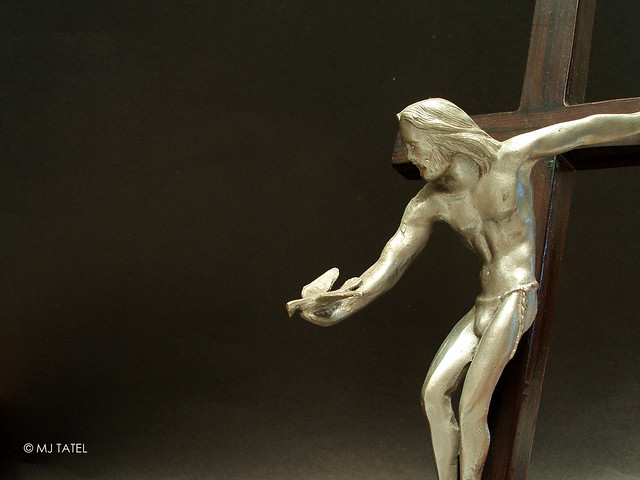
 [picture of figure on cross with dove alongside a sunrise photo], we consider the specifically Christian dimension.
[focus on picture of figure on cross offering a dove] Jesus's teaching is heavy with love of neighbour, love of enemies, forgiveness. His ministry is full of reaching out to the despised and the hated, and his last earthly week is full of choosing not to offer violence but rather to absorb the hatred and violence offered. For these reasons the church of the first three to four centuries consistently teaches that Christians may not be involved in violence.

There occurs in the fourth century a growing rapprochement of the Roman Empire with its Christian minority which eventually leads some Christian theologians developing just war theory
[see green table labelled 'Just War Theory'] which sought to allow Christians to participate in the defense of civilisation while maintaining moral limits and building in mitigations. This is consolidated by the emperor Constantine who supposedly has a vision [see picture of sunrise]
probably prompted by a sun-halo like in the picture. But overlaid by hearing a voice
[close in on next picture -red cross and words]  saying in hoc [signo] vinces -'Conquer by this sign'. Constantine then put the sign of the cross on his army's armour and went on to win the battle. He politically then makes Christianity a licit religion and sets the Roman Empire on a course to absorb Christianity and the Church to legitimise the Empire (and its violence).


The next thing we know on this trajectory is that not only is the Church giving comfort for the doing of limited violence but developing a holy war theology which creates the possibility of crusades -violence as a way to extend the church's mission. By this point it becomes obvious that the limited allowance of deadly collective violence by the just war theory was indeed the top of a slippery slope into warfare as an instrument of policy for the church. In effect overturning the teaching and example of Christ. And that is how we end up with troops killing and maiming each other each side in the name of Christ, justice and 'peace'. Truly, the decision to offer any kind of justification for violence is likely to be increasingly loosened in scope and ways are found to express reasons for taking up arms in terms that look like they might be 'just'.

On not feeding the four horsemen.
[Painting of the four horsemen of the apocalypse]. The ANE creation myth is essentially a myth of redemptive violence: a way of proposing that violence is what effects important change and brings about good, the goodies must employ violence to make sure that their 'good' values prosper and prevail. It is a myth that is propagated in many -most- Hollywood films. It encourages us to think that means are not necessarily directly or inherently related to ends; that we can create good by doing harm.


Our societies are held captive by the Myth of redemptive violence. The Judeo-Christian traditions question that. Jesus' teaching very strongly undermines it. Our faiths have been co-opted by the MRV and our imaginations colonised by it. We must stop sanctioning violence, full stop. Only then will we be able to stimulate imaginations to envisage solving problems peacefully. Only then will we be committed enough to begin to tear down the automatic justifications and misleading chains of reasoning fed by the relentless MRV-form narratives spilling out of the media. 

If we allow ourselves to think that violence could sometimes be justified, very soon we will find that we are defending horrors such as firebombing, dropping nuclear bombs, waterboarding, drones ... the list will grow and grow.


07 February 2011

Barack Obama affirms his Christian faith

It's interesting to see that Obama has decided to be fairly explicit about owning up to a Christian faith. No doubt that will please some, perplex others and enrage others. Pleased will be those, like myself, who think that Christian faith has a somewhat 'progressive' agenda in wanting to be pro-active in helping people. Perplexed will be those who really thought he was Muslim -hopefully this may help them to reappraise the sources of their information for accuracy. Enraged will be the right who will see an obstacle to their attempted hijacking of Christian values and language to serve the agenda of Empire.#

But I'm even more interested in this:
"It was Obama's involvement as a community organiser, 'working with pastors and laypeople, trying to heal the wounds of hurting neighbourhoods', that had first led him to see himself as a Christian."
Not least because it seems to affirm a way of disciple-making that coheres with Raymond Fung's Isaiah Vision and Anne Morisy's Beyond the Good Samaritan: that as we go about trying to make a difference for Good, people want to be a part of it. That's very like calling attention to God's desire for love, peace justice which is under construction in lives near you and inviting people to join in. Ie. "Repent for the Kingdom of God is near". Yes, it is near in works of service and generous empowerment, in lives making Good flow into the bloodstream of life among those least able to grasp it from the System.

06 September 2010

Metaphysics and the limits of science

Mary Midgley is often good value. And this article is certainly thought provoking, closing with:

Our problem here is to understand the relation between these two things – between our inner and outer life, between consciousness and its objects, between the vulnerable self and the world it has to deal with. This is not a physical problem. It is a problem about how to understand and face life as a whole. And it is not about to go away.

http://www.guardian.co.uk/commentisfree/belief/2010/aug/28/philosophy-science

07 July 2009

Muslims and Christians ‘can share faith ethically’

Check it out. I've just been considering how we represent the ethics of mission in some of our courses, and this seems to add grist to that mill: Church Times - Muslims and Christians ‘can share faith ethically’: There is a ten-point code of conduct to guide us. Actually seems pretty good. Only the last point might be controversial for some Muslims. The rest are hard to object to in principle. Though, of course, sometimes practice falls short.
"1. both faiths believed they should proclaim their faith by words and attitudes, actions and lifestyles;

2. in language and method, both faiths should recognise that people’s choice of faith was primarily a matter between themselves and God;

3. “sharing our faith should never be coercive”;

4. caring for people should never be manipulated to gain a convert;

5. nor should conversion be linked to inducements;

6. neither faith should diminish the faith of others and each should speak honestly about their own faith;

8. people should be honest about their motivations;

9. they can rejoice with converts but be sensitive to the loss that others felt; and

10. “Whilst we may feel hurt when someone we know and love chooses to leave our faith, we will respect their decision and will not force them to stay, or harass them afterwards.”"

See also Richard Sudworth's comments.

10 May 2009

Quantum arguments for God veer into mumbo-jumbo?

I think that perhaps this riposte article in NS about whether quantum indeterminacy gives room for God's action in/on the cosmos. It's a response to a Christian scientist (note small s!) making such a claim. A little while back I commented on a possible development in theory that could change the way we view this argument anyway. Read the whole article: Quantum arguments for God veer into mumbo-jumbo - opinion - 06 May 2009 - New Scientist and the nub of it seems to me to be this, starting with a restatement (how fair?) of the argument being reacted to: "So, because God somehow tinkers in a quantumy type way, it's worth praying for divine guidance and intervention. To me, and to other scientists and commentators, Collins is straying into pseudo-scientific speculation simply to keep God in the earthly frame. Believing in God in the first place is by definition a leap of faith, and one that many scientists and many non-scientists are, after careful and reasonable thought, unwilling to take. For those who have trouble accepting that we're a product of pure chance, there is the option of believing that God set everything in motion."
To add my two-penn'orth: I think that the riposte misses the point that if time is part of 'created' order, and that the Theist view of God is that God is outside of this space-time continuum. Therefore the creative act could be (and I think should be) interpreted as covering the whole STC. So if there is a conceptual possibility for a deist 'wind-up-the-clockwork' god, there is by the same logic one for a theist God. It doesnt' help us with the 'how' of God-STC interaction, but we should be careful to note creation and sustenance are not completely different categories, but rather a time-bound 'observation'-dependent thing.

10 April 2009

Redding shahada saga ends in deposition

You may recall my blogging about this a year or so back. It is picked up in these terms by the Church TimesChurch Times - US cleric deposed after becoming a Muslim: "A CLERIC in the Episcopal Church in the United States, the Revd Ann Holmes Redding, has been deposed for becoming a Muslim. She made a public profession of her faith 21 months ago, and was given a year by the Bishop of Rhode Island, the Rt Revd Geralyn Wolf, to discern where her faith commitment lay.
She was deemed at the end of that year to have abandoned the communion of the Episcopal Church, and was inhibited from exercising her ministry. The inhibition continued until 31 March, when she had the opportunity either to withdraw from the Muslim faith or renounce her orders. She did neither, and was therefore deposed." And the Seattle Times -obviously- picked it up too.

I think that this was probably the only outcome in the end; but I still believe that the bishop acted rightly; it is better to give time to consider, and if necessary repent than to act precipitously where the intimacy of a relationship to God is concerned (unless we have a very clear supernatural insight and the humility to exercise it wisely). The only difficulty with it is highlighted by comment in the Seattle Times: "In Christianity and Islam, while "there are streams of tradition that are mutually exclusive, there are also streams that are not mutually exclusive," said Eugene Webb, professor emeritus of comparative religion at the University of Washington. "Ann is exploring those."
It would be a good thing, Webb said, if more churches allowed for such exploration since it's "going to take place one way or the other. It might be better to wait and see what comes of them, rather than decide in advance that it wouldn't be fruitful.""
It adds an interesting dimension to the dialogue about contextualisation and syncretism; usually the latter is seen as the former 'gone too far' usually in mission. However in this case it's not an evangelistic issue but rather a spirituality thing. I'm still concerned that Ms Redding should be given space to explore: it's a centred set thing: if she still feels in her heart that Christ is central but somehow there is 'that of God' (to borrow a Quaker concept that seems uesful at this point) in Islam that she must explore, then she needs to do so in a way that allows her to retain a positive relation to Christian faith. I think of figures such as Sadhu Sundar Singh and wonder whether it may be that she could be part of Christ's strategy with Islam. It's too early to say. That said, her state intellectual beliefs seem not to be affirmative of orthodox Christian belief, but that predates her shahada-saying. So no easy resolutions here.

08 August 2008

military pornography

This is a mini rant. Actually 'rant' is not the right word, it's more a sharing of puzzlement.

It starts with a Christian friend building a model of a piece of medieval military technology and my thoughts moved from there to thinking that I was uncomfortable with the subject matter of the model because it was about a piece of technology designed to endanger life and property. I then got to wondering why it was that as Christians we generally think it's okay to have an interest in military history, literature and paraphernalia but would have problems with someone showing similar interest in the history of sexual infidelity, bondage equipment or pornography. And yet the Christian position on warfare is probably just as circumscribed as that on sexuality, perhaps more so: war is either not to be entertained at all, or if it can be then it is only a last resort with heaviness of heart. Given the justification given for engaging in war in the Christian tradition, it is actually pretty hard to justify certain levels of interest in matters military when compared with matters to do with sexual expression.

I suspect that this shows up a degree of acculturation which may not be healthy in western Christians and which makes, by implication, interesting comparison and comment on our attitudes to sexuality. I'm tempted to take the view that I won't accept certain arguments in respect of homosexuality unless the proposer of those arguments makes consistent arguments with regard to war and peace also...

31 October 2007

capitalism's inner contradictions?

A banking friend of mine was shocked once when I pointed out in a sermon that money runs on faith. And I still stand by it: you have to believe that this token will be accepted (on faith) by other people when in turn you want to turn it into goods or services. The banking system is more so. If we lose faith in the system, it will collapse. So it's interesting to note, that herein, lies one of the contradictions of capitalism: it promotes self-interest but within a system that relies on others to maintain good faith. Perhaps it's another variant on the epistemological paradox that you have to believe something to know something.

I find some confirmation of this in the recent matter of the run on the Northern Rock bank following the blowback from the USA's bad debts problem. The fact is that the institutions that are often most gung-ho about the importance of private enterprise and not ruining markets by government intervention, nevertheless are happy to be bailed out when it suits. The irony is magnified when seen through the lens of particular protagonists like this: "When his libertarian business model failed, Dr Ridley had to go begging to the detested state. If the government and its parasitic bureaucrats had not been able to use tax-payers’ money to clear up his mess, thousands of people would have lost their savings. Northern Rock would have collapsed and the resulting panic might have brought down the rest of the banking system." Thanks to George Monbiot for the nice quote. The irony is that the business model the guy lived by says you go to the wall in such circumstances. The difficulty is that to allow them to do so could actually be bad for the economy more fully and there is a problem about letting financial institutions think that they can take big risks because they will be bailed out if they are wrong. We have to find a way to make sure that risk-takers in such influential positions get the feedback of failure to keep them from risking our futures and resources.
Monbiot.com � Libertarians are the True Social Parasites:

29 May 2007

Scientists divided over alliance with religion | Science | Guardian Unlimited

Martin Lord Rees apparently said this recently, in a speech about science and religion "'You can imagine eco-groups who imagine the world would be better off without human beings. We need to combat these new irrationalities and,..."
Now I'm not sure that this is irrational. It seems to me that it is a perfectly rational belief based on good evidence. What is not rational is to use the word 'rational' rhetorically, like that, as a way to maintain a fig-leaf of humanism. I'm seriously worried now that we can't have a rational debate with some of the scientific community because of unacknowledged comments to a-rational basic thinking tools and inadequately founded notions of morality.
Scientists divided over alliance with religion | Science | Guardian Unlimited:

Faith and science, again.

Dawkins, again:
"If we are too friendly to nice, decent bishops, we run the risk of buying into the fiction that there's something virtuous about believing things because of faith rather than because of evidence. We run the risk of betraying scientific enlightenment."

Yeh, yeh. Now he's moving into shooting himself in the foot territory. After all, the context is some scientists saying that alliances with moderate religious people is in the interests of scientific enterprise. Too right it is; quite a lot of scientists actually are 'religious', in fact science was, arguably, driven by religious convictions.
And Dawkins still seems not to have got over positivism: where is his learning that all human knowing rests on believing as the likes of Polanyi and Popper have shown and that the kind of certitude he has is not 'scientific' either, as per Popper (and to believe otherwise is faith, Hume would agree).
Scientists divided over alliance with religion | Science | Guardian Unlimited

Technorati Tags: , , ,

A review of Common Threads

  Most of my Christian life, I've been what is usually labelled "an inclusivist". Lately I've been re-examining what that ...