Showing posts with label nonviolence. Show all posts

02 January 2018

Seven Stories: How to Study and Teach the Nonviolent Bible


One of the characteristics of this book is to take Rene Girard's scapegoat theory of human culture and violence as disclosive and helpful for hermeneutics.
If the mainspring of the Bible is not the legal weight of each word but a progressive engine of disclosure, overturning a root human condition, then we are discovering a radically new hermeneutics. One which provokes human transformation. (p.26)
As I am a little more skeptical about Girard* nowadays, I was interested to see whether one really had to commit to that package in order to find this useful or not. Or whether it could be that the insights can be accepted without the whole package.

The book is set out as a resource for groups or class-work and is designed attractively from a typographic point of view -though not so easily read on screen in the pdf format I had access to, I trust that this will be addressed by suitable formatting for e-book versions in due course. Part of the course-book nature of the volume shows up at the end of each chapter where there are discussion questions and personal questions. I did wonder whether those ought to be the other way round: to encourage readers to be honest and in touch with their own history and responses before entering a group situation. Also, each chapter begins with aims and key points as well as a heads-up for key terms. Good educational practice.

The parts dealing with hermeneutics are set out clearly and succinctly which is no mean feat, I think. I was at first surprised by the basic laying out of the canon of scripture but as I saw it was done comparatively including the RC and Orthodox canons I began to see the point -it gently de-absolutises some approaches to reading scripture by raising implicit questions about why some of us can be so fierce about things which have a little bit of contingency about them -and what does that do to our considering scripture to be God-breathed? -Obviously I'm not going into that here and neither does this book, but it is important to dwell on it before coming over all crusader.

We also have a useful and equally succinct  primer in atonement theories (possibly one of the best I've seen in this respect), and again this can have the effect of encouraging more considered discourse on what Jesus's Ministry, Cross and Raising achieve. This section helps us to see the way that culture relates to plausibility and tends to assist in the foregrounding of particular theological motifs. Again we need to develop a healthy sense of contingency about such things, not to dispose of them but to be able to make use of them (or not) wisely in the service of God's mission. One of the things it notes in presenting these theories is the role that violence plays in the motif, hinting at how that can, in turn, give subliminal permission to populations, rulers or church polities to endorse the use of violence.

There is a brief outline  of the development of the the doctrine of penal substitionary atonement (PSA) which is again helfpful not least in reminding us that the term 'hilasterion' used in Paul is 'mercy seat', that is a place where mercy is found. It also notes that there is not a developed doctrine in Paul, merely metaphor and allusion.

The introduction to Girard's take on violence in human society is very clearly done and again briefly; a great service to the reader. The re-presentation of the Hapiru (=Hebrews) as a class rather than a race is a fair idea and worth putting out there in this regard. This enables us to appreciate reading the text of scripture as a sedimentation of revelation of divine love struggling against the violent defaults of human thinking and its projection onto the divine. This calls us to attend to the whole fabric of scripture and the deep -structures or divine drumbeat of love, resisted as it is by the vested interests of violently upheld power and wealth.

For those who have already been thinking a lot about non-violence, the gospel and Christian peacemaking, there is probably little in this that will surprise. Though the Girardian reading of the fall may be intriguing and thought-provoking. Where this book really scores is in offering a well-presented, clearly argued and succinct tour of the 'deep structure' of non-violence in scripture in a way that is thoughtful. The strength of the Girardian reading of the Hebrew Bible is to give a way to reframe what appears at first to be divine violence. It is a strength that this book is not so much an argument for a particular reading (or set of readings) but an invitation, in effect, to 'reason together' by inviting study and asking questions, including personally reflective questions. It is a kind of invite to try the approach on for size.

The book is also offering itself as a helpfully laid-out teaching/learning resource. In the USA I guess it would work as adult Sunday school material. In Britain it would more naturally lend itself to cell-group or home-group contexts or even to a Lent-course particularly for people who are keen to get to grips with something a bit 'meatier' and are okay with a degree of challenge.
if the
mainspring of the Bible is not the
legal weight of each word, but a
progressive engine of disclosure,
overturning a root human condition,
then we are discovering a radically
new hermeneutics. One which
provokes human transformation.
if the
mainspring of the Bible is not the
legal weight of each word, but a
progressive engine of disclosure,
overturning a root human condition,
then we are discovering a radically
new hermeneutics. One which
provokes human transformation.
if the
mainspring of the Bible is not the
legal weight of each word, but a
progressive engine of disclosure,
overturning a root human condition,
then we are discovering a radically
new hermeneutics. One which
provokes human transformation.

Links for this Review

Seven Stories on Amazon
Anthony Bartlett’s Website
Wood Hath Hope Website
Anthony Bartlett on Facebook
#SevenStories
Seven Stories: How to Study and Teach the Nonviolent Bible: Amazon.co.uk: Anthony W Bartlett: 9780692931943: Books:

*I don't find the linkage between the three pillars of the theory very convincing. I definitely think that the mimetic theme is right -and this was the reason I first looked into Girard. I also am convinced that there is something important in recognising that the sacrifice of Christ is among other things an unmasking of violence and power. I'm less convinced by the rivalrous sacrificial crisis-resolution aspect in that it purports to offer a universal cultural mechanism, and I'm simply not sure that it is so. I do think that there is a reality to the scapegoating mechanism but I just don't think it is necessarily a total explanation or a universal. And then I guess too that my own take on atonement -basing it in forgiveness rather than things like 'satisfaction' or 'penalty' tends me towards considering that seeing sacrifice purely as a human construct misplaced onto the divine may be in danger of removing an important insight about love.

05 April 2014

Learning war no more

 It used to be the case that the psychological studies seemed to indicate that video games didn't cause violence. I guess that they were mainly showing that there was not a direct causal link. But I had always thought that it wouldn't be a direct link, rather it would be creating dispositions and habits of thought -a 'mentality' as I expressed it, more likely to result in violent attitudes and in turn attitudes would be more likely to foster behaviours. The obverse side to that would be that by funding our imaginations so heavily with responses of violence and aggression, we are failing to develop a repertoire of reactions and attitudes that could lead to non-violent outcomes, defusing tension, reconciliation etc.


So, yet more research has been added to the more recent discoveries in research that indeed the intuition I (and others) had is broadly correct. So:

Children who repeatedly play violent video games are learning thought patterns that will stick with them and influence behaviors as they grow older, according to a new study. The effect is the same regardless of age, gender or culture. The lead researcher says it is really no different than learning math or to play the piano.

Life lessons: Children learn aggressive ways of thinking and behaving from violent video games, study finds -- ScienceDaily:
 Of course, we now have a problem: the earlier directly causal research now inhabits a broad public perception of the matter so there's a culturally significant attitude that we don't have to worry about violence in computer games or on television because it doesn't cause violence and it might even be cathartic. So we have a challenge to reverse that now that we know better: we have to try to get the attitude changed to one of 'garbage in, garbage out: violence in gaming trains us in violent reactions and attitudes'.


Then, what we've got to do is find ways to develop games that are engaging, 'fun' and credible but which 'train' us in conflict resolution and fund imaginations for non-violent reacting. I wonder if anyone is trying to do that?

21 November 2013

Religion, war and peace -A Christian contribution to an interfaith event

Last night, I was one of the speakers at a Voices of Faith event where a Jewish, Muslim and Buddhist also presented their own takes on the topic. I used a prezi to navigate through the 15 minute presentation. I thought I'd give a write-through of the content (bearing in mind I had to abbreviate my presentation to fit into the time available so this is a filled-out version with a bit more background and explanation in it. the prezi is here.

First off 
[dove image made up of weapons' silhouettes), a note that this approach to war and peace is my own reading of the Christian tradition, it is also one that takes a rather different 'tack' to what might be expected in the interests of trying to make a proposal which could be more than a simple exposition of a Christian 'take' but rather something that invokes the nature of Ultimate Reality to invite us to consider how our respective faiths construe that in relation to the issue of violence. So I'm interested not just to give a basic exposition of Christian scriptures and framing them within the development of Christian thinking over the following centuries, but rather to seek something that opens out what I take to be the theological deep-structure in relation to human history.

Christmas Truce 
 [Picture of WW1 Christmas Truce handshake with swapped soldierly parapernalia]. Christmas Eve 2014 sees the 100th anniversary of one of the most remarkable events in the history of warfare: the unofficial Christmas truces of 1914. They commonly began with German soldiers and officers putting up Christmas trees, shouting or writing Christmas greetings, and singing songs recognisable to their British counterparts such as Stille Nacht (Silent Night). From these beginnings troops met in no-man’s land to bury their dead, exchange gifts and souvenirs, share festive food and drink, give cigarettes and cigars, sing and entertain each other, swap names and addresses, conduct joint Christian services, and even, it is rumoured, to play football. These were not isolated incidents but were widespread right down the front from the North Sea to Switzerland, made possible in part by shared traditions of Christian celebration. It was a hopeful moment of recognition of common humanity and a rejection of the cruelty of industrialised warfare pursued by rulers in a deadly game of global imperial competition for territories and resources. It was quashed by orders backed by threats, and by replacing troops with men ‘untainted’ by the Truce (including soldiers from the Empire who didn’t share a tradition of celebrating Christmas).


WW1 was a war arising from Imperial ambitions clashing -principally those of Germany on the one hand and Britain and France on the other. It was precipitated by a failure of the deterrence supposedly offered by huge military alliances and offers of mutual aid in literal co-belligerence. At the heart of it were supposedly Christian nations -the next picture frame focuses on the German troops' belt buckle with the words "Gott mit Uns" which means 'God with us' and while the British didn't have a direct equivalent in terms of clothing it is clear that many British propagandists and opinion-formers held a similar view -that God was keen for the British to win because they were the guardians of Christian civilisation against German barbarism. The mirroring of each others' official 'theologies' of war and nationhood is tragic and would be laughable if it weren't what actually happened with such dire consequences. Obviously, they couldn't both be right.


My question in this forum is how they ('we') arrived there? How did two supposedly Christian countries both with good civilisational credentials end up demonising each other and slaughtering one another and claiming it was God's will? Worse yet, we should recognise it's not just Christians implicated in this. In an interfaith understanding event, we should also understand that troops on both sides held different faiths and also secular and atheist views. On the British side, one of the means to put a stop to the informal truces at Christmas in 1914 was to draft in other-faith troops from parts of the Empire that didn't share the Christian sentimentality about Christmas.


A Myth and a riposte [picture of an Ancient Near Eastern deity and a piece of art depicting a visual interpretation of the seven days of Genesis 1-2:4]. Here I press on into the unusual turn of my exposition, looking at something more ancient that most of our religious traditions.

There were two ways of viewing humanity in relation to our purposes on earth and relatedness to deity in the Ancient Near East (ANE). Both deal with origins, ostensibly: chaos and order; what is the human place in the cosmos; what are we humans here to do; what is authority in human affairs? But each have a rather different message for us as humans.

Ancient Near Easter myths:
[picture of ANE deity in full armour holding thunderbolts] though these varied in characters and the detail of plot lines, they tend to tell stories which indicate that order is created out of chaos by the might of the gods and that order is establish and maintained by violent actions. Human beings are, in this kind of schema, made out of the offal of the slaughtered defeated god (who represents chaos) and are made in order to do the work that the gods don't want to be bothered with. So we're getting a picture of humans not being high in the value and dignity stakes -we're almost afterthoughts made from disrespected  materials to slave for the gods and their representatives on earth (the kings and priests). For our purposes though, we should note that the created order is violently produced: ultimate reality is violent, 'agonistic'.

Genesis 1-2:4
[picture of seven thin panels hinting at the 7 days of creation] seems (to me) to be telling a counter-story emphasising that creation is founded in an original peace rather than violence, and that we humans have a dignity since we all image God -a view which automatically flattens hierarchy and deligitimises kingly and priestly claims of privilege. We are also created for rest as well as to participate in the work of God.

So there are two world views on offer, and I would argue that these are still a fundamental choice set before us. Do we believe ultimately reality is about love, peace, co-operation, dignity and so on or do we believe it is ultimately about self-assertion, violence, hierarchy, winners and losers. Every time we claim that there is no choice but to do violence, we are in effect asserting that ultimate reality is about violence rather than co-operation: division rather than relationship.

Moving from ANE to Jesus
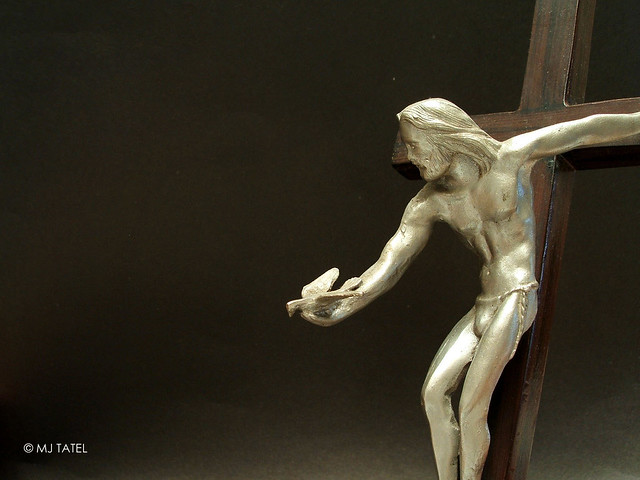
 [picture of figure on cross with dove alongside a sunrise photo], we consider the specifically Christian dimension.
[focus on picture of figure on cross offering a dove] Jesus's teaching is heavy with love of neighbour, love of enemies, forgiveness. His ministry is full of reaching out to the despised and the hated, and his last earthly week is full of choosing not to offer violence but rather to absorb the hatred and violence offered. For these reasons the church of the first three to four centuries consistently teaches that Christians may not be involved in violence.

There occurs in the fourth century a growing rapprochement of the Roman Empire with its Christian minority which eventually leads some Christian theologians developing just war theory
[see green table labelled 'Just War Theory'] which sought to allow Christians to participate in the defense of civilisation while maintaining moral limits and building in mitigations. This is consolidated by the emperor Constantine who supposedly has a vision [see picture of sunrise]
probably prompted by a sun-halo like in the picture. But overlaid by hearing a voice
[close in on next picture -red cross and words]  saying in hoc [signo] vinces -'Conquer by this sign'. Constantine then put the sign of the cross on his army's armour and went on to win the battle. He politically then makes Christianity a licit religion and sets the Roman Empire on a course to absorb Christianity and the Church to legitimise the Empire (and its violence).


The next thing we know on this trajectory is that not only is the Church giving comfort for the doing of limited violence but developing a holy war theology which creates the possibility of crusades -violence as a way to extend the church's mission. By this point it becomes obvious that the limited allowance of deadly collective violence by the just war theory was indeed the top of a slippery slope into warfare as an instrument of policy for the church. In effect overturning the teaching and example of Christ. And that is how we end up with troops killing and maiming each other each side in the name of Christ, justice and 'peace'. Truly, the decision to offer any kind of justification for violence is likely to be increasingly loosened in scope and ways are found to express reasons for taking up arms in terms that look like they might be 'just'.

On not feeding the four horsemen.
[Painting of the four horsemen of the apocalypse]. The ANE creation myth is essentially a myth of redemptive violence: a way of proposing that violence is what effects important change and brings about good, the goodies must employ violence to make sure that their 'good' values prosper and prevail. It is a myth that is propagated in many -most- Hollywood films. It encourages us to think that means are not necessarily directly or inherently related to ends; that we can create good by doing harm.


Our societies are held captive by the Myth of redemptive violence. The Judeo-Christian traditions question that. Jesus' teaching very strongly undermines it. Our faiths have been co-opted by the MRV and our imaginations colonised by it. We must stop sanctioning violence, full stop. Only then will we be able to stimulate imaginations to envisage solving problems peacefully. Only then will we be committed enough to begin to tear down the automatic justifications and misleading chains of reasoning fed by the relentless MRV-form narratives spilling out of the media. 

If we allow ourselves to think that violence could sometimes be justified, very soon we will find that we are defending horrors such as firebombing, dropping nuclear bombs, waterboarding, drones ... the list will grow and grow.


09 May 2009

Play and power: the Jesus way

I've long felt that Walter Wink's take on this was broadly correct: it makes sense of a strong current in Jesus' and even Paul's teaching and examples. However, seeing Wink's article here was helpful in making a connection to the Play Ethic and all that stuff.How turning the other cheek defies oppression | Ekklesia: "This unmasking is not simply punitive, however; it offers the creditor a chance to see, perhaps for the first time in his life, what his practices cause-and to repent.
Jesus in effect is sponsoring clowning. In so doing he shows himself to be thoroughly Jewish. A later saying of the Talmud runs, 'If your neighbour calls you an ass, put a saddle on your back.'
The Powers That Be literally stand on their dignity. Nothing takes away their potency faster than deft lampooning. By refusing to be awed by their power, the powerless are emboldened to seize the initiative, even where structural change is not possible. This message, far from being a counsel of perfection unattainable in this life, is a practical, strategic measure for empowering the oppressed. It provides a hint of how to take on the entire system in a way that unmasks its essential cruelty and to burlesque its pretensions to justice, law, and order."
I seem to recall Harvey Cox's Feast of Fools makes a similar point somewhere ...

Anyway, the creativity in protest is definitely a Christian way by this, and to exercise moral imagination that seeks third ways, surprise and redefinings of situations seems encouraged. It certainly helps me to see something of the spirit of Christ in some of the actions and lifestyles of some of the 'alternative' people I have had the privilege to share time, space and good conversation with. Sometimes we need to take account of Christ's words "You are not far from the Kingdom of God" -though sometimes recognise that because we, the church, have not been/embodied Good News, to say so might not be heard as an encouragement!

The Science And Spirituality Of Addiction

 What drew me in was the collocation of science and spirituality in the title. I'm also a little interested in addiction through having ...