Showing posts with label religion. Show all posts

17 November 2023

Religious fandom and the Sermon on the Mount

 The starting point for this reflection is one of this morning's lectionary readings. Matthew 6:1 Beware of practising your piety before others in order to be seen by them; for then you have no reward from your Father in heaven. 

It occurred to me that this might connect with the odd-moments thinking I sometimes do about fandom and piety. This arises from noticing that there seem to be some similarities between the behaviours and attitudes of sports fans (or fans of media celebrities) and some religious people. So I find myself occasionally musing about what characteristics fandom and piety may share. Are fans' attitudes a kind of piety, are attitudes of religiously pious people a kind of fandom?

There is, I think, a very real 'pride' and desire to assert a religious identity, perhaps especially among those who are relatively new to a faith or who gain a renewed sense of its goodness and helpfulness -for whatever reason. I've tended previously to interpret this verse and those that follow as relating mainly /only to those who are seeking human validation or status: using religion as a way to gain esteem socially. But maybe also it applies to those who are wanting more to assert identity or even to impose their religious sentiments on others? The feelgood factor of religious fandom, like football supporters thrusting their team and their love for it in the face of any around them. Especially when in groups or feeling themselves to be representing a group. I used the word 'pride' earlier, it is that but it's also bound up in a kind of joy, and a fulness of self-esteem bolstered by the identification with something bigger than themselves and further by the community of others similarly elated.

There's a much earlier reflection on this blog too.

12 January 2018

Chaplaincy: secular and global ministry?

I was recently asked how I thought about chaplaincy as a Christian minister given the secular context, multifaith nature and impacts of globalisation. This was my response. Perhaps I should remind readers that I'm in Britain working as a chaplain in a university and we work within a framework of human rights legislation particularly equality and diversity.

It’s not quite right to say that chaplaincy is a statutory requirement for equality –although it seems that most HEIs interpret it in a way that chaplaincy seems to be a main way to try to address the appearance of religion (including non-belief) as a protected characteristic.
I’m also keen to question the terms ‘secular’ and ‘secularisation’. It is often seen as a bad thing but we should recall that some of the impetus for it grows out of the European religious wars following the Reformation –it became evident that moving religion (indeed, in the fullness of time any strong ideology) away from absolute power moved it away from the apparently strong temptations to murder opponents. One of the things about the Baptist and many other non-conformists is that, as people who were mostly persecuted, they have a strong ethos of separation of religion and state and of religious tolerance –it is interesting to note that the oft-persecuted Shi’ite Muslims tend in the same direction. 
In addition to this practical response to abuse of power by religious agents (and later by agents of ‘secular’ ideologies) there are theological reasons for supporting secularism at least of a certain kind. I’d note here the distinction between hard and soft secularism and I’d making a theological case for the latter. Hard secularism is a way to characterise anti-religious ideology –the immediate aftermath of the French revolution is an extreme example: the replacement of a religious ideology of governance by anti-religious. Hard secularism can be more tolerant than that: modern France and Turkey operate hard secular regimes (in theory) by excluding all religious expression from the public sphere (government, education, publicly owned space etc –hence debates about hijab-wearing or crosses on classroom walls).
Soft secularism (in theory the state of India) recognises that people come into the public sphere with religious identities and commitments and rather than excluding them, seeks to be impartial about their claims (perhaps the USA is this too) and to make sure that they don’t become co-ercive.
I think that latter approach can be defended theologically. The idea of doing as you’d be done by in Jesus’ teaching seems to indicate that if we would like the right to practice our faith, we advocate for all to have that right –even those who are our ‘enemies’. If we want to be able to commend our faith to others, we must allow them the same privilege. Furthermore, as I read the teaching of Christ and of Paul I find a scepticism about religion particularly where it becomes a legalistic thing (and state religion has to be legalistic –by definition). I’m also interested to note that in the first chapters of Genesis the duty of humanity is to tend creation and there is no temple. The impetus towards religiosity flows from the conversation with the serpent and its aftermath. So I’m in favour of trying to help the churches to think about secular life as the arena of Christian mission and effort: our tending of creation and society is our religion. Chaplaincy might be a way to help promote this insight among the churches.
This impacts on chaplaincy in several ways in my view. One is to alert us to our own faith’s impetus towards treating others hospitably, with dignity and to do so particularly when they are in some way our ‘enemy’ (that is, they oppose us or what we stand for). This does not mean downplaying our distinctive message and its challenge to consider Christ as the one to be followed, it means doing that in a way that is appropriate and respects the humanity and dignity of others.
At its best an organisation’s policies and systems are ways to make sure that people are dealt with even-handedly, with justice and dignity. So in broad terms, as chaplains it is appropriate that we abide by an organisation’s ethos etc when we work with it. It is also appropriate that where it becomes clear that polices and systems are prejudicial, harmful or unjust, we should find ways to challenge that. Ways that will be effective. Sometimes that means, as in all small-p political matters, being prepared to be patient and pragmatic, finding allies and seeking to build momentum for change and finding right timings. All the while trying to find the best ways to support those who are badly done-by and to advocate for them in the best ways we have at that time. This is a dimension of the prophetic side of chaplaincy. I think that the personal spiritual challenge for chaplains is to love the institutions and their people appropriately –that is without it becoming a wilful blindness to faults and especially faults that can be rectified. I think also it means being realistic too about human nature which is also capable of subverting the best schemes. So sometimes the prophetic dimension of chaplaincy could involve being, in effect, a whistle-blower or supporting those who are speaking out about misuses of power and privilege. We should also be wary of our own tendencies to subvert the good and cultivate a certain lightness to our perceptions and agenda and practice self-examination.
From where I am at the moment, globalisation appears to mean a series of mechanisms for allowing capital to maximise its returns while creating a race to the bottom for labour. Universities have been subjected to this regime. I’m convinced, theologically, that human systems and organisations are purposed by God to serve human welfare (which also entails the welfare of the ecosystem) and so I’m not happy about the way that a particular set of views about marketisation and metrics have come to dominate the running of Higher Education because I think that in the longer term they tend to have negative impacts on important things like human welfare and quality of education. So I tend as a chaplain to try to encourage questioning of systems that ensue from that kind of globalisation agenda. (That's not to say that some aspects of HE didn't need some shaking up -there are positives things about improving teaching and research and putting the student experience much more at the heart of thinking -however, I dissent about the means currently employed ostensibly to achieve these ends).
I also try to encourage human-welfare-centred interpretations of legislation and policy. For example in our HEI, I support vocally and in meetings, interpretations of the Prevent duties that focus on safety of students rather than more authoritarian and politically paranoid interpretations. I also try to encourage thinking based in properly thought through evidence rather than prejudice and ill-founded fears.


27 April 2017

Mindfulness and men and spirituality -or culturally masculine at least

I've been leading mindfulness and more general meditation for a while now; quite typically two or three times a week in the university I work with. Sometimes further afield. One of the things I had realised recently was that the groups' gender composition reminds me a bit of the churches I work with; more women than men. There are some men who come along but typically there are women only or only one or two men in the groups. And it turns out that in research on mindfulness, there are gendered differences which may be related to cultural gender constructions.
... stereotypically, women ruminate and men distract," Britton said. "So for people that tend to be willing to confront or expose themselves or turn toward the difficult, mindfulness is made for [improving] that. For people who have been largely turning their attention away from the difficult, to suddenly bring all their attention to their difficulties can be somewhat counterproductive. While facing one's difficulties and feeling one's emotions may seem to be universally beneficial, it does not take into account that there may be different cultural expectations for men and women around emotionality."
I'm interested in the further research and thoughts about how to identify the composing elements of mindfulness and to package them in a way that might be more accessible to men who actually do fit to some degree the cultural stereotypes of masculinity.

Obviously, I'm wondering whether there may be factors in common with the churches' experience of gender engagement in worship and other activities. In my mind too arises another set of images: Muslim prayers where the situation is pretty much reversed; men pray in our quiet rooms, not so many women do. And I have got to wondering whether the 'forcible' engagement of men in prayer by tradition and scriptural interpretation actually acts as a kind of cultural bulwark to encourage men to be religious. I guess in asking that it seem obvious that the answer must be 'yes' (though there are nuances and caveats to be recognised). I'm also reflecting on my time as one of the conveners of an alternative worship group which was very much weighted towards men participating. Not deliberately, it was just something we noticed after a while. We wondered whether in that set up it was something about using technology and deploying hands-on activity as part of the liturgy which some was enabling of men in the cultured-masculinity of our society.

All of which has me interested to see how the further research works in terms of finding ways to engage men. It's a health and wellbeing issue for that research but I wonder whether there may be insights to be gained for the churches too.

28 May 2016

Advent: do we need to reclaim the season?

Okay, so the season is well over, but perhaps, while it is fresh in our memories, we could think about how to improve things into the future?
The article has some interesting thoughts but I do want to ask who is the 'we' here? The article seems confused between thinking about 'we' as a wider society and 'we' as Christians.
... some churches in the USA are exploring the idea of Extended Advent�– reconnecting with the fact that Advent used to be a season of seven Sundays until Pope Gregory VI cut it down to four in the 11th�century ( Christmas without Advent is cheating: Why we need to reclaim the season | Christian News on Christian Today)
To be fair, Advent has had several forms in the western churches. And today in the East, it is 'little Lent' and practised as a forty day season of preparation. The Celtic church seemed to have the same forty-day season. However, in the contemporary world, we might want to recognise a huge tension. While the inherited religious tradition has twelve days of Christmas starting on 25th December, the culture around about tends to see the 25th as the culmination of the season, perhaps supplemented by New Year's eve.
So strategically, we might be better to recognise that Christmas season begins earlier and have our more Lent-like preparatory season before that. I would suggest that pretty much all the current Advent season is, in effect, the Christmas season with the parties, the food and coral services where the incarnation is read about and sung of.
This would mean that perhaps the Kingdom Season should be treated as a preparation season. Interestingly its lectionary themes do tend in that direction. So, perhaps we should start 'advent' in November and shade into Christmas season in early-mid December. Encourage fasting in November. Perhaps consider a Ramadan-style fasting in that time (the shorter days in the northern hemisphere might make this not to burdensome).
Perhaps it is time to encourage experiments about all of this. including how to mark the various bits and phases with liturgical colours, music and ceremony.

01 January 2016

Religious Children show up as less altruistic: but why?

I found myself very intrigued by this report of research. Partly because it sems to contrast markedly with a lot of research which indicates that te pattern is reversed in adults who tend to show up as having greater altruism and empathy where religion or spirituality is positively involved in their lives.
Family religious identification decreases children’s altruistic
behaviors.Religiousness predicts parent-reported child sensitivity to
injustices and empathy.Children from religious households are harsher in their punitive tendencies
The best explanation by way of working hypothesis to bridge the gap might be to investigate how far it might be to do with children growing into their faith and negotiating identity. Also the forms of religiousness in the background might need closer investigation and by contrast the social and political views of the groups involved: I'm wondering how far 'religion' in parents correlates to socially conservative expressions of faith to. What if we controlled for social attitudes and then investigated whether that correlated. Would socially conservative and non-religious be different to their religious counterparts? Would socially 'liberal' non-religious be different to theirs?
Once we know things like that, we might be able to assess more helpfully.


The Negative Association between Religiousness and Children's Altruism across the World - S0960-9822(15)01167-7.pdf: Family religious identification decreases children’s altruistic
behaviors

11 April 2015

Fan-damentalism is uncore

An internet buddy in many things missional, Matt Stone, recently wrote in a post on Facebook something that reminded me of posts (one here and the other here) I'd made before on this blog and occasionally I find myself continuing to mull over.
Seriously, I think we need to start challenging the narrative that fundamentalists are hard core Christians. On the contrary I think they're flakes who are in desperate need of a late night Nicodemus encounter.
 It's an interesting idea and i think it touches on my fandom thoughts. I responded:  
Yeah. I've been thinking about the phenomenon in terms of 'religious fandom'. I'm trying to get a handle on why it is that we tend to regard the 'fans' (recall it's short for fanatics', arguably) as somehow the norm. There's something about religiosity and identity involved, I think  which is actually contrary to the genius of Christian faith.
I find Bob Faser's definition of fundamentalism to be quite helpful in picking up the main facets of the phenomenon as found in people...:
 ... who combined an ultra-conservative approach to their faith, a puritanical approach to personal conduct, a sympathy for authoritarian political movements, and a contempt for people of other faiths, non-religious viewpoints, and less “intense” versions of their own faith.
To be fair that is how he characterises it for the 1990's. He reckons it has been overtaken by " a particularly one-eyed approach to reality" which could include devotion to a sports' team. And so connects with my intuition about fandom and certain kinds of religiosity. In terms of the 90's definition, it could be translated into fandom terms (and Bob has some interesting further comments here): a chauvinistic devotion to their team, an emblematically commited approach to personal style, contempt for those who follow other teams or don't follow their sport at all and some disparaging views about those who are mere 'followers'.

I am intrigued by the way that we can identify some kind of likeness across the domains. I am intrigued that there are people who in a religious context act like fans of the religion. They are blinkered, derogatory towards people with other faith commitments or even towards those whose commitment seems lesser. It seems to me that this crossover between domains indicates that it is a phenomenon more rooted in psychology than in spirituality. In this case I think it is about identity formation empowered by the excitement of new discovery (analogous to new love, I suspect).
The common means of identity formation are to do with demonstrating you are "one of us" and partly this is achieved by knowing who is "one of them" and who and what will imperil your insider status or aspirations to it. In these ways dressing or accessorising rightly, being seen in the right places at the right time and displaying the correct attitudes to people and issues deemed relevant.
I do agree with Bob in the second of the posts I reference above, that the real 'fundamentals' of the Way of Christ are not the kinds of things typical of identity formation by in-group and out-group demarcation. Rather they are love of God and neighbour, skepticism towards religiosity, wealth and power (because they are often intertwined in a bad way) and commitment to paying good attention to those deemed 'outsiders',
The thing that the Christian 'fan' and the follower of Jesus have in common is devotion to the Christ. In the former case, the devotion is led by psycho-cultural understandings, in the latter, the counter-cultural route is realised and informed by a self-wariness about the in/out psychology. In practice, many of us have both going on at once, especially in the early stages. Part of faith development is about untangling the two dimensions and learning to temper the fandom reflex with the follower transformation.
This probably means that we should reflect on nurture, baptism preparation and formation beyond the initial instruction phase for 'converts'. Currently, it seems to me, there is a tendency to ignore or even encourage the fandom responses. What we probably need to do is help new Christ-followers to be aware and wary of the fandom phenomena and to help them to form attitudes very much centred in loving God and neighbour in a self-aware way leading to wisdom.
I can't help wondering whether in some church circles, the fandom response is actually thought to be somehow a mark of true spirituality and so established believers are being held in fannish attitudes and behaviours which tends to produce wierd, holy Joes who are incapable of bearing witness to Christ because what they want to pass on is shouted down by how they behave.

11 January 2015

Jesus is Charlie ... ?

I keep finding when I see the signs on television news, that some of them I catch myself reading as "Jesus is Charlie" and then having to correct myself. I guess years of interacting with texts where the letters "Jesu" are either a version of the name or actually are the majority of the name Jesus has conditioned my text processing.


So then I have found myself asking whether there is a sense in which we might assert "Jesus is Charlie"?


Now I think that one of the difficulties with the assertion can be inferred from the cautionary article here: I Am Not Charlie Hebdo - NYTimes.com: which suggests,
Most of us don’t actually engage in the sort of deliberately offensive humor that that newspaper specializes in.
And so many of us would find on the basis of that kind of characterisation that it feels difficult to associate Jesus with it. And certainly as a Christian I tend to find that, trying to work out what it is to love my neighbour, I am most often working out how not to offend because my biggest challenge in many cases is to dial down my tendency to be relatively inconsiderate of others' feelings.

But then I'm challenged by some of what the gospels show of how Jesus spoke of and spoke to some people. "Whitewashed tombs" and "hypocrites" were almost certainly offensive. At one point Jesus is told "When you say that, you insult us also" and he responds by rubbing it in for his interlocutors. So it is possible that in some ways "Jesus is Charlie" in terms of offence.

However, I think it is important to notice what seems to me an important distinction. The cartoons in Charlie Hebdo often/sometimes take a pot-shot at communities who are in a minority and are relatively powerless and marginalised. Like Muslims in France. And these same cartoons reinforce negative stereotypes in a way that we/I would find difficult (and Joe Sacco's cartoon about this is instructive) to bear were they to be about black people or Jewish people today.

On the other hand, what I think I see Jesus doing is speaking against the powerful and the wealthy and against those who, in a sense, should know better in spiritual terms and who have and inherit a history, in effect, of using their privilege hypocritically to make the lives of many people harder and to keep them from connecting with the God who cares and critiques such use of privilege. This amounts to a kind of bullying and in more corporate terms that becomes systemic violence or institutionalised prejudice and oppression. Unfortunately, if Joe Socco, is right, there were times when the satire of Charlie Hebdo bolstered the prejudices and justifications of the powerful at the expense of the marginalised. In this sense, then, Jesus is not Charlie.

I guess we should remember, though, that the point of 'Je suis Charlie' is to assert a solidarity in freedom of speech and an implied condemnation of those who take their insulted-ness to a murderous extreme. So some of this could be taken to assert that Jesus should have been free to insult as part of his teaching. However, it seems to me that the rule of love implies not adding to the burden of those who struggle with powerlessness and oppression but that it does sometimes call for pricking the bubble of those who profit (often literally) by oppression. And I guess that is where I, and probably you, differ from Jesus: our ability to give right offence is compromised by lack of self awareness, unconscious privilege-bearing, bolstering self-image through group identity ... we are likely to let such things derail our other-care into other-disrespect and stereotyping.

But I suppose that we have to deal with the question of whether insulting a group of oppressive and powerful people is loving towards them. This question amounts to asking whether Jesus was truly loving when he did such things: is it possible that we can give what I called above "right offence". It sits ill with my cultural mores: insulting someone is not 'nice'. On the other hand, letting someone get away unchallenged with making life worse for others is also not nice. In a situation where two neighbours (both of whom we are to love) are before us and we find that one of them is making life miserable for the other, we may have to say or do something which is not 'nice', we may have to commit a social faux pas in order to begin to help them to change. And, we should note, that if "your brother repents" you have loved them well. There can be no doubt that the God who loves both is delighted by one sinner who repents, both because the oppressed neighbour begins to be released from their bondage and because the oppressing neighbour becomes a better, more humane person.

In such circumstances, telling the truth in love may be insulting by the standards of prevailing social mores. However, we should note that different cultures evaluate such mores differently: Dutch, French or Israeli honesty can be excruciating in English or Indian contexts. Then too, even taking that into account, there may be times when pricking the bubble is the only way to get round the defences, justifications and ideological ramparts the oppressor has in place. So I can accept that insulting privileged people with a view to nudging or even hurrying them towards repentance is potentially a loving thing to do. (I also accept how easy it would be to let that be an excuse for downright disrespectful rudeness).

So where Charlie Hebdo attempts to prick the bubble of privilege, the Jesus is Charlie, as well as not being Charlie where Charlie gives succour to bullying by the privileged. Given my propensity to mistake my own self-justification for rightness as well as sometimes to get it right, probably moi, je suis Charlie: for good and ill.

There is one other layer that I think we should consider before leaving the topic: Jesus's bubble-popping got him killed. So there is a sense in which Jesus shares something with those assassinated last week. These deaths, whatever else we might say about them (and I lament them and feel for those bereaved by them), might be read alongside the political dynamics that got Christ killed. Interestingly, in both cases, there were religious as well as political justifications involved. Jesus was killed, in part, by religion-as-ideology. I'm not by that saying that the thinking of these men is representative of Islam any more than I would say that the Spanish inquisition represents Christianity properly: in neither case do they speak or act for the spiritual paths as a whole: they in fact fail to exemplify them at anything like their best.

PS
I've not checked this out but I've been assuming that the name of the magazine is  composed of a reference to Charlie Chaplin and an abbreviation of Hebdomedaire meaning 'weekly'.

29 December 2014

Secularities and religions

As a brief way into helping managers and others at my university to think about how the university should handle matters of religion, I have tended to use a distinction I learnt from Phil Lewis who was our diocesan interfaith advisor when we were in Bradford. It  has proved useful in helping people to think about what they mean by "secular" when we talk about the university as a secular institution. What appears to be the default in many people's minds is that secular means to exclude religion. In Phil's binary this would be "hard secularism" and the explemplar national exponents would be France and Turkey who work to remove religious symbols and ideas from the public square. Religion can only be practised in private and can have no influence on public affairs.

The contrast, and the sort of stance we try to encourage people to take, is 'soft secularism'. The national exponent of this would be, in theory, India (though this is under threat) where the state remains impartial about religion but recognises that citizens come to the public square as, among other things, religiously-identified actors.

In this article, Building Ethical Bridges in a Secular Age | Comment Magazine | Cardus,  a three-part distinction in made using the words 'freedom' and 'religion' but varying the adjective between them.
  • Freedom of religion—the state does not impose a religion on its citizens: there is no state religion. 
  • Freedom for religion—the state does not restrict the free practice of religion by its citizens. 
  • Freedom from religion—the state excludes religion and religious voices from the public square, in particular, in relation to law and public policy making.
I think that this is a useful way of thinking about it in a secular organisation. The final point, of course, is pretty much the "hard secular" approach. The first two are both "soft secular" approaches. The first point is about impartiality: not favouring one above the rest. The second point is about allowing all expressions to flourish. These first two points are complementary. However, the human rights approach does restrict the second by making clear that expressions that infringe the rights and freedoms of others are not covered. This reminds us that there is, in fact, a fine line between allowing religious expression and one or more of them becoming an imposition on others.

Beyond this the referenced article makes a case for a post-secular approach.
one of the arguments is this:
... we should point out that everyone has beliefs, so the argument that those with religious beliefs should be excluded from the public square because of those beliefs is discriminatory and anti-democratic. The new option, "none," in answer to the survey question about religious belief, reflects a belief system.
One of the reasons I became convinced of the importance in broad terms of a soft secular approach was noting how the hard secular approach was, covertly, an imposition of a particular viewpoint which has a bearing on religion. As such it functioned in a quasi religious way. In the European human rights framework, religion is paired with philosophical viewpoints. This would include "hard secular" approaches. To be truly pluralist and respectful of the rights of others, the hard secular approach has to be eschewed: it ends up imposing a particular religiously-significant stance on people who conscientiously may believe that their faith is supposed to have a public-square face.

It does require though, an acknowledgement that there are no easy answers. At least with the hard secular approach there is a clarity, even if it can be somewhat oppressive to religious actors. With a soft secular approach, the messiness of understanding, dialogue, compromise and negotiation is implied as no single solution will fit all societies and communities and over time the actors and circumstances and interpretations change, meaning that we will be engaged in constant monitoring, listening, learning and dialogue. But then, isn't that what human society is about anyway? Why should we expect religion and spirituality to be different in that respect?

30 June 2014

Chuggers and ruggers: Good News appears bad news

I've been think a bit lately about being approached in the streets beacause while it doesn't happen to me a great deal, it could. You see, in the streets round where I work, there are often chuggers (charity muggers) and recently Mormons and JW's. Now the reason I don't get approached is that I take evasive action quite a lot. I'm aware of taking trajectories as I walk to put me in a position to be less likely to be approached and avoiding making eye contact. When I am addressed directly, I tend to say things like "I'm not interested" or "I'm in a hurry" (which is true when I say it) or "no thanks".

What I'm mostly reflecting on, though, is why I don't want to engage. An article from a few years back identified one aspect:

Some people though not as many as you might think consider "chuggers" to be an infringement on their right to walk down the street without being accosted. They believe chuggers or face-to-face street fundraisers, in plain English guilt-trip people into giving, while denying donors the opportunity to give to the charities they want to at a time of their choosing.

All these "asks" have the potential to make the donor feel a bit guilty if they choose not to give. But, as any fundraiser will tell you, if you don't ask, you don't get: people rarely give spontaneously to charity.


Certainly part of my inner reaction is to the guilt-trip implied: I find myself composing possible justifications, "I already give 10% of my earnings to charities ...". I think that self-justificatory response (never actually said except once when someone came to my door) tells me that I'm feeling that they are making a moral claim on me which I feel that I would be judged negatively -and wrongly- on (and of course I'm projecting that: they may not be judging me at all). That's somewhere in the vicinity of guilt. If the article is right and lots of people don't actually feel that way, then clearly that' mostly my problem. On the other hand though, the article describes by implication a number of avoiding or deflecting tactics that are clearly in common enough use to make me think that a reasonable number of us don't want to engage. In fact some of the discussion leads me to think that a number of people are quite anxious or defensive in brushing off approaches.

I think that the defensiveness could often be about guilt arousal or at least feeling implied judgement. By that latter term I mean that we are being put into the position of appearign to refuse to help sad soulful kittens, or more seriously, hungry or abused children or whatever the charity is concerned with. That is damaging to our self-image if we consider ourselves averagely or better-than-averagely empathic and concerned about relieving suufering.

I found another well expressed couple of paragraphs on the discomfort of avoiding chuuging:

Whilst I am generally in favour of the concept of charity and I understand charities need to promote/advertise in order to raise revenue, I have to say I have found this aggressive on the street promotion quite intimidating and annoying. I wouldn't have minded perhaps if it was just a one-off event or even a couple of days but it has been more like two weeks solid now that they've been there. And I can't get away from it as at the moment I have to go into town three days a week for hospital appointments. So three days a week I have to walk down these streets and be faced with up to five people in a row trying to accost me as I walk by - if the first one doesn't stop you, the next one (5 metres further on) will be calling out to you, and then the next etc etc etc.

It's reaching the point where I dread walking down those streets. I hate being accosted and I hate having to give them an excuse why I can't/don't want to stop - and some of them are very persistent and even when you say, "Sorry, I can't stop," they carry on cajoling, saying, "Just for one minute..." etc. I already make monthly donations to charities that I choose to support and I kind of resent being made to feel uncomfortable on a nearly daily basis by charity workers hassling me! I can imagine it must be even more annoying for people who work in the area and have to go out on those streets every day to buy lunch etc! I dislike anyone (market researchers, people trying to sell me things etc) hassling me on the street but when it's for a charity, it somehow makes you feel guilty for rebuffing their approach!

Pasted from <http://community.babycentre.co.uk/post/a7173445/wyoo_charity_promoters_on_the_street> (see some of the responses to the article at the end of this post)

I note the words of response: "intimidating"; "annoying"; "accost"; "dread"; "having to give an excuse"; "cajoling"; "resent"; "uncomfortable"; "hassling". Here the additional thing seems to be about the inconvenience of it. This underlies my own 'busy' responses: I've actually often gone out for particular purposes, I usually have limited time (often I'm going to an appointment or catchin a bus) and not just sauntering around looking for something to do.  I think the writer is right about the guilty feeling when it's a charity and I can imagine for some people that on top of inconvenience might give rise to the insulting and offensive responses implied in the Guardian article.

It's not quite the same with ruggers (I just made that up: religious muggers). I note in that last quoted section, that the more general statment which applies to market researchers and sales-pitchers (they don't mention religious propagators but I imagine the same sort of reaction) are disliked for "hassling". I notice that my own inner response to market researchers is less anxious and evokes less self-justification inwardly. Perhaps because I don't see their appraoch as making any claims on me.

So, what about ruggers? I have to admit I've been one in the past. We might argue that it's not asking money from anyone but rather offering a great gift but that's not really how it comes over. In reality most people frame an approach from a rugger in the ame sorts of ways: at beat they might be seen as a market-researcher and quite often, judging from the reactions, ruggers are seen more like chuggers. I think I'd have to argue that on the whole approaching people in this way is not embodying "good news" and because of the largely negative framing of it is in fact counter-productive.

I have a further concern in this respect. If a religious group in a university was doing this, what should be done, if anything? Well, it seems to me that there'd be a right to promote one's views and indeed ones events. On the other hand most policies on harrassment and bullying say, in effect, that there's a prima facie case to answer if someone feels tat they have been harrassed or bullied. Looking back at the reactions I've discovered in the articles quoted above and in my own sel-reflection, I'd say that there is a high risk that if someone wanted to object and claim harrssment, the kinds of words used above would make it seem very likely that they might be judged to have a point. I suspect that the reason that universities have 'no proselytisation' rules and restrictions on leafletting is driven largely by the sometimes fierce dislike of many people to being approached by strangers with an agenda. It's not directly or only a religious matter, it's a matter of neighbourliness
-and that implies a theological evaluation rooted in doing to others as you'd have them do to you ...

Some other responses from <http://community.babycentre.co.uk/post/a7173445/wyoo_charity_promoters_on_the_street>

I don't want to have to look a person in the eye and justify my skintness, I don't want to have to lie about why I cant stop and speak
----------------
 It is invasive for people who live and work in the area to be stopped every day when they're just trying to go for lunch or whatever.
----------------
I hate being hassled in the street and think it should be outlawed, it's basically intimidation and bullying yet as long as they have a little badge on saying they have a license to be on the street they are allowed to do it.
---------------
 i tried to carry on walking but he blocked my path. i said i was in a rush but he said it wouldn't take long. i let him talk and when he'd finished his spiel i said i couldn't afford to have another direct debit going out of my account. he said 'not even for £2 a month?' i said no, and reminded him he'd actually been asking for more than that. then he looked down at my shopping bags judgingly and said to me 'having a nice shopping spree?' i was livid! i simply said that not that i had to justify myself to him, but i was shopping for the first time in over a year and was only doing so because i was pregnant and none of my clothes fitted anymore. with that i walked off.

21 November 2013

Religion, war and peace -A Christian contribution to an interfaith event

Last night, I was one of the speakers at a Voices of Faith event where a Jewish, Muslim and Buddhist also presented their own takes on the topic. I used a prezi to navigate through the 15 minute presentation. I thought I'd give a write-through of the content (bearing in mind I had to abbreviate my presentation to fit into the time available so this is a filled-out version with a bit more background and explanation in it. the prezi is here.

First off 
[dove image made up of weapons' silhouettes), a note that this approach to war and peace is my own reading of the Christian tradition, it is also one that takes a rather different 'tack' to what might be expected in the interests of trying to make a proposal which could be more than a simple exposition of a Christian 'take' but rather something that invokes the nature of Ultimate Reality to invite us to consider how our respective faiths construe that in relation to the issue of violence. So I'm interested not just to give a basic exposition of Christian scriptures and framing them within the development of Christian thinking over the following centuries, but rather to seek something that opens out what I take to be the theological deep-structure in relation to human history.

Christmas Truce 
 [Picture of WW1 Christmas Truce handshake with swapped soldierly parapernalia]. Christmas Eve 2014 sees the 100th anniversary of one of the most remarkable events in the history of warfare: the unofficial Christmas truces of 1914. They commonly began with German soldiers and officers putting up Christmas trees, shouting or writing Christmas greetings, and singing songs recognisable to their British counterparts such as Stille Nacht (Silent Night). From these beginnings troops met in no-man’s land to bury their dead, exchange gifts and souvenirs, share festive food and drink, give cigarettes and cigars, sing and entertain each other, swap names and addresses, conduct joint Christian services, and even, it is rumoured, to play football. These were not isolated incidents but were widespread right down the front from the North Sea to Switzerland, made possible in part by shared traditions of Christian celebration. It was a hopeful moment of recognition of common humanity and a rejection of the cruelty of industrialised warfare pursued by rulers in a deadly game of global imperial competition for territories and resources. It was quashed by orders backed by threats, and by replacing troops with men ‘untainted’ by the Truce (including soldiers from the Empire who didn’t share a tradition of celebrating Christmas).


WW1 was a war arising from Imperial ambitions clashing -principally those of Germany on the one hand and Britain and France on the other. It was precipitated by a failure of the deterrence supposedly offered by huge military alliances and offers of mutual aid in literal co-belligerence. At the heart of it were supposedly Christian nations -the next picture frame focuses on the German troops' belt buckle with the words "Gott mit Uns" which means 'God with us' and while the British didn't have a direct equivalent in terms of clothing it is clear that many British propagandists and opinion-formers held a similar view -that God was keen for the British to win because they were the guardians of Christian civilisation against German barbarism. The mirroring of each others' official 'theologies' of war and nationhood is tragic and would be laughable if it weren't what actually happened with such dire consequences. Obviously, they couldn't both be right.


My question in this forum is how they ('we') arrived there? How did two supposedly Christian countries both with good civilisational credentials end up demonising each other and slaughtering one another and claiming it was God's will? Worse yet, we should recognise it's not just Christians implicated in this. In an interfaith understanding event, we should also understand that troops on both sides held different faiths and also secular and atheist views. On the British side, one of the means to put a stop to the informal truces at Christmas in 1914 was to draft in other-faith troops from parts of the Empire that didn't share the Christian sentimentality about Christmas.


A Myth and a riposte [picture of an Ancient Near Eastern deity and a piece of art depicting a visual interpretation of the seven days of Genesis 1-2:4]. Here I press on into the unusual turn of my exposition, looking at something more ancient that most of our religious traditions.

There were two ways of viewing humanity in relation to our purposes on earth and relatedness to deity in the Ancient Near East (ANE). Both deal with origins, ostensibly: chaos and order; what is the human place in the cosmos; what are we humans here to do; what is authority in human affairs? But each have a rather different message for us as humans.

Ancient Near Easter myths:
[picture of ANE deity in full armour holding thunderbolts] though these varied in characters and the detail of plot lines, they tend to tell stories which indicate that order is created out of chaos by the might of the gods and that order is establish and maintained by violent actions. Human beings are, in this kind of schema, made out of the offal of the slaughtered defeated god (who represents chaos) and are made in order to do the work that the gods don't want to be bothered with. So we're getting a picture of humans not being high in the value and dignity stakes -we're almost afterthoughts made from disrespected  materials to slave for the gods and their representatives on earth (the kings and priests). For our purposes though, we should note that the created order is violently produced: ultimate reality is violent, 'agonistic'.

Genesis 1-2:4
[picture of seven thin panels hinting at the 7 days of creation] seems (to me) to be telling a counter-story emphasising that creation is founded in an original peace rather than violence, and that we humans have a dignity since we all image God -a view which automatically flattens hierarchy and deligitimises kingly and priestly claims of privilege. We are also created for rest as well as to participate in the work of God.

So there are two world views on offer, and I would argue that these are still a fundamental choice set before us. Do we believe ultimately reality is about love, peace, co-operation, dignity and so on or do we believe it is ultimately about self-assertion, violence, hierarchy, winners and losers. Every time we claim that there is no choice but to do violence, we are in effect asserting that ultimate reality is about violence rather than co-operation: division rather than relationship.

Moving from ANE to Jesus
 [picture of figure on cross with dove alongside a sunrise photo], we consider the specifically Christian dimension.
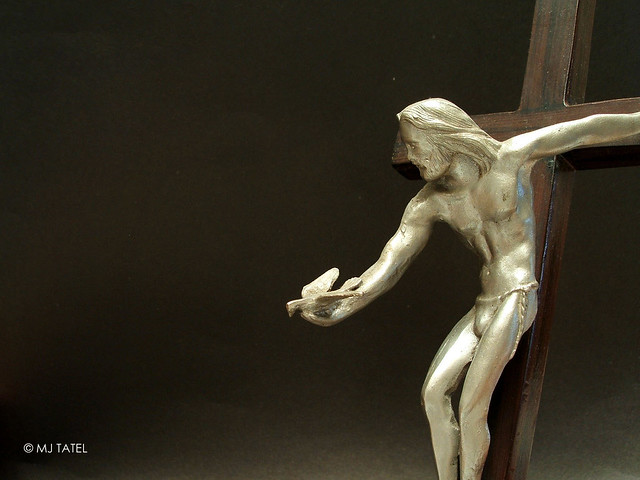
[focus on picture of figure on cross offering a dove] Jesus's teaching is heavy with love of neighbour, love of enemies, forgiveness. His ministry is full of reaching out to the despised and the hated, and his last earthly week is full of choosing not to offer violence but rather to absorb the hatred and violence offered. For these reasons the church of the first three to four centuries consistently teaches that Christians may not be involved in violence.

There occurs in the fourth century a growing rapprochement of the Roman Empire with its Christian minority which eventually leads some Christian theologians developing just war theory
[see green table labelled 'Just War Theory'] which sought to allow Christians to participate in the defense of civilisation while maintaining moral limits and building in mitigations. This is consolidated by the emperor Constantine who supposedly has a vision [see picture of sunrise]
probably prompted by a sun-halo like in the picture. But overlaid by hearing a voice
[close in on next picture -red cross and words]  saying in hoc [signo] vinces -'Conquer by this sign'. Constantine then put the sign of the cross on his army's armour and went on to win the battle. He politically then makes Christianity a licit religion and sets the Roman Empire on a course to absorb Christianity and the Church to legitimise the Empire (and its violence).


The next thing we know on this trajectory is that not only is the Church giving comfort for the doing of limited violence but developing a holy war theology which creates the possibility of crusades -violence as a way to extend the church's mission. By this point it becomes obvious that the limited allowance of deadly collective violence by the just war theory was indeed the top of a slippery slope into warfare as an instrument of policy for the church. In effect overturning the teaching and example of Christ. And that is how we end up with troops killing and maiming each other each side in the name of Christ, justice and 'peace'. Truly, the decision to offer any kind of justification for violence is likely to be increasingly loosened in scope and ways are found to express reasons for taking up arms in terms that look like they might be 'just'.

On not feeding the four horsemen.
[Painting of the four horsemen of the apocalypse]. The ANE creation myth is essentially a myth of redemptive violence: a way of proposing that violence is what effects important change and brings about good, the goodies must employ violence to make sure that their 'good' values prosper and prevail. It is a myth that is propagated in many -most- Hollywood films. It encourages us to think that means are not necessarily directly or inherently related to ends; that we can create good by doing harm.


Our societies are held captive by the Myth of redemptive violence. The Judeo-Christian traditions question that. Jesus' teaching very strongly undermines it. Our faiths have been co-opted by the MRV and our imaginations colonised by it. We must stop sanctioning violence, full stop. Only then will we be able to stimulate imaginations to envisage solving problems peacefully. Only then will we be committed enough to begin to tear down the automatic justifications and misleading chains of reasoning fed by the relentless MRV-form narratives spilling out of the media. 

If we allow ourselves to think that violence could sometimes be justified, very soon we will find that we are defending horrors such as firebombing, dropping nuclear bombs, waterboarding, drones ... the list will grow and grow.


26 July 2013

Spiritual but not religious in Britain

This article The Brains Behind Spirituality : RSA blogs makes some good observations. First, the big picture:
Post-Religious Britain: The Faith of the Faithless, a 2012 meta-analysis of attitude surveys by the thinktank Theos, revealed that about 70% of the British population is neither strictly religious nor strictly non-religious, but rather moving in and out of the undesignated spaces in between. While the power of organised Christian religion may be in decline, only about 9% are resolutely atheistic, and it is more accurate to think of an amorphous spiritual pluralism that needs our help to find its form.
In a sense nothing surprising there. What is interesting about that quote is the thought about the amorphousness needing to be given form. That becomes a reflection on the role of (organised) religion. The point being that religion  could have an important role to play:
we are relatively starved for forms of practice or experience that might help to clarify our priorities and uncover what Harvard psychologist Robert Kegan calls our immunity to change
 This is religion in the sense of something that gives form to spirituality in entities that have legal status and the ability to make collective action efficient and effective and which can help direct effort and educate participants and draw them into practices and perspectives that have proved helpful and healthy in the past. Of course that is religion at its best. Part of the problem is that many people in the early C21 are more aware of the negatives relating to religion: its vulnerability to capture by vested interests and misuse by office holders, its tendencies to bearing down on people in a life-diminishing way and its failures to help people to understand in terms relevant to their lives how spirituality can contribute to their flourshing. I myself tend to be suspicious of 'religion' for just these reasons. But I do balance my skeptical tendency in this with an awareness that corporisations do have a potential to marshal human collective efforts for the general good and well-being. Churches are, whatever else they may be, corporisations.
The article captures the situation thus:
those who value spiritual experience and practice are often suspiciously quick to disassociate themselves from belief in God and religion, as if such things were unbearably unfashionable and awkward, rather than perhaps the richest place to understand the nature of spiritual need
 The RSA article offers us an interesting foil to think about this:
is it not the sign of a spiritually degenerate society that many feel obliged to define their fundamental outlook on the world in such relativist and defensive terms? Compare the designations: ‘educated, but not due to schooling’ or ‘healthy, but not because of medicine’.
 Which helps us to note that the place for religious expressions in our kind of society has to be in relation to a bottom-up rather than hierarchical practice of religious spirituality. Hierarchy worked in a context where deference to perceived and institutionally-honoured expertise was normal. That's no longer our context.

Jonathan Rowson, the author of the linked to article, suggests that the fundamental issue of spirituality to which religion needs to address itself is
to know oneself as fully as possible. For many, that means beginning to see beyond the ego and recognise oneself as being part of a totality, or at least something bigger than oneself.
 I think that's probably right as far as it goes. It's a project that will seem too minimalist for many with more definite spiritualities and/or expressing their spirituality reasonably happily in the context of a religious corporisation. And part of the critique might be to ask why on earth we might want to start with that issue as the way into spirituality. The argument would presumably be that this is where, existentially, most people start. I wonder whether that is right. I suspect we might actually want to start with meaning-making in relation to our place in the universe with a view to supporting good, healthy and convivial living. In fact, putting it that way ties into the calling, as I see it, of corporisations in general to serve the individual and common good. And this in turn may relate necessarily to the shared noetic space that humans collectively generate which is is big part (I hypothesise) of the make-up of corporisations. That shared noetic space is what enables us to share our thoughts and to collectivise our acting in the world..

On this account, another function of 'religion' at its best would be to enable us to think ethically about our participation in corporisations and give us support to challenge and change them when they fall short of their purpose.


18 July 2013

Coming Interspiritual Age. A review

I was intrigued by this book for two main reasons, I think: one was that, as someone working with different expressions of faith, I am finding myself a little weary of 'interreligious' and 'multifaith' as labels; the other is that the blurb told of an 'integral' worrld view.

The 'multifaith' and 'religions' issue is that I have a suspicion of 'religion'. I'm only too aware that institutional forms and 'brand loyalties' can obscure what might actually be going on with people. So 'inerspirituality' seemed to hold out the promise that there might be ways to address that.

I've enjoyed the attempt to situate spirituality in a "big history" of the scientific understanding of origins -both cosmological and anthropological and it is certainly important to do this and to co-ordinate this with the various spiritual traditions. There's a fascinating engagement with the idea of the bicameral mind, though I'm not convinced by the thesis and so the account of human cognitive-cultural development which is developed and relies on the thesis seems, therefore, less strong than the author might hope.

In fact, this seems to point to a weakness in the book more generally. At various points where the ambitiously wide-ranging account touched on areas about which I know a reasonable amount (eg areas to do with linguistics), I found the account sometimes inaccurate in ways that did not instill confidence in the overall argument. In fact, quite a lot of the time this read as a kind of updating of New Age thinking and approaches to spirituality, so I became increasingly concerned as I read that there is a particular politico-spiritual agenda at work which was not entirely 'respectful' of those of us who baulk at certain dimensions of syncretism.

My hope was that this book would give ways to handle spiritual dialogue and inter-religious encounter creatively and respectfully and there are insights in it to help this. However, it does have it's own spiritual agenda and is, in effect, arguing for a particular way of reading the world which could actually not convince many of the people whom it would include. I fear that the mistake is to offer a meta-narrative for a task where learning to sit light to meta-narratives for the sake of dialogue is required. We need a practical wisdom to handle plurality and this is not served well by trying to replace viewpoints with ones own.

Coming Interspiritual Age: Amazon.co.uk: Johnson, Ord: Books: Coming Interspiritual Age

21 December 2012

Atheist prayer for the soul of England

If this were the face of the new atheism, we'd hardly have a beef with it.
An atheist's prayer for the churches that keep our soul | Simon Jenkins | Comment is free | The Guardian The flavour of it is an appreciation of what faithful, humble contributions are being made to the common good by churches and clergy -even if one didn't believe our message.
Local England has reverted to the middle ages, with the clergy as its most public face. The clergy are the ones who tend to know who is in trouble, who is a villain, who a saint. Their workplace is a church. They apparently mobilise 1.6 million parish volunteers for what amounts to social work, from caring for the elderly to hospital visiting. This output must be worth billions to the state. And all the state does in return is impose VAT and health and safety regulations on church repairs.
It's just a shame that the stats hadn't been read a bit more carefully: Simon says,
This month, the census appeared to confirm a Religious Trends reportthat church attendance was falling so fast that by 2035 there would be more active Muslims than Christians in Britain, and by 2050 as many Hindus.
Thing is, the report is from 4 years ago and the census is reporting a drop in nominal Christianity while the active Christian population seems to be more stable than the earlier report indicated -in some places and organisations it is growing. My own diocese seems to be seeing more churchgoing even while nominal Christians fall in number. I suspect that journalists will need to think a bit harder about the cliched categories they think in about religion in this country.

Much better from that point of view is another Guardian article by Zoe Williams (who is an atheist also) in Comment is Free, who asks properly what people might understand by the rather blunt Census Question (which I actually felt constrained to answer in a way that would have made it hard to interpret -as a Christian with a streak of Reformed in me, I don't react well to the label 'religious').
Overall, then, the structure of the question was deemed to have hoovered up a lot of people who were only Christians atmospherically, neither cleaving to its beliefs nor upholding its practices. Personally, I didn't mind that – one of the many joys of being an atheist is that you don't have to pretend to be inclusive. Organised religions have to take all comers. I am proudly exclusive in my belief system – I only want other people to be atheists if they're committed to not believing in God, and are prepared to say so. I don't want to scrabble madly among the "don't knows" for people who might be in my club on a particularly trenchant day. The Jedi Knights are welcome to them.
That's a good point, and at my university when the possibility of entrance documentation asking for religious information, I felt that it was important to put down a marker that the way that the census asked the question was not very helpful and that we might want to catch some nuances that would be more useful for guiding thinking in an institutional context.
In fact Zoe picks up a thought that is pretty much my own (here);
self-described Christianity is disintegrating – not because anything's happened to make God's existence less likely, but because, as a badge of respectability and cultural identity, it no longer cuts it.

07 December 2012

One: The Gospel According to Mike: a review

There are things I like about this book and there are things irritated me.
First the things I like.
It's a really interesting core proposal and one which resonates for concerns I have myself. The core thesis seems to be that on the cross God has already achieved in Christ everything needed for God to become one with creation -hence "ONE" the title. Mike Williams talks about this in terms of the sin of one man, Adam, being offset by the righteousness of the one man Jesus. What I liked was Williams' unrelenting attention to the once-for-allness of this proposition and his exploration of the declension of various forms of Christianity from this such that we all too often reintroduce or substitute law for grace (my characterisation more than his, that). As a result, he writes about "Christianity" and it becomes evident that for him it is not an affectionate term but rather a term denoting a system of religion which in effect avoids or side-steps the real good news and substitutes rules and/or unfreedoms.

There's a big part of me that resonates to this approach. I think he's right to notice how religiosity both binds and screws people up. ONE is laced through with Williams' own testimony of how religious Christianity helped put him in mental health hell on several occasions -illustrating vividly the latter point. This is rooted in one of the things that I think he's right to explore theologically: in older language 'the sufficiency' of the cross. I think he's broadly right to notice that a lot of contemporary Christianity often doesn't take the cross seriously enough as a game-changing event cosmically affecting the relationship between God and creation. Williams does take it seriously. My main criticism here would be the lack of attention to the systematic/philosophical dimensions of this, for example considering the time -related implications: whether the cross could affect people backwards in time being one area of consideration here.

What Williams seems to be doing is reiterating the theology which says that the Christian life is about putting into practice what Christ has already achieved for us: becoming what we are. I think that Williams goes further in that his thesis seems universalist so it is about all human beings becoming what we are in Christ rather than continuing to live in Adam. This is an important area for consideration because I think Williams is right that much Christian teaching has fallen into legalism -that is in effect what he is railing against. It is a legalism that is rooted in a negation of the Cross at key points of thinking and doing. It is a negation of the cross which has filip from enforcement of power and status games within Christian communities and networks.

I liked too that he wrestled with his sexuality and had a deep and passionate dialogue between the theology he inherited and the realities of his human condition. And so as an example of practical theology it is useful to see the way that experience can question our neat theologies and the practical outworkings of them.

What I found irritating most were things like the lack of systematising the topics: I kept finding myself wondering how Williams would handle the more philosophical and theological implications of the position he was developing. For example, what would he say to the charge of antinomianism? -or rather to the suspicion that his position would provide no way to gainsay licence or wickedness. I think that there are ways to deal with that kind of charge from what I understand his position to be, but I kept finding that he simply didn't go there at the points when that question was begged.)

The lack of systematisation also irritated in relation to his repeated statement that God imputed unrighteousness to humanity following the sin of Adam. What does it mean to impute unrighteousness? Does that mean we weren't really unrighteous? Similarly he tends to see this in very clear timely terms: so before the cross everyone was unrighteous in God's sight, afterwards everyone (absolutely, without exception) is unrighteous in God's sight. Now I think that there is a way to think this through (and which doesn't necessitate a commitment to a historical Adam -another issue, despite Williams' protestation towards the beginning).

I think that I'd recommend that Williams engage with the work of Karl Barth (you may get a flavour of why I say that from this article) -on religion and then Barth's thinking about Christ as saviour in the Dogmatics -perhaps especially the exposition of Ephesians chapter 1. In that way Williams's instincts about the Cross and its meaning could be given some systematic rigour and he'd also be able to come to a more nuanced assessment of some of the church where such things have already been thought about.

I felt that Williams could sometimes be unfair to positions and people he thought disagreed with him -and not always consistently so. I think that Martin Luther actually agreed with Williams' over many things but you wouldn't always get that from the way the Williams writes about him, for example. Also there are sometimes sweeping statements which are borne of ignorance: Williams appears to think of Christianity as a fairly narrow section of EPIC Christian expressions and a cartoon of Catholicism. Yet if he know more about theology more widely than there is evidence of in this book, he'd find that much of what he says is already part of a wider Christian conversation -and has been for some time.

That said, I recognise that this was born out of some pain and desperate circumstance and so the catharsis of it is an important part of it: I would just want to say that this is not a finished or polished theology and there are more questions that arise from it and more discussions to have even if one grants Williams's perspectives as seen here.

One: The Gospel According to Mike"

08 September 2012

Religion, evolution, reason

Andrew Brown's been writing an intriguing mini series in the Guardian in response to Robert Bellah's book on Religion since the axial age. There are some points he makes that are worth pondering further. One is to do with the 'invention' or 'discovery' of reason; we're so used to it that we forget that it may not always have been 'around' in human culture in the disciplined and methodical way we now approach it. And indeed, part of the story is about religion and not just in the inimical way that New Atheists would have us hear it (since the story begins before the so-called Enlightenment).
This isn't a universal conflict. "Reason" itself, as contrasted with myth, is a relatively recent invention. You could in fact understand the history that Bellah tells of religion up to the Axial age as a story of the invention of reason (or, for Platonists, and theists, its discovery).
The story involves understanding myth as something more than a mere fiction and being able te recognise the bona fides of cultures approaching existential issues and matters of public knowledge and indeed wisdom with different backgrounds and teloi than the Modern West.

Thus:
 If religions are best understood as ways in which we dramatise and come to understand the urge to power and the urge to nurture, it's obvious that they can never be displaced by science, nor vice versa. Science itself is a playground, or arena, for both urges.
In other words, I think, Science is not immune from its protagonists continuing to behave badly, to compete with malice, to deceive and do-down even while proposing that it is all about nurturing the common good and treading the way to a brighter future.

Nevertheless, moral imperatives are well to be grounded in some degree of reality else they'll not overcome the ingrained self-serving and confirmation-biases which would undercut ideologies of Reason: there is still a difficulty about deriving an ought from an is and any ought grounded in 'human nature' is too immediately self-defeated and open to challenge. Why should we follow the better angels of our nature? And who says they are better? And can we really argue with the Ayn Rand's of this world?

I think that this is part of What Brown is getting at when he writes:
Ever since that discovery [of reason], in all the places where it has been kept alive, reason and myth eat away at each other, and feed on the other's remains. Unless myth is felt as a truth larger than ourselves, and unless it is understood from the inside, it just won't work. But a working myth cannot be made entirely proof against reason. Perhaps the first discovery of this was by Adam and Eve. It was certainly obvious to the thinkers of the 18th century, whether or not they were Christians. You find it in Voltaire and Hume as well as Swift and Bishop Butler. They all understood that reason alone cannot justify the claim that we should live by reason alone.
It seems to me that the last bit there is a reflex of the incompleteness theorem in Maths and of the epistemological conclusions of mid 20th century philosophers that in order to know something, you first have to believe something.

Religion in Human Evolution, part 8: the invention of reason | Andrew Brown | Comment is free | guardian.co.uk:

04 August 2012

Pussy Riot and a concerning reaction by Patriarch Kirill

The article I'm referencing here may not be fully viewable for acouple of weeks due to the CT internet policy. As a subscriber I feel it's fair, for the purposes of discussion to make a little piece of Canon Bourdeaux's article a bit more open. I'm assuming that readers know the basics of this but if you don't try this. What struck me was the appearance in the same issue of the Church times of this article by Michael Bourdeaux in which the following quote appears and a column featuring the prayer that I will reproduce following it.
: Patriarch Kirill has reacted by sending a circular letter to all his churches in Moscow, to be read out after the liturgy. It was an "Appeal to the Procurator General", encouraging parishioners to sign in support, requesting the maximum sentence for the women: five years, for blasphemy and aggravated hooliganism, (Is this a return to the Cold War?)
And then there is this prayer from a traditional Eastern Orthodox source which seems to be an indictment of patriarch Kirill's response:

Lord Jesus Christ who didst command us to love our enemies, and those who defame and injure us, and to pray for them and forgive them, Who Thyself didst pray  for Thine enemies, who crucified Thee; grant us, we pray, the spirit of Christian reconciliation and meekness, that we may heartily forgive every injury and be roconciled with our enemies. Grant us to overcome the malevolence and offences of people with Christian meekness and true love of our neighbour ... And help us repay evil with goodness, and to remain safe from the temptations of the devil, and from all the perils which threaten us, in the form of visible and invisible enemies. Amen.
Perhaps we should pray that Kirill might find it in him to try to embody this prayer that speaks so well of his Tradition?

06 April 2012

Hot 'Crescent' buns upset some Christians in RSA

 This is one of theose stories where there is a tem[tation to say, with Marge Simpson; "There are so many things wrong with that, I don't know where to begin."
A retailer in South Africa has had to remove the Muslim food certification symbol of a crescent from the packaging on some of its hot cross buns after conservative Christians complained.
Is it worse that the retailer removed the symbol or that those Christians complained? The latter seems a bit 'precious'. Personally I'd be delighted to know 'my' hot cross buns would be halal and even kosher (unlikely, I suspect) it seems to me it'd represent a step forward in interfaith relations. I'd have been more expectant of seeing something about Muslims objecting that a halal council had approved something with a cross on it and strong associations with the crucifixion which most Muslims have traditionally denied (based on what I believe to be a misreading of the Qur'an). In other circumstances I could see these Christians celebrating that the 'gospel' was being sybolically proclaimed to Muslims. Looks like the 'fan' /'tribally-religious' instinct won out in this case; it's funny how some people seem to look for excuses to be offended. And to interpret it as 'turning their backs on Christians', well, words fail me. Part of me wants to say 'grow up'. And to Woolies, who gave in: if you give in to this now you'll be at it for ever...
Hot Crescent Buns Upset Christians in South Africa | The Jakarta Globe:

03 March 2012

Christianity is 'broad shouldered'

Yeah, we thought so.
BBC director-general Mark Thompson has claimed Christianity is treated with far less sensitivity than other religions because it is ‘pretty broad shouldered’.
Actually it's a compliment. And it's as it should be in the sense that it's a more Christlike image. That doesn't mean we shouldn't point out the inconsistencies and call people to account: but we should do so assertively not aggressively. My fear is that many Christains when it comes to the public arena become shrill and aggressive and don't knlow how to be appropriately assertive -which involves respecting the other parties.

It's interesting to consider this:  
“I complain in the strongest possible terms”, is different from, “I complain in the strongest possible terms and I am loading my AK47 as I write”. This definitely raises the stakes.’
The question is whther we should be giving that kind of privilege to that kind of implied threat. I think not. Geese and ganders probably ought to be served with the same media sauce...
Read more: http://www.dailymail.co.uk/news/article-2106953/Christianity-gets-sensitive-treatment-religions-admits-BBC-chief.html#ixzz1o4Qt9u7P
And a later article in the Guardian is worth a look too, picking up as it does on the implied point I make in the previous paragraph.


Christianity gets less sensitive treatment than other religions admits BBC chief | Mail Online:

The Science And Spirituality Of Addiction

 What drew me in was the collocation of science and spirituality in the title. I'm also a little interested in addiction through having ...