Showing posts with label worship. Show all posts

08 April 2023

Turning over the Church's year

 I find myself saying from time to time that we should make more of Holy Saturday. I know that the Orthodox have a liturgy about the burial of Christ's body. I think that holding it as a day of lament, a day to consider what it would be like to live, for example, in a meaningless universe without God, a day to remember the finality of death -holding back from anticipating a relativising of that finality. This appears not to be what the Orthodox do -as they think about the harrowing of hell and the 'resting' of Christ -which still seems framed by the hint of resurrection. I think we could do with an exploration of the darkness, maybe.

But then as I think about adjusting our liturgical practice, a flow of other things I'd like to explore about the church's year starts (some of which I've posted before) ...

I think that we should perhaps start the church's year with Creationtide; in September. This would align with the new academic year and draw us much closer to our Jewish roots. I'd suggest that the liturgical colour should be green and that to compensate, we might take another colour for 'ordinary time'. I'd suggest a pale grey or cream -something basically perceived as neutral.

Then in November we've lately begun to have Kingdomtide. How about we have that as the penitential preparation for the Christmas season? -And use purple or deep blue as the season's colour? Maybe during this season we might fast a la Ramadan -not eating during daylight hours.

I'd suggest then we swap the Advent colour for a festal red (and inter-shot with green?) recognising that December is essentially in experiential terms in our society, greater Christmas: let it be and don't fight it -hence penitential prep in November, Kingdomtide which lends itself to the themes of death, judgement, the last things etc.

I think I'd suggest that the liturgical colours for Lent should be brown and/ or sack-cloth should be used. This suggests soil, humility and the basis for new growth. To support this, I'd suggest we use ash and/or soil instead of (or as an optional alternate to) holy water at the entrance to church buildings during this season encouraging people to mark themselves with a streak or two. I'd also suggest exploring a fresh ashing on Good Friday -perhaps as a way to start a Stations of the Cross or similar.

During Holy Week, I reckon black and grey should be the theme palette. This resonates with the way that black is generally conceived in wider society as a colour of sombreness and mourning. Perhaps dark grey during most of the week and black for Good Friday and Holy Saturday -which we should definitely do more with liturgically. A day of lament and consideration of loss -including the death of God, hope etc.

Easter. Yes, gold is a good colour. But how about also using vivid spring greens? -Certainly for the Easter season. I'd strongly discourage any celebration of Easter before sunset of the eve. I'd encourage more careful consideration to strengthen the experience in the liturgy of darkness contrasted by light -which is often lost in the practical enactment of the rites. I've written more about this elsewhere.

I keep wondering whether at Pentecost, we should take an idea from the Holi festival in India (and beyond): "one and all, chase each other around with dry paint or coloured water, in water pistols or balloons!". And perhaps a good colour to use in this season would be sunny yellow or a warm orange to pick up on the fiame imagery of Pentecost.

I also think that it'd be great to have a festival -a change of colour- somewhere between the end of Pentecost and the start of Creationtide. So, there's midsummer, traditionally associated with the feast of John the Baptiser on 24 June and there's Transfiguration on 6 August.  The latter should be bright white and maybe a week or two of  that. Midsummer might run from 20 -25 June? Gold?

The other thing is to think through the environmental dimensions of many of these seasons and give them greater prominence. This is important because of the times we live in: we need to bring our relation to the non-human creation into a bigger part of our thinking on the way to becoming better climate citizens. So this could involve recognising Lost Species Remembrance day at the end of November -which would fit with All Souls on 2nd and Remembrance day on and around 11th. Transfiguration could have a dimension of the transfiguration of all creation in the Fullness of Time. Easter holds promise for all of creation. Some days hold seasons of the year significances which could be brought out more: spring, midsummer, autumn and midwinter have ecclesiastical near-neighbours which have traditionally been celebrated togther. There or also cross quarter-days of Candlemas, Mayday, Lammas, Hallows'eve which could be opportunities to consider our human relationship to our environment and our Christian discipleship in the natural world in which God has placed us and in which so many of us encounter God. 

I'd suggest that we should be holding days of penitence and lament around Earth Overshoot days. And Rogationtide might gain more prominence as days to consider and pray about our food systems globally as well as locally. Since Rogationtide is tied to the feast of the Ascension, it would serve as a short penitential lead-in to that feast. It might be that we look at the tradition of 'beating the bounds' at Rogationtide, -maybe to take in how our 'bounds' have been breached by pollution and by extraction, globalisation and colonialism. The message would be that, yes, we have to look after and know our own patch but also it is not possible to be simply parochial.

There are probably things I've been thinking about that I've for the moment missed out. I'll add more if/when I recall any.

02 August 2019

Call and Response: Litanies for Congregational Prayer — recommend?

Okay, so I have to admit that I'm a bit of a liturgy buff, I have a particular interest in liturgies for daily prayer and I'm also drawn to litanies and preces. I had to consciously rein myself back from overusing the latter in Book of Our Common Prayer. The scope of this book, then, grabbed my attention. Especially so because it promised, "Written with attention to beauty, theological resonance, and justice-mindedness," All good and often the first is ignored. So the question I approach it with is whether it does those things. I think this book fulfils that brief.

To be sure, it's hard to review a prayer or collection of them without a reasonable amount of time to actually pray them. So having 30 days means that what I am doing is more like first impressions and whether there are things that at first view I think will be enticing me into prayer or not and also whether I think I can mind's-eye them in congregational settings I'm familiar with. Actually praying them with a congregation in a substantial enough amount of usage is a different question. I'll do my best.

So what about contents? Well, I was impressed and excited by the introduction 'How liturgy saved my life'. A succinct and human-centred in-life rationale for using what she calls 'intentional liturgy'. Probably I tend to call it 'pre-written liturgy' nowadays, but I know what she means and it is difficult to find a term which also implies 'those of you who think you don't use liturgy are kidding yourselves -it's just that you don't write it down'. But this chapter in the book is one I think I shall try to encourage some people I'm in conversation with to read to help them to 'get' what I'm on about.

Then the "litanies". They're pretty varied and the contents pages breaks them into different section and there really is a wide selection of topics: humility; stillness; government; midwives; lament; 'terrorized city'! ; doing hard things; ordination; death; Advent; Lent and all sorts of other things. So I decided I would sample various ones that caught my interest.

Something to say was that I realised that my working definition of a litany is different to Fran's. I was expecting less variation on the response parts; for me that's the essential difference between a litany and preces; that in the former the responses tend to be more constant so the congregation can often respond without seeing the words. However, I do recognise that this is not necessarily how the dictionary puts it over. And I do like preces -my own work is full of them. And, in fact, as I read them in this book, several times I felt that chunks would fit well with some of the prayer forms in Book of Our Common Prayer. For example much of the Meekness litany would work in the last phase of the Lord's prayer pattern. I did wonder whether an assemblage of Fran's litanies could be constructed in the Lord's prayer pattern, maybe I'll give that a go

The litanies in Fran's book are often quite concept-dense in the ideas and reflections embedded in them. I would commend them for a meditative (slow) reading rather than racing through them. I also suspect that one-off usage will not do right by them: I suspect that using them several times in a period of days or weeks would enable the richness of the imagery and insight woven through them to unfurl within a soul.

Some of the forms had large sections of litanies in the sense of my normal working definition, and these were nice, though I suspect that with a congregation I might seek to expand on them a bit to get a sense of exploring meaning and of rhythm.

One use I imagined for them was in a prayer room or chapel where there are prayers posted to help. I also felt that this is one of the few e-books I have read that I might want to get as a hard copy; the easier to refer to when assembling acts of worship to lead.

Definitely worth getting as a resource for worship.

Call and Response: Litanies for Congregational Prayer — Fran Pratt: contemporary liturgy for the post-modern church.

Link-Love 

Call and Response on Amazon
Fran Pratt’s Website
Fran Pratt on Instagram
Fran Pratt on Facebook
Fran Pratt on Twitter
Tag: #CallAndResponse

Please note I got sight of this book as a 'for review' deal. I was under no obligation in receiving a copy to review it favourably.

24 June 2018

Light of the World | some more words


I few years ago I wrote some words.  Now I have some further words to the same tune and using some of the same lines.


Light  of  the  world,  of  glory  born,
Focusing  radiance  in  earthlife
pinpoint  Divinity's  form,

Light  of  the  world  in  darkness  shine,
Word  of  God  fleshed  out  in  spacetime,  
love  of  God  tested  in  pain.

For  it's  the  Mystery  of  the  universe
The  Uncreated  makes  a  home  in  created  time  and  space
Saviour,  shine  your  life  in  us
enliven  us  in  bearing  light,  as  wells  of  grace.

Andii  Bowsher  cc2014   8.8.7.8.8.7   10.12.7.12  (cf  Matt  Redman,  O  Sacred  King)


For comparison here's the 'original from 2000, posted in 2004.


Light of the World 
of glory poured 
Word of God fleshed out in spacetime 
Love of God tested in pain 

O gladdening light 
enlightening all 
we embrace love you've made human 
light of truth that sets us free 

For it's the mystery of the universe 
the uncreated makes a home 
in created time and space. 
And now you share your self with us 
pouring Godlife into death 
breaking open life in us. 

Jesus, Splice eternity in us 
encode in us your Godwardness 
and centre us. 


Putting them together, I would recommend.


Light of the World of glory poured Word of God fleshed out in spacetime Love of God tested in pain  

O gladdening light enlightening all we embrace love you've made human light of truth that sets us free 
 
For it's the mystery of the universe the uncreated makes a home in created time and space. And now you share your self with us pouring Godlife into death breaking open life in us.  

Light of the worldof glory bornFocusing radiance in earthlifepinpoint Divinity's form, 

Light of the worldin darkness shine,Word of God fleshed out in spacetimeLove of God tested in pain. 

For it's the mystery of the universe the uncreated makes a home in created time and space. And now you share your self with us pouring Godlife into death breaking open life in us. 

Jesus, Splice eternity in us encode in us your Godwardness and centre us.


Light  of  the  world,  of  glory  born,
Focusing  radiance  in  earthlife
pinpoint  Divinity's  form, 

Light  of  the  world  in  darkness  shine,
Word  of  God  fleshed  out  in  spacetime,  
love  of  God  tested  in  pain. 

For  it's  the  Mystery  of  the  universe
The  Uncreated  makes  a  home  in  created  time  and  space
Saviour,  shine  your  life  in  us
enliven  us  in  bearing  light,  as  wells  of  grace.

Andii  Bowsher  cc2014


8.8.7.8.8.7   10.12.7.12  
(cf  Matt  Redman,  O  Sacred  King)


10 December 2017

Physical presence and social media

The article referred to underlying the title text is about why some scientists are postulating that smell may be implicated in autism. However, for me the new learning was that we do, in fact, subliminally process smells from each other that we can't consciously notice:

Although this sense [smell] is not our primary sense, as it is in many other mammals, we still subliminally read and react to certain odors. For example "smelling fear," even if we cannot consciously detect its odor, is something we may do without thinking... this is a form of social communication...
So, one of the things that this led me to was the thought that this may be a factor in why it is that we often think that church should involve face-to-face meeting: something about bonding and responding to each other in physical proximity is actually biologically important.

This is not to say no aspect of church and fellowship should be done any other way than by physical presence. After all, swathes of the New Testament are actually the remnants of first century social media -fellowship at a distance via letters and Roman roads. However, it should help us to value the dimension of physical presence.

What this article doesn't really go into is the effects of other kinds of subliminal smelling -assuming that there may be pheromones (I'm assuming that's what we're talking about here -but happy to be informed more fully) for enjoyment or other kinds of general affect. There is mention of hexadecanol in relation to calmness, so I guess there is something in this.

Of course, the other thing we need to notice is that this study is related to autism -and seems to suggest that those with ASDs may misinterpret these chemical signals. So that's a matter for us to consider in working out, as churches, how better to include them.

A further surprise was that
Research in recent years has turned up smell receptors like those in our nasal passages in all sorts of other places in our bodies -- from our brains to our uteri.
Intriguing eh?

Autism and the smell of fear: Odors that carry social cues seem to affect volunteers on the autism spectrum differently -- ScienceDaily

'via Blog this'

01 September 2015

Looking back on the Long Slow Eucharist

So, it's done. Last night the last movement of the Long Slow Eucharist at Greenbelt was concluded. You may recall that I advertised it beforehand a post or two back. I have a few reflections on the experience and felt a, perhaps slightly meandering, blog post might be a helpful thing -to me at least.
The idea was to have a communion service which took most of the festival and wove together the wider festival and the act of worship. There was a further aim to reference and use the festival theme "The Bright Field" taken from the RH Thomas poem of the same name. The outworking of this in the case of the LSE was a focus on mindfulness as a way of learning to pay attention to the created world with the hope that we could become better able to notice and enjoy the epiphanies and the "ordinary wonder". So the liturgy aimed to help form (or at least introduce) participants in practices of giving attention as well as of making strong connections between the wider festival and the acts of gathered worship that formed the Long Slow Eucharist.
These aims showed themselves in the inclusion of various kinds of mindful meditation practices into the liturgy. And these were done both as individual exercises and also small group work (it is, after all, a corporate thing -a liturgy). Many of these exercises also drew connections to the wider activities of the festival by using it as raw material for reflection and bringing insights and recollections from it into the liturgy.
I should say that 'liturgy' I mean more than the words on the page (which are reproduced below) and include guided reflection and discussions and sharing in small groups. Also included are the symbolic actions within the sessions.
In the primer session on the Friday night which was simply a talk by me to give a bit of a prospectus about what would be happening.
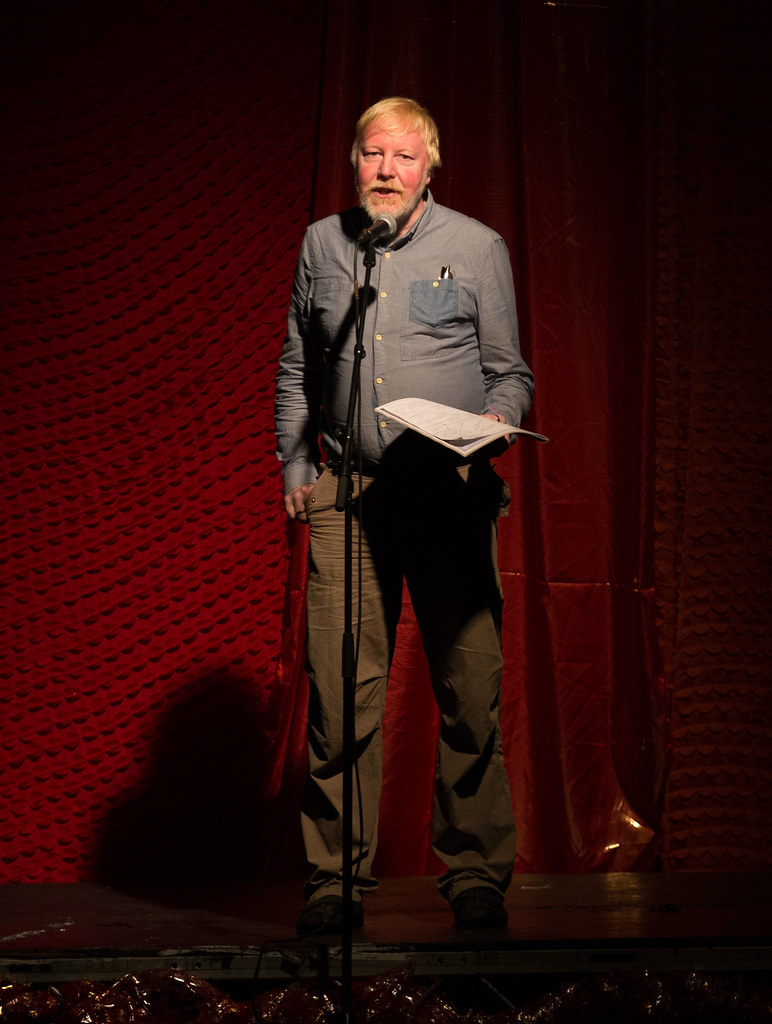
AJ-GB15-Fri--63 In that I mentioned the aims as set out above and also that the aim was to have an event covering the time of the whole festival. In a sense to try to make visible the claim on the Greenbelt website that in a way the whole festival could be regarded as worship by giving that claim a concrete eucharistic form.
It's quite a big ask at a festival to get people to come back to the next bit of the same liturgy rather than to come to one in a series of essentially stand-alone events. Therefore, I did not expect huge numbers: it's a significant commitment when there are so many other things happening and there is an increased chance of having to make (invidious) choices about what to attend when inviting things are happening at the same time. So I was expecting we might only have about 20 people. In fact we probably had about 50 at the primer session on Friday night, 40 or so on Saturday and Sunday and 30 on Monday -the rain may have deterred some, but then there were a handful came who hadn't been before. I'm not sure whether the blurb in the programme should perhaps have been clearer about the continuity issue and I'm not sure how it would have felt to simply be at the final session without having experienced the prior two. Certainly some of those I spoke with at the end wanted to see it happen again next year.
One of the ways to weave together the wider festival and the gathering for LSE that I put in place was "Re.immersion cards" these were given out between gathered sessions and had on them suggestions for ways to engage the festival, I will include these at the relevant points below.
One of the things I was quite pleased about which doesn't show up in the way the liturgy is set out is the way of helping people to form small groups for discussion. One of the participants made a particular point of thanking me for this at the end of the Saturday evening session. While thinking about this beforehand, I realised that it was likely that there'd be a number of people who would have come with one or more other people and a number who would essentially have arrived in the session alone. Since I feel that the theology of Eucharist gives a preference for a Communion to be a corporate event rather than one where people essentially attend as individuals and remain so, that there should be some way to encourage people to interact together as part of the LSE. This meant trying to find a relatively uncringeworthy way to get people to talk together. I considered asking those who had come alone to identify themselves so that they could be 'adopted' by others around them. But then it seemed to me that this would potentially feel patronising or stigmatising in the context of a culture where singleness is suspect. So I opted rather to ask the accompanied to stand and then to look around to befriend one of those still sitting and for them all to introduce themselves to each other. This took place near the beginning of the Saturday (that is the first 'proper' session).
In the main sessions, the non-congregational lines were mostly spoken by one of two or three other voices apart from myself as presider. This includes the lines in the thanksgiving. The role of presider was enacted by leading the responses into the thanksgiving and standing at table to handle the bread, wine, water and vessels as well as the opening and closing prayers.
We had a slight logistical problem in having microphones tethered by wires at one end of the tent. I very much felt that the communion table should be in the dead centre of the space which meant that there was a gap of 3 or 4 metres. So, if I wanted to speak something while at the table, I couldn't; I had to either rely on the voice of one of the helpers or tread back to a microphone. Mostly the way was to use the voices of others while I performed the actions. This was mostly okay or even good. At one or two points it was less smooth than I would have liked.

Long Slow Eucharist Primer

Read out the RSThomas poem at start of GB guide. Highlight the bit both sides of the laid-out stanzas (not hurrying into the future or holding back in the past), making connection to mindfulness, being aware of the present moment.

Genesis of idea

The idea began in leading retreats and days of prayer involving spending time praying and learning together, and then ending with HC. BUT then I thought, HC is meant to be about praying and learning -not just a set-piece hour relatively disconnected from the rest. And vice versa: life and activity is meant to inform and be informed by our worship; centrally worship is HC.
AND the GB website claims that the whole festival is meant to be worship.

Rationale

To integrate the  festival and acts of worship (liturgical events) and help us to FEEL the connections more fully.
Slowing down -taking time to worship -so why not take a good long time ...
Mindful in the sense of paying attention to the simple and commonplace as potential epiphany. So the worship is to try to help connections and epiphanies to occur.

Mindfulness (I lead sessions at Northumbria University) is fundamentally about learning to direct attention and be conscious of oneself in the present moment. -More later.

The Liturgy

I intend 'liturgy' to mean the whatever we do together as God's people before and with God to build up each other and to be equipped for God's work in the wider world.
So: not wedded to particular forms just because ...
Smearing the Communion service across the days. This means messing with the order otherwise it might feel backloaded (a discovery from early experiments)...
7-fold /4-fold action (Doing in remembrance) Take bread, take wine, bless them, break the bread; ... wine; eat bread; drink wine (> take; bless; break; share)
the sessions pick up these but spread them across the 3 sessions and interweave ministry of the word and prayers.
There will be times of communal reflection as well as individual...

Slowth (vs sloth or slowness)
Ctr hurry or hurriedness -supposed curse of modern life and esp. of so-called time saving tech like transport and ICTs. Leading to Slow mvt and "multitasking is a sin". I disagree  a bit: the problem is with our attitudes and taking hold of them. Not the tech in itself. It is a convenient shared fiction that these things own us / control us. But it's actually our need to learn to use or not use them wisely. To make them servants of human welfare not tyrants of dis-ease.
Our experience of Time: memory and attention. Age and busyness. Slowth is about deciding for slow when it is appropriate for the sake of our mental and emotional (and physical) health.
To be mindful is not emptying mind but filling it with single attention on just one thing in order to be in the present moment.
Breath, a sight, an awareness of God .....
Also about self awareness especially with attitude of being compassionate to ourselves: slow to 'anger' about our reactions, slow to judge, curious about what we find.
Exercise: Basic breath awareness exercise.

Immersion exercises for Friday to Saturday
Take a few minutes to be still amongst noise, activity and/or hurry. Just be physically still without interacting with those around and simply observe the sounds, smells, sights and feel of the moments as they pass. Sense yourself as a quiet centre amidst it all. And enjoy …
Perhaps set an alarm to call you to stillness.

Long Slow Eucharist, Introit

Saturday 6pm

In the worship text, bold parts are to be said all together, italicised parts are headings or information, ordinary type is normally said by a single voice.

Surfacing
A Light in the name of God; author of all being, who lights the bright field of our world with Life
A light in the name of God the eternally begotten, who invests the bright field of our world with grace
A light in the name of God the Go-Between who energises all with God-ward-ness
Three lights in honour of God
in whose three-fold friendship we now gather.
Three lights attracting festal fragments
So may we gather them and full-feel them
To know them with brightening hearts.

Introductory comments. (in this case mainly offering some words of welcome and to reaffirm that this was the first of three gatherings. The main theme would be 'taking' more about which would be said later in the session)

Blessed and hallowed be your name, O God; Giver of good gifts;
you have guided and sustained us and brought us to this space and drawn us to this occasion.

We are gathered here to encourage one another to grow more fully into the loving purposes of God.
We are gathered here to grow in our appreciation of God and God’s ways.
We are gathered here to be nourished with the acknowledged presence of God.

Taking in the Festival: orientation, groupwork and ownwork. The 'taking' of bread and wine to be complemented by taking our own experiences and bringing them to table. The groupwork

Petitionary prayer, Closing with
Our Father ...


Reading
1Chronicles 29: 10-12
So David blessed the LORD in the sight of all the assembly; and David said, "Blessed are You, O LORD God of Israel our father, forever and ever. "Yours, O LORD, is the greatness and the power and the glory and the victory and the majesty, indeed everything that is in the heavens and the earth; Yours is the dominion, O LORD, and You exalt Yourself as head over all. "Both riches and honour come from You, and You rule over all, and in Your hand is power and might; and it lies in Your hand to make great and to strengthen everyone.

Reflection on 'Taking' and Taking and tasting exercise


Taking bread and wine for hallowed use

With this bread that we bring
We will remember Jesus
With this wine that we bring
We will remember Jesus
Bread for Christ's body, wine for Christ's blood
God's gifts, and ourselves to this table we bring. *

Re.immersing...

Blessed are you God; you gave us to each other for a time and now you call us to join you in the wider relationships and activities of this bright field. People called by God, when you leave this venue ...
go knowing you are loved
go secure in God’s sustenance
go revelling in God’s continuing presence.

Saturday's Re-immersion in festival (Saturday to Sunday)
Try to 'collect' at least five experiences of 'ordinary wonder' -where you have a sense of the beauty, is-ness or glory of something ordinary in the festival that you encounter. Give yourself permission to notice them consciously and tarry a while to appreciate them.


*Prayer based heavily on Church of England, Common Worship prayer of preparation © Archbishops' Council: under license for use.

Long Slow Eucharist, gradual

Sunday 6pm

"Gradual" is a word meaning a journey from one point to another. Often, usually, in liturgy it refers to the music and process of taking the gospel book to the point where it will be read. In this case the term is used because this is the middle gathering of three and helps move us from the taking phase of the LSE to the final.

Resurfacing
A light in the name of the Father of lights
A light in the presence of the Light of the world
A light in upholding of the bright inspiring Muse.
Three lights drawing in festal fragments
So may we gather them and full-feel them
To know them and God with brightening hearts.

Introductory comments. The main focus at this session is 'blessing' or 'thanksgiving' (brief explanation about Jewish blessings, hallowing by thanking etc)


Blessed are you, God; giver of good gifts; we are thankful for companions and conversation, time and place, and leisure to bring them together. As we are gathered:
May we encourage one another
As we converse:
May we grow more fully into your loving purposes.
As we share:
May we be nourished with your presence O God.

Exercises: “Take of your shoes...” -literally (just one if two is a faff because you are wearing boots, for instance. Or even do the exercise with your hands). Just feel the grass beneath your feet for a minute or two. Try to fill your attention with the feel of grass beneath your feet. Then, with or without footwear, walk slowly around for a bit, noticing and filling attention with the the sensations of walking, moving.

Reading
1Timothy 4:3ff

They forbid marriage and demand abstinence from foods, which God created to be received with thanksgiving by those who believe and know the truth. For everything created by God is good, and nothing is to be rejected, provided it is received with thanksgiving; for it is sanctified by God’s word and by prayer. If you put these instructions before the brothers and sisters, you will be a good servant of Christ Jesus, nourished on the words of the faith and of the sound teaching that you have followed

-Reflections: rationale, communal exercise in 'counting our blessings'. Essentially this involves sharing in groups one each of the things discovered in the prior re.immersion exercise. We write them down (on the exercise cards and bring them to table.
 Thanksgiving...
God be with you
And also with you
Let's lift up our hearts
We lift them to our God
Let us give thanks to the Lord our God
it is right to give thanks and praise

Blessed are you God: for every good and perfect gift comes from Above;  [the cards with the blessings written on are poured/dropped on the bread and wine on the table] …
Thank you for blessing us by your presence and bringing us joy.
You reach out to commune with us through every particle of creation.

We laud you for Jesus who shared our condition, suffered our abuse, and entered our death.
dying and living, he declared your love, gave us grace and opened the gate of glory

We praise you for Jesus' sharing of our Earthliness & connecting with our brokenness.
In Christ we know ourselves beloved of you, that we are truly children of God.

Blessed are you God; your generosity brings us this bread & wine; earth-& rain- & sunlight-born, products of human care and delight. In our sharing of them now, renew us and mend us.
Father as we do this, may we re-present Christ in the world

Re.immersing...
God, you draw us into the field of your nurturing presence, you give us to each other and to the world that we may create together care and flourishing, life and delight. May we show forth your image as we seek your love-bright purposes in the wider field of this festival.
Amen.

Re-immersion in festival (Sunday to Monday)
Try to notice three things that remind you of the brokenness of the world. Spend a little while tracing in your mind the connections between this festival and the wider world through these things.


Long Slow Eucharist, consume/ation

Monday 6pm

Resurfacing
Source of all life, as a child to her mother:
We turn to you
Saviour of all life, as a flower towards the sun:
We turn to you.
Sustainer of all life, as music to silence:
We turn to you.

Explanatory comments. -Focus this time on breaking and sharing. 'Breaking' is also taking in the breaking of the world as well as the breaking of ourselves as we connect with the broken things and places of the world and in our own lives.

Blessed are you, God; giver of good gifts; we are thankful for companions and conversation, time and space, and leisure to weave them all together.    
As we are gathered:
May we encourage one another
As we converse:
May we grow more fully into your loving purposes. O God.
As we share:
May we be nourished with your presence.

Breaking open of wordly sorrows: exercise. By 'worldly' is meant not 'sinful' necessarily but rather 'belonging to this earthly vale of tears'. The exercise is to share in small conversation groups something that we lament over, perhaps it is something we've heard about in the festival, perhaps it is something from the wider world. In token of this we fill a flask each with a few drops of water to symbolise the tears shed (recalling the Psalm that pictures God saving all our tears in a jar). This flask of water is brought to table ready to be added to the wine later.

Call to confess our sins … (framed as how we have prepetrated or perpetuated brokenness in the world)
We acknowledge that we have played our part in the breaking of the world.
And that we have allowed ourselves to despair
(a moment of silence)
We refuse the risks of faith, preferring the safety of our sorrow or cynicism
we are afraid of being broken.
(a moment of silence)
Loving God, father and mother to us, speak hope into the bleak fields of our life
Speak comfort into the sorrow of our hearts
Speak love into the brokenness of despair.
forgive us and make us whole
words of forgiveness are spoken leading into...
Let us choose faith even where we find it hard to see God or to hear God’s voice and our minds are awash with questions
We turn to God and choose to persevere
Let us choose hope in this world created in goodness, but where goodness is run through with pain, crushed, and death is always present
We turn to God and choose trust
Let us choose love even where love hurts and selfishness, greed and apathy seem mightier
We turn to God and choose life
God in Christ asks us whether we would continue in the way of Spirit and truth:
Lord to whom shall we go
you have the words of eternal life.
We believe and know that you are the Holy One of God


Preparing ourselves, and the bread and wine
We are the Body of Christ
God's Spirit is with us
We have blessed God:
We have given God thanks and praise

By your Spirit brood over us and over these gifts of your creation: as we eat and drink unite us in the body of Christ.
As bread and wine are made one with us, may we become one with you; living our prayer and praying our life.  *

Proclaiming and celebrating Christ's death and rising in glory, let us find in this bread and this wine an assurance that we are indeed your beloved children.
As we eat and drink now, make us one in Christ, once dead and now alive.

Around this table we come with creation groaning in childbirth anticipating its liberation from decay. We offer our sacrifice of praise and join with the eternal song of heaven.
Holy, holy, holy, Lord God Almighty, Heaven and earth are full of your glory,
hosanna in the highest.


Breaking of bread
We break this bread |the bread is broken and placed on tables| to share in the body of Christ.
Though we are many we are one body because we all share in the one bread. **

Lamb of God, you take away the sin of the world; have mercy on us.  (x3)

We pour this wine |the wine is poured from bottle into glasses| to share in the blood of Christ.
Though we are broken we are healed and forgiven because we all share the wine of the new creation.

The tears of affliction |the water in the flask is added to the wine| we bring for hope:
Tears may stay the night but joy comes in the Morning.

sharing of communion;
the hallowed bread and wine are shared with these or similar words:
The body of Christ broken for you
The blood of Christ for your forgiveness

Gospel reading John 21:15-17
Hear the words of the gospel of our Lord Jesus Christ, according to John
Glory to you O Lord.

When they had finished breakfast, Jesus said to Simon Peter, ‘Simon son of John, do you love me more than these?’ He said to him, ‘Yes, Lord; you know that I love you.’ Jesus said to him, ‘Feed my lambs.’ A second time he said to him, ‘Simon son of John, do you love me?’ He said to him, ‘Yes, Lord; you know that I love you.’ Jesus said to him, ‘Tend my sheep.’ He said to him the third time, ‘Simon son of John, do you love me?’ Peter felt hurt because he said to him the third time, ‘Do you love me?’ And he said to him, ‘Lord, you know everything; you know that I love you.’ Jesus said to him, ‘Feed my sheep.

This is the gospel of the Lord
Praise to you O Christ.

reflection: drawing a parallel between Peter's being commissioned and ours as we go into the rest of our lives, having been fed by Jesus, the Bread of Life.

Ending

Blessed are you God; you lent us to each other for a time and we give thanks for what we have learnt and the support we have known.
Whatever we have heard that is Good
Let us remember and take to heart.
Whatever we have found challenging
Let us recognise the benefit and find wisdom to carry out.
If we have offended in some way
Let us come to know it gently and make amends wisely

As people loved by God and called into the wider world:
We go to seek God in all
And find God in each
To discover God at work
in creation and human culture
To discern God’s blessing
And to be God’s blessing to others

Sharing signs of peace as we leave
Re-immersion in wider life
Choose one of the things that you feel God might have been drawing your attention to during the Festival. Draw up at least one thing you could embed in your life as a response to that thing.


*This phrase from Iona Commmunity Communion
**Prayer from Church of England, Common Worship prayer of preparation © Archbishops' Council: under license conditions for use.

28 July 2015

Long Slow Eucharist of the Greenbelt Soul

So... this year's Greenbelt festival... Looks like I'm leading a strand of worship. Here's how it is planned to play out.
They're all scheduled for the Forge venue.


Friday night, 9pm. Long Slow Eucharist Primer

On Saturday, Sunday and Monday at 6pm the Long Slow Eucharist of the Greenbelt soul will surface to take air. If you think a long and slow Eucharist taking in the whole festival might be for you, come to this primer to find out what might be involved. LSE is led by Andii Bowsher.

Saturday 6pm Long Slow Eucharist, introit
The first of three integrally connected surfacings of the longest slowest communion. We take time, we take bread and wine, we take in the whole festival. We slow to know ...God in it all.

Sunday 6pm, Long Slow Eucharist, gradual

Greenbelt's slowest Lord's Supper surfaces for a second time. God bless us every one. All that we touch. And all that we see. All that we taste. All we feel ... is wine and bread awaiting fulfilment in divine communion.
Priority given to those who came up for air in LSE1.

Monday 6pm, Long Slow Eucharist, consume/ation:

Surfacing for the culminating time of the Long Slow Eucharist, we knead together our souls with the soul of the festival as we consume bread broken and wine pressed; joining God Christfully, Spiritedly, in slowthful Communeon,

08 February 2015

Does the Church really exist for the worship of God?

What I need to say, right upfront, is that I support, broadly, the organisation Praxis which originated the following definition in support of its mission (this is the UK instantiation of the organisation):
The Church exists for the worship of God.
Worship is the only activity of the Church which will last into eternity.

Worship enriches and transforms our lives.
In Christ we are drawn closer to God in the here and now.
This shapes our beliefs, our actions and our way of life.
God transforms us as individuals, congregations and communities.

Worship provides a vital context for mission, teaching and pastoral care. Good worship and liturgy inspires and attracts, informs and delights. The worship of God can give hope and comfort in times of joy and of sorrow. Despite this significance, we are often under-resourced for worship. Praxis Home

I think the problem with this is a conflation and confusion of different meanings for the word 'worship' which often, I think, ends up misdirecting our attention and effort when it comes to what happens in church buildings.

I think I need to unpack what I mean more. You see, I think that the two meanings of worship play out in that statement but one tends to displace the other while relying on the displaced meaning for its justification.

I guess that still needs unpacking further. So let's start by saying what I think the two meanings are and how they relate to one another.

The first meaning is summed up in Romans 12:1-2 "... in view of God's mercies, offer your bodies as a living sacrifice to God which is your spiritual worship ...". This is picked up in Anglican communion liturgy in the prayer after communion in which we "offer our souls and bodies to be a living sacrifice". That this is an important way to understand "worship" is accentuated by Matthew Myers Boulton's book God Against Religion, which (drawing on insights from Karl Barth) makes a case for understanding liturgical worship as a fallen artefact and understanding the message of the first chapters of Genesis as showing the more fundamental human calling to be to tend and till creation as created co-creators.

So, I think that there is a problem with "The Church exists for the worship of God" and "Worship is the only activity of the Church which will last into eternity", if "worship" is understood primarily as an assembly for the the performance of  rites, actions, words (what many would call 'liturgy'). Assuming the basic rightness of Boulton's (and Barth's) thesis, the church exists for the worship of God only really if we understand worship primarily as becoming and being part of God's work (and rest from) [re]creating. The problem, it seems to me, with the Praxis landing page blurb is that it seems to shift the meaning into narrowly liturgical events. Such meaning -by the Barthean thesis as picked up by Boulton- is precisely the wrong way to go: there is no temple in the New Jerusalem and the liturgical acts of Revelation chapters 1 to 20 are not to be understood as eschatological but as representations of present reality (as per the kind of approach to interpretation of the book of Revelation in David Wilcox's commentary). The only  kind of worship in the New Jerusalem seems to that which could be included in the wealth of the nations -which would surely be all human achievement rooted in God's own work of creation.

So what place liturgical worship in the Christian life? Well, I think that the blurb does give indication of that where it says:
In Christ we are drawn closer to God in the here and now.
This shapes our beliefs, our actions and our way of life.
God transforms us as individuals, congregations and communities.
 Liturgical activity in the form of "public worship" and it cognates of prayer groups, family prayers, so-called personal devotions and the like, should have the effect all being well of drawing us closer to God, shaping us Christicly and transforming us ("by the renewal of our minds" as Romans 12:2 puts it). Barth and Boulton point out that this can only happen because such a fallen artefact as liturgy is reoccupied (my metaphor not theirs) by Christ who redeems it by the Spirit so that it can accomplish such purposes.

So, when the blurb says; "Worship provides a vital context for mission, teaching and pastoral care." I am inclined to say that it should be more radically stated still: Worship is mission, teaching and pastoral care (Rm.12:1-2, applied), some worship is accomplished through liturgical acts much may be supported by them.

And this speaks to that last line: "Despite this significance, we are often under-resourced for worship".  It might be better to rephrase it "... under-resourced for liturgical events" to help us to recall that the resourcing of these events is meant to be part of equipping the saints. Perhaps even a major part given that for many church folk an hour in church most weeks is it for corporate formation. Thought about like that, perhaps we should indeed be taking with utmost seriousness the potential of liturgy to support and strengthen worship in terms of joining God in mission beyond the service.

Of course, this prompts a question as to whether a lot of liturgical worship really does a good job of promoting in-life worship. I have doubts that  it does, in many cases. I suspect that the confusion between the two meanings of 'worship' misdirects churches as to what we are meant to be about when we meet together round the Lord's Table or other 'services'. Believing that worship is preeminent in Christian life and interpreting it as wh at we do together when gathered for a service, we end up fetishising liturgical acts and the criteria for assessing them becomes detached from -or downgrades- equipping the saints and prioritises aesthetics and/or shared emotion.

That's not to say aesthetics or shared emotion are irrelevant to equipping the saints. However, we should recognise that it is really easy for them to become ends in themselves with little carry over into the service of life. They should play their part in inspiring, encouraging and making connections. They make good servants but terrible masters. So liturgy might be under-resourced, but I'm not convinced. I worry that there may be many churches where liturgy is quite possibly over-resourced in relation to the in-life worship of their members. Where what goes on in church is in effect considered the most important part of discipleship.That would be like considering medical school the most important part of a medic's life and work. It clearly is important but it is supposed to be focussed towards a career which will help many people to be well, become well or not to die so soon.

08 October 2013

The Divine Commodity: Discovering a Faith Beyond Consumer Christianity

Skye Jethani has written a great set of reflections on the way that USAmerican Christians, especially Evangelicals, have been seduced and co-opted by the marketisation of their culture. One of the prima facie odd things about this book is the way that Skye uses Vincent Van Gogh as a way to help us into the key insights he wishes to convey. In fact this works well and helps us to learn about Van Gogh and to retrieve him as a Christian worth listening to for what he can help us to appreciate about Christian responses to culture and social issues.
 There are some good insights into the way that a wrongful assimilation to culture have affected the way we conduct church and worship.
See ...

Quotes and notes

Over a century ago another struggling Christian fled the church to find God in the stars. Vincent van Gogh is remembered for his volatile mental health, severing his ear, and later taking his life. But the tortured artist also had a volatile relationship with Christianity, oscillating between devotion and rejection. At one time his fervor was so intense he became a missionary. Later he announced, “That God of the clergymen, he is for me as dead as a doornail,”1 and called himself “no friend of present-day Christianity.” His paintings and letters show us a man wrestling to synthesize his faith with modern thought. But his struggle was primarily with the institutional church, not Christ. In his final years, as his mental illness became more severe, van Gogh reveals a profound devotion to Jesus while remaining disillusioned with the church. His most celebrated painting from this period, Starry Night, captures this sentiment. The scene of a quiet hamlet beneath a churning sky of stars was composed from his imagination. For this reason Starry Night depicts the vistas of van Gogh’s soul more than the countryside surrounding Saint-Rémy, France. The deep indigo of the sky was used by Vincent to represent the infinite presence of God, and the heavenly bodies are yellow — van Gogh’s color for sacred love. The divine light of the stars is repeated in the village below, every home illuminated with the same yellow warmth. For Vincent, God’s loving presence in the heavens was no less real on the earth. But there is one building in van Gogh’s imaginary village with no light, no divine presence — the church. Its silent darkness speaks van Gogh’s judgment that the institutional church was full of “icy coldness.” Like many people today, van Gogh struggled to find God in the confines of institutional, programmatic religion. Instead, he found himself drawn outside the respectable piety of the church to commune with peasants and prostitutes. And his devotion to Christ was inspired by nature — the radiance of sunflowers, the knuckled contortion of olive trees, and the silent providence of the stars. Rather than visiting the church, van Gogh said, “When I have a terrible need of — shall I say the word — religion, then I go out and paint the stars.” location 135

A more recent painting by pop artist Ron English captures the church’s condition today. A parody of van Gogh’s work, Starry Night Urban Sprawl replaces the original French village with the architecture of consumerism — fast food restaurants and Hollywood icons. The church steeple is crowned with McDonald’s golden arches and King Kong straddles the roof. Unlike van Gogh’s Starry Night, in Ron English’s composition the church is not dark. Light diffuses through every window and door, but it is not the sacred yellow light of the stars above. Instead, the church repeats the electric white light of the franchised stores and restaurants around it. It reflects the values of the earth, not the values of the heavens. This church is a corporation, its outreach is marketing, its worship is entertainment, and its god is a commodity. It is the church of Consumer Christianity. Richard Halverson, former chaplain of the United States Senate, is said to have observed that: In the beginning the church was a fellowship of men and women centered on the living Christ. Then the church moved to Greece, where it became a philosophy. Then it moved to Rome, where it became an institution. Next, it moved to Europe, where it became a culture. And, finally, it moved to America, where it became an enterprise. location 156

Our minds are so captivated by these ideas that we’ve lost the ability to think an alternative thought. As a result, the imagination has become the critical battleground between the kingdom of God and consumerism, and before we can hope to live differently we must have our minds released from consumerism’s grip and captivated again by Christ. As Thomas Kelly contends, before we can live in full obedience to God we must be given a flaming vision of such an existence. This burning image comes to us through our intuitive faculties. “Holy is imagination, the gateway of Reality into our hearts.” location 197

cannot imagine how to carry out the fantastical mission of our leader. Wanting to obey Christ but lacking his imagination, we reinterpret the mission of the church through the only framework comprehendible to us — the one we’ve inherited from our consumer culture. location 299

who dismissed Jesus’ words, they had eyes but they could not see. Vincent believed the ability to perceive the unseen was achieved only by the grace of God. He wrote, “You need a certain dose of inspiration, a ray from on high, that is not in ourselves, in order to do beautiful things.” location 425

the Gospels are dominated by Jesus telling stories and weaving parables. He used these verbal Trojan horses to sneak radical truths past his listeners’ defenses and into the chamber where their imaginations slumbered. And as they began to awaken, Jesus’ stories illuminated a new vision of the world. They disentangled reality for his listeners, and his disciples slowly perceived the kingdom of God that Jesus saw all around him. It was a kingdom that defied the conventionality of his day. location 458

If we are to effectively make disciples of Jesus Christ and teach them to obey everything he commanded, we cannot neglect the imagination. Knowledge and skills are important, but neither will be employable if the mind is still imprisoned by the conventionality of the surrounding culture. location 476

Who would want an uncontrollable, mysterious, and holy God when you could have a genie in a Bible? location 632

Sometimes amnesia can be very convenient. Without awareness of one’s story or context a person can be whomever and whatever he or she desires with no worry of repercussion. Without context there is no responsibility. location 730

items are rarely packaged to convey the story of their creation or the human lives impacted by their production. Instead the packaging reinforces our consumer amnesia by appealing only to our desires. Marketing actively discourages shoppers from contemplating where items come from, nor do we want to. We simply want to buy them, use them, enjoy them, and discard them with no larger responsibility. location 746

a brand is a manufactured idea that infiltrates the imagination. location 898

Colin Bates, a marketing expert, says “a brand is a collection of perceptions in the mind of the consumer.” location 898

Nothing in the commercials explicitly communicates PC users are dullards or klutzes, but that is the power of branding. It triggers the imaginative ability of the mind to make these associations automatically. Branding has allowed Apple to become a seller of identity and not merely computers. location 944

Should it scare me that my five-year-old has memorized more corporate brands than prayers, Bible verses, or even names of relatives? location 980

Ford and Pizza Hut spend millions of dollars marketing in preschools?18 Three- and four-year-olds cannot order a pizza or buy a car, but by planting a branded seed in the kids’ imaginations and associating it with positive feelings, these corporations hope to reap the fruit when these children begin to form their identities as teenagers. This sort of brand marketing has been so effective that the average ten-year-old has already memorized between 300 and 400 brands. location 987

After studying recent Social Security records he’s reported an increase in the number of children named after popular brands. location 994
Note: of ccourse thisshould be reflected on in the light that conventional names are often saints ...

Brands are the little gods of modern life, each ruling a different need, activity, mood, or situation. Yet you’re in control. If your latest god falls from Olympus, you can switch to another one. location 1014

appears that God’s people are constructing and expressing their identity through the consumption of Christ-branded products. As Mark Riddle observes, “Conversion in the U.S. seems to mean we’ve exchanged some of our shopping at Wal-Mart, Blockbuster, and Borders for the Christian Bookstore down the street. location 1019

becoming synonymous with “unclean” or “heathen.” Because the absence of a foreskin carried so much meaning in the ancient world, in a real way it was the prototype religious brand — location 1071

When the church gets into the business of staging experiences, that quickly becomes idolatry. MS: I’m stunned. So you don’t encourage churches to use your elements of marketable experiences to create attractive experiences for their attenders? Gilmore: No. The organized church should never try to stage a God experience. location 1383

We’ve come to regard our church buildings, with their multimedia theatrical equipment, as mountaintops where God’s glory resides and may be encountered by mere mot-als. location 1503

Others may simply be carried along by the music, crowd, and energy of the room. Whether a result of God or group, what is beyond question is that many people depart feeling spiritually rejuvenated and capable of taking on life for another six days. The problem with these external experiences, as Moses discovered, is that the transformation doesn’t last. In a few days time, or maybe as early as Sunday lunch, the glory begins to fade. The mountaintop experience with God — the event you were certain would change your life forever — turns out to be another fleeting spiritual high. And to hide the lack of genuine transformation, we mask the inglorious truth of our lives behind a veil, a façade of Christian piety, until we can ascend the mountain again and be recharged. location 1510

Far more energy is poured into the Sunday morning experience than actually equipping people to internally experience God throughout their “common business.” location 1596

from a smiling Quaker man, or syrup from Aunt Jemima? Through branding corporations came to possess names, faces, and even personalities. They became people in the public’s imagination just as they had gained personhood in the courts. Advertising has formed us to give our affection not only to the products we consume, but also to the personified corporations that supply them. location 1757

Through branding a church differentiates itself from all the others offering the same basic product — God. After all, in a competitive religious market the goal is not simply for believers to be dedicated to God, but to the particular institution who supplies him. location 1776

people became, the more dissatisfied they were with the church. In fact, those recognized to be the most Christ-centered were the least enthusiastic about engaging church programs. Rather than a utilitarian ocean liner transporting them closer to God, the church was seen as a lumbering cruise ship full of entertaining distractions, and the more mature Christians were eager to get off. location 1989

In less than a century, Christians have gone from opposing over-consumption at Christmas to demanding it be done in Christ’s name alone. location 2069

Ads became the prophets of consumerism — turning the imaginations of the people toward the goods they didn’t know they wanted. location 2096

a consumer culture designed to keep adults thinking, and buying, like children. Maturity and rationality are the enemies of our desire-based economy. As Benjamin Barber says, “For consumer capitalism to prevail you must make kids consumers and make consumers kids.” location 2144

The ideal consumer remains a child from the womb to the tomb. location 2150

The dilemma posed by consumerism is not the endless manufacturing of desires, but the temptation to settle for desires far below what we were created for. The forces of marketing have captured our imaginations and convinced us to desire mud pies and sneer at the possibility that greater pleasures even exist. We have been reprogrammed to desire immediate satisfaction rather than infinite satisfaction. location 2223

The redemptive affect of sorrow, its power to redirect our desires from the immediate to the infinite, was the subject of an English sermon van Gogh delivered in 1876: Sorrow is better than joy . . . for by the sadness of the countenance, the heart is made better. Our nature is sorrowful, but for those who have learnt and are learning to look at Jesus Christ, there is always reason to rejoice. It is a good word, that of St. Paul: as being sorrowful yet always rejoicing. For those who believe in Jesus Christ, there is no death or sorrow that is not mixed with hope — no despair — there is only a constant being born again, a constantly going from darkness into light. location 2272

Perhaps the complicated interplay of sorrow and joy he recognized in Gethsemane eluded even his artistic brilliance. In 1889, his friends Gauguin and Bernard sent him photographs of their paintings of Christ in the Garden ofOlives. Vincent said the paintings “got on my nerves” perhaps for the same reason he abandoned his own attempt. They could depict Jesus’ suffering, but not the inner joy that led him to accept the Father’s will. Rather than painting Jesus in Gethsemane, Vincent used the olive trees themselves to illustrate the truth of the story. He believed “that one can try to give an impression of anguish without aiming straight at the historic Garden of Gethsemane.”26 Instead, he saw in the contorted trees a representation of Christ’s pain. By giving the olive trees a vaguely human form van Gogh hoped to “make people think” more than if he had depicted Jesus explicitly. In this way the trees could be the symbol of Jesus’ pain as well as his own. location 2292

This kind of pain comes in two varieties — there is suffering we don’t choose, which is often referred to in the New Testament as a “trial,” and there is suffering we do choose, which we call a “discipline.” location 2325

The table of Christ confronts and abolishes our consumer tendencies. It mocks our desire for comfortable community, and it abolishes the principle of homogeneity because we come to the table of Christ as guests and not the host. We have no control or authority over who is invited. Instead we are asked to surrender control and simply take our seat with the other wounded souls redeemed by the broken body and shed blood of Jesus. location 2655

In Starry Night the golden light of the heavens, his color for divine love, is not seen in the church building. Instead, he reserves this sacred hue for the houses of his imaginary village. location 2736

“The structure of the suburb tends to confine people to their houses and cars; it discourages strolling, walking, mingling with neighbors. The suburb is the last word in privatization, perhaps even its lethal consummation, and it spells the end of authentic civic life.” location 2757

Note: this may relate to Actor Network Theory but in any case tells how physical non human stuff affects culture and organisation of humans

In many ways the suburb is the topological manifestation of consumerism, the ethos of commodification lived out in architectural form. Suburban living means dividing life into clearly discernable parts. Professional, recreational, industrial, and residential activities each have their zone. These zones are connected by roads where we drive alone in our cars, minivans, or SUVs. Socioeconomic zones are separated by neighborhoods and school districts. Family zones are demarcated by fences. And within the home, family members are zoned into private bedrooms — each with a television, Internet connection, and telephone. The suburb, like the consumer worldview from which it came, forms us to live fragmented and isolated lives of private consumption. location 2761

most homes are set as far back from public spaces, the street and sidewalk, as possible. The rooms facing the street tend to be the spaces we use least — the formal living room or dining room. The spaces where real life happens, the kitchen and family room, are hidden in the back. Outdoor recreation is also confined to the back of the house, usually behind a fence. Everything about suburban home design communicates to the passerby, “Leave me alone!” location 2774

With no real sense of self apart from our possessions and preferences, every telephone ring, knock at the door, or alert from our inbox is not welcomed as a human-to-human connection, but merely an attempt to invade our personal zone to take some commodified part of “me” away. We instinctually assume that every stranger we meet has a hidden agenda. In our society it has become altogether implausible for anyone to be genuinely interested in us. location 2792

we aren’t actually interacting with real people online but “phantoms.” The medium allows us to abandon real identities to become whoever we want, or whoever we think people want us to. location 2798

Note: this may relate to the idea that in corporisations we are roles rather tha whole people. Do we transfer that or is something else going on? cf also I and Thou and the Secular City

Van Gogh’s painting from 1888 is clearly modeled from Millet’s work, but the sower neither fills the canvas nor dominates the composition. Instead, Vincent’s painting is dominated by a radiant citron-yellow sun that saturates the sky with light. We know from his letters to his friends that van Gogh used yellow light and the sun to represent God. It is Christ who dominates his Sower painting, rather than the humble servant in the field. location 3229

Van Gogh’s painting reminds us that we have a role to play, but we are minor actors in a much larger cosmic drama. Our work certainly matters, but probably not as much as we’d like to think — because ultimately the outcome of our labor is not in our hands. We work, and the world is changed, but exactly how this spiritual impact occurs remains a mystery. location 3237

Rather than abandoning the outcomes to God, we’ve been formed to judge a ministry’s legitimacy, and our own, based on measurable outcomes. The most common are referred to as the ABCs of ministry: attendance, buildings, and cash. If these three factors are increasing, we assume that our ministry is effective, our church is legitimate, and our community is blessed. But what if Jesus, Paul, and Vincent are right? What if the outcome of our labor is beyond our control? What if we are not the primary agents behind bountiful growth or its absence? What if we stopped judging ourselves and others based on outcomes which rightfully belong to God, and rediscovered the humility of the sower — the one who rises day and night, casts the seed upon the ground, and marvels as it grows? location 3257

The shock-and-awe approach to mission is extremely appealing to people shaped by consumerism. location 3278

we ask, How does Coca-Cola impact the world? How does Disney impact the world? How does Starbucks impact the world? And we forget to ask the only question that really matters: How does Jesus impact the world? location 3286

We have incorrectly made the scale of our methods conform to the scale of our mission. location 3288

God’s plan to redeem creation (big) is achieved through his incarnation as an impoverished baby (small). Jesus feeds thousands on a hillside (big) with just a few fish and loaves (small). Christ seeks to make disciples of all nations (big) but he starts with a handful of fishermen (small). Even Goliath (big) is defeated by David with a few stones (small). location 3302

Phil Vischer came to embrace the counterintuitive wisdom of God after losing his Daisy Cutter dream. He now advises other followers of Christ to embrace a mustard seed approach to changing the world: location 3313

The premise of this book has been that the Christian imagination must be free to sing a new song before the world can hear our music. This requires a process of deconstruction and reconstruction: Deconstructing our commodified view of God, and reconstructing a sense of wonder through silence. Deconstructing our branded identities, and reconstructing identities rooted in faith through love. Deconstructing our attempts at transformation through external events, and reconstructing internal transformation through prayer. Deconstructing our devotion to institutions as God’s vessels, and reconstructing relationships with our brothers and sisters in Christ. Deconstructing our unceasing pursuit of pleasure, and reconstructing the redemptive power of suffering through fasting. Deconstructing our contentment with segregation, and reconstructing the unity of all people through the cross. Deconstructing the individualism pushed by consumerism, and reconstructing our love for strangers through hospitality. All of this razing and building begins in our own imaginations. location 3330

the recommendations in this book have been primarily personal disciplines to awaken and transform, rather than calls for changes within the church. Silence, prayer, fasting, love, hospitality, and friendship — these are what I need to loosen consumerism’s hold on me. And it is only when minds are illuminated, imaginations set free, and wounds healed, one by one, that real transformation can come to the church. location 3390


The Divine Commodity: Discovering a Faith Beyond Consumer Christianity: Amazon.co.uk: Zondervan: Books

30 July 2013

Millennials leave church because

This resonated with me:
Having been advertised to our whole lives, we millennials have highly sensitive BS meters, and we’re not easily impressed with consumerism or performances.In fact, I would argue that church-as-performance is just one more thing driving us away from the church, and evangelicalism in particular.Why millennials are leaving the church – CNN Belief Blog - CNN.com Blogs
I'm not a millenial but my kids are and actually I feel these ways too. To me it suggests that we need to be careful about the 'presentational bent' of a lot of contemporary forms of church. It suggests to me that highly relational forms of church are to be commended.

But beyoond that it suggests that liturgies (and by that I mean ways of ordering our time together before God) would do well to take issue with consumerism implicitly and sometimes explicitly. Liturgies should perhaps subvert and poke fun at 'selling' and identity-formation-through-buying. They should celebrate and affirm people for being people not consumers and root that celebration and affirmation in the love of God.

04 May 2013

Have people stopped singing in church?

Now this is USAmerican by context, but relates to a phenomemon that 'New Churches' in GBlighty probably share; certainly I can see the like in churches I've been visiting in the last year or so. The blog post linked to is also one focussing on men in church so the issue presented is Why men have stopped singing in church: but it is probably wider than men, and in fact the matter is framed first in terms of 'people'.

It starts from an informal observation that people, including men, have stopped singing. It offers a few possible reasons, the most important being this:
 Songs get switched out so frequently today that it’s impossible to learn them. People can’t sing songs they’ve never heard. And with no musical notes to follow, how is a person supposed to pick up the tune?
 The follow-on point is that this reduces participation and that this is a bad thing.
I think that the lack of participation is a point of concern, and agree that this might be so especially in relation to men. However, I think also that the un-learnt-ness of the songs may not be quite as big an issue as suggested. 

In my experience of a few band-led services in different churches over the last year or so, I have been exposed to a variety of songs that were new to me. I didn't find them hard to learn on the fly, for the most part: first of all they were often repeated enough for me to get the hang of the main features, but then (secondly) I could in any case easily predict most of the turns of musical phrase since they were written in a very predictable MOR rock style with common chord sequences. Heck, I could even harmonise lines on the spot without having heard them before!

So, I'd have to say that I don't think that learning new songs is really at issue here if people aren't singing. So what might be? I have a couple of hypotheses. One is to do with the style and sentimentality of the music and lyrics and the other is to do with the presentational format.

I have tended to come away from services like this feeling that I've spent a lot of time in a MOR, soft-rock zone with a penchant for Disney-esque big numbers. I've also felt that the lyricisation was on the whole rather restricted, general, cliche'd and rarely poetic. It all felt overall as if the music and lyrics could have been written by a modestly sophisticated computer algorithm. And I think that this saccharinity could be one reason why some people (maybe proportionally more men) don't sing along: it feels too bland, it puts sentiments into their mouths that they are not sure about.

However, I don't think that hypothesis is so strong: I think for the sake of community many people will sing along even if they aren't with the programme in their hearts. Although if you get a critical mass of non-singers then it's more likely that others will feel they don't have to join in or even that joining in is bad form. In fact this latter point may point to a stronger reason: cultural priming.

The whole set up of putting a band on a stage, up front, and using contemporary instruments and styles says, culturally, "concert". And so a whole set of associations, connotations and expectations are cued up. Among these is that it is largely a spectator event where occasionally people might join in if they felt like it.

There are two more theological issues involved here. One is about the nature of leadership and participation. The semiotic value of the band approach is in effect, I would suggest, the priestification of the band, especially the leader/s. And this raises all the usual issues about every-member ministry, parity of esteem and so on. The band puts a bunch of people on a pedastal and magnifies their ministry. A worrying subtext of this could be to devalue other ministries by comparison, and my concern here is not only for teaching and learning but also for ministries 'in the world': worship becomes a very restricted concept which doesn't take in service in the world (for more on this, see the argument in God Against Religion) restricting worship not only to what goes on in church but, even more, to what the band leads.

The other matter is to do with what should be at the liturgical heart of worship. Singing/music has become, it seems to me, another sacrament. And one without scriptural support. Yes there are a couple of Pauline passages that encourage singing, but this hardly weighs equally with 'do this in remembrance of me'. I fear that in experiential terms, despite what might be said, the Lord's Supper has been almost totally eclipsed by singing 'worship songs'. As a side-bar to this point I observe the very pared down and often individualistic celebrations of Eucharist which don't even have a proper fourfold structure* related closely to the bread and the wine.

I think we should be seeking to decentre the 'worship band' visually, address the balance of content in worship and encouraging a wider variety of participation methods for congregants. 

I'm also concerned at the ethics of worship of this kind. Now that we know that serotonin releases and brain-alteration take place in band-led 'worship', we have a duty of care to congregants not to simply take them for emotional/hormonal rides and simply and isomorphically equate this with the work of the Holy Spirit, implicitly or explicitly. I'm not saying that the Spirit isn't at work or that the work of the Spirit wouldn't show up in such ways, but I am saying that more things than the Spirit can produce the feelings most associate with such worship sessions and that we are in danger of substituting well-crafted musical-emotional dynamics for encounter with God and have people addicted to this process rather than relying on the Holy Spirit.

At the level of personal anecdote, I'm constantly surprised that people whom I would expect to be able to enter into praise of God in informal, simple verbal prayer are not apparently. It seems that their ability to do this is dependent on music of a particular style and emotional strain. And I have to wonder if this isn't an indication that something has gone awry with their Christian formation and whether their 'spirit-led'ness has less to do with the Spirit than with the musical genre they worship by.

PS Stephen Garner helpfully drew our attention to this article. 
*The fourfold structure is what Jesus told us to do in remembrance: 1. Take bread and wine; 2. Bless/give thanks (by implication God is thanked for acting in favour of our salvation); 3. Break the bread; 4. share/consume the elements. Thanks to Gregory Dix for helping us to appreciate this.

A review of Common Threads

  Most of my Christian life, I've been what is usually labelled "an inclusivist". Lately I've been re-examining what that ...