21 November 2009

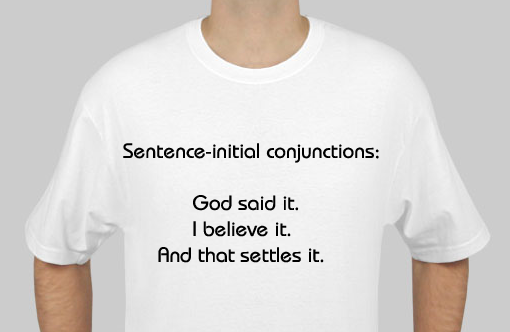
God wants you to use more initial conjunctions !


A bit of fun here: Language Log � Does God want you to use more initial conjunctions?:
evidence came from a sample consisting of the first 80 verses of Genesis in the original Hebrew and in the King James translation.

The serious point here is the precariousness of prescriptive linguistics. Remember folks, the most you can say is that particular locutions do or don't find acceptability within particular linguistic communities and may have certain connotations un/favourable to the user. They aren't incorrect if they are spoken by a native speaker who regards them as well-formed. -Oh and I don't mean a native speaker whose ability to assess hasn't been compromised by the acceptance of the oppressive prognostications of the grammar police.

19 November 2009

Secular and Catholic France grows evangelicals

"From a postwar population of around 50,000, French evangelicals are now estimated to number between 450,000 and 500,000. According to the Evangelical Federation of France (FEF), the number of churches has risen from 800 in 1970 to over 2,200 today." That's quite a big change. It looks like a lot of the growth is in Pentecostal style churches but not all. The Guardian article has a kind of comment overview:
For secular and Catholic France, a shock to the system: the rise of the evangelicals | World news | The Guardian. However, if you're interested in a bit more detail on the way the figures look, and you read French, then the article in Le Figaro is better: Le protestantisme en pleine mutation (if your French is rudimentary, the Google translation kind of works but is very stilted). The occasion is the 500 anniversary of the birth of John Calvin (in France, recall).

11 November 2009

The internet is killing storytelling | Ben Macintyre - Times Online

I think that Ben McIntyre in this article, The internet is killing storytelling | Ben Macintyre - Times Online is drawing on an article last year:
In a remarkable recent essay in the Atlantic Monthly Nicholas Carr admitted that he can no longer immerse himself in substantial books and longer articles in the way he once did. “What the net seems to be doing is chipping away at my capacity for concentration and contemplation,” he wrote. “My mind now expects to take in information the way the net distributes it: in a swift-moving stream of particles.”
If the culprit is obvious, so is the primary victim of this radically reduced attention span: the narrative, the long-form story, the tale. Like some endangered species, the story now needs defending from the threat of extinction in a radically changed and inhospitable digital environment
I think it may have the hallmarks of a 'moral panic' article. (However it's probably quite a good teaching resource ...)

There are various holes in the argument. Like the fact that much of what is happening on blogs, twitter etc is storytelling: people are narrating their own lives and those of others around them. The point about long stories is less telling when we realise that the modern novel is -well- modern: I've just been commending the Confession of St Patrick to some students, pointing out that it doesn't take long to read; people didn't write 'War and Peace' -sized tomes before printing and the turn to the introspective conscience. At least the author recognises this in the last paragraph. It's really attention span he's worried about, but I think the jury's still out on that one: we need to work out what the new technologies are doing to our sensoria in dialogue with culture and it's too early to tell for sure; my guess is that ADD aside, we have the same attention capabilities, we just use them differently and there will be upsides and downsides to that.

In fact, it's worth looking at an article, by Jamais Cascio, published about a year after Carr's which responds to the concerns in much the same way, only in more depth and naming what may be becoming the change to our mental reflexes: fluid intelligence. Like me, he's concerned that it's too early to tell for sure. However, he goes on to make a few tentative explorations of the kinds of effects mind-enhancing drugs and technologies could have; this is important territory and, given the speed of change, not too early for some of us to be developing perspectives to be able to assess the matters as they present -without the moral panic reaction of 'new/different=bad'. He ends with this intriguing couple of paras.

The bad news is that these divergent paths may exacerbate cultural divides created by already divergent languages and beliefs. National rivalries often emphasize cultural differences, but for now we’re all still standard human beings. What happens when different groups quite literally think in very, very different ways?

The good news, though, is that this diversity of thought can also be a strength. Coping with the various world-histori­cal dangers we face will require the greatest possible insight, creativity, and innovation. Our ability to build the future that we want—not just a future we can survive—depends on our capacity to understand the complex relationships of the world’s systems, to take advantage of the diversity of knowledge and experience our civilization embodies, and to fully appreciate the implications of our choices. Such an ability is increasingly within our grasp. The Nöocene awaits.

Hmmmm. Noocene sounds a bit like there's an influence from Teilhard de Chardin: noosphere ...

10 November 2009

A bright nuclear future?

I think I recall blogging about a number of these. Worth revisiting if you're beginning to think 'what the hey; surely nuclear must have a place at the table?' A bright nuclear future: true or false? | Jeremy Leggett | Comment is free | guardian.co.uk Here are some of my 'favourites':
This July, a heatwave shut a third of French reactors, because rivers became too hot to act as coolant. France was forced to import electricity from the UK.

6) Things got little better as winter approached. With almost one third of France's reactors out of service for maintenance and other reasons, France will have to import electricity at peak hours during the winter – for the second year running – to avoid the risk of blackouts.
...There were 1,767 leaks, breakdowns, or other safety "events" at British nuclear plants between 2001 and 2008. A Nuclear Installations Inspectorate (NII) report says about half were serious enough "to have had the potential to challenge a nuclear safety system".

9) A radioactive leak, undiscovered for 14 months, was found at Sellafield just before a visit by the prime minister. A board of inquiry concluded the leak went unnoticed because "managerial controls over the line were insufficient and there was inadequate inspection". Meanwhile, elsewhere on the site two containers of highly radioactive material went missing. The operator said it was most likely that "the anomaly lies within the accounting procedures".

Now while some of those are fixable, I'm still left concerned that human error or mismanagement could be a factor when the stuff we're talking about is so scary ...

09 November 2009

Signs of the flesh

'Flexitarian' may be taking over from 'piscetarian' but what's most interesting is the move towards less meat eating. Come on Christians.... BBC NEWS | Magazine | The rise of the non-veggie vegetarian: "Mintel categorises 23% of the population as meat-reducers, people attempting to eat less meat, probably mainly for health reasons. Another factor is climate change - livestock rearing produces methane, which is 23 times more powerful than carbon dioxide in global warming terms, according to Lord Stern. It identifies 10% as meat-avoiders, people who plan to eat little or no meat but sometimes lapse, and who might well accept the ethical basis of vegetarianism.

'More than a quarter of people say they eat less meat than they did five years ago. There is a shifting change in the diet,' says Ms Gellatley. 'A third of our membership are meat reducers.'"

08 November 2009

Individualism depresses us

As I hope many readers will know, the Christian gospel has a nuanced relationship to cultures: on the one hand it has adaptability and can, indeed should, find expression within human cultures. There are issues of identity, of communication and translation involved in that. Indeed, in some cases the gospel even acts to affirm and develop vernacular cultures (see Lamin Sanneh's work on the way that missions impacted west African culture). On the other hand the gospel drives critique of culture (and so campaigns to change things: suttee in India (William Carey being a big name there), or the slave trade).

This research indicates the psychological effects of culture with implications for social and individual health. The article sent to me by a colleague is this one Britain's 'me culture' making us depressed - Telegraph:
'Nations with greater individualism showed higher prevalence of anxiety and depression,' she said. She said that in contrast, the collectivist and conformist cultures of East Asian countries such as China and Taiwan seem to 'buffer' the inhabitants from poor mental health.
What we should notice here, broadly speaking, is that this is an affirm /challenge issue for the gospel: there is a great deal of Christian affirmation of taking individual and personal responsibility and of personal decision which works well with individualism. On the other hand we recognise that we are social beings both in creation and in redemption (solidarity in Adam and -at least potentially- in Christ) and that there is a huge streak of biblical stuff about being our neighbour's keeper and exercising and developing solidarity for justice and the common good.

So now, with this research emerging, we need to take on board how the balance of things affects aggregate health. Another cause to reflect on texts like that about causing 'little ones' to sin, perhaps ... ? How should Christians act and do mission and pastoral care to build greater and healthy solidarity without eroding right degrees of individual and personal responsibility; this is clearly now a missional question. Indeed, do we need to ask further questions about how this works? Who does it bear down most heavily on? Who does it marginalise most? How does paying attention to the most affected by it help us to understand the sinningness of our society?

And who'd'a' thunk it? It turns out we're more individualistic than the USAmericans ....

That said, there are some relevant questions from comments on the page. Predictably, for the Torygraph, a lot of questioning which is thinly veiled contempt for 'socialised' stuff and a riding of ideological hobby horses which is less convincing because of a conflation of individualism with matters such as freedom and government regulation.

The problem with individualism as an ideology is that it tends to hide social 'mentalities'. As a Christian, I do feel I have to challenge that particular act of elision: the appearance of 'principalities and powers' etc in the NT indicate a reality of social entities and collective spirituality which can be recognised as being spiritually significant. As some readers will recall, this is an area I'm doing some thinking and writing (when I've a moment or three) about, so this article has gone towards the resources for that. I hope that I'm going to be able to track down the research report on Science Daily.
04 November 2009

MPs -still more to do

I just got an email I'd like to ask you to consider acting on. It reads in part:
Today many politicians are telling us to "move on" - the problem is fixed, the beast has been tamed.

I welcome Christopher Kelly's report - and urge MPs to take their medicine and accept his recommendations in full. But this crisis was the result of our failed politics - not the cause. And in truth, yesterday's broken system still stands.

The politicians have had their chance to change: but they've failed. I've just written a letter to the three Party leaders telling them that it's now time for the people to be given a genuine say in how our democracy is run.

If you're fed up with seeing MPs arguing over their second homes and the right to give jobs to their nearest and dearest, while our public services face severe cuts, people are losing their jobs and homes and struggling to repay their mortgages - then you should sign it too:

http://www.power2010.org.uk/notenough

We'll deliver all of the signatures to the Party leaders ...
Our politicians have shown us time and time again that they are neither able nor willing to clean up politics and renew our democracy. The fact that MPs cannot be trusted to have a vote on the Kelly recommendations says it all.

Join us in standing up to broken Westminster politics - join the thousands of people who have already told the politicians that their time has passed and that our future rests in our, not their, hands.

Send the politicians a message by co-signing my letter now:

http://www.power2010.org.uk/notenough

Now more than ever it is clear that if change is to happen - it'll be powered by us. Sign my letter now and join our rallying call for change.

Thank you,

Pam Giddy
Power2010

POWER 2010 | Kelly: Not enough

A review of Common Threads

  Most of my Christian life, I've been what is usually labelled "an inclusivist". Lately I've been re-examining what that ...